

Therefore, the Co Tu culture is the subject of study for many anthropologists, researchers, collectors, museum experts, and others.
Among the cultural researchers who left behind many valuable writings, drawings, and photographs about the Co Tu people, Le Pichon stands out. He was a French officer appointed as the commander of the Ben Hien outpost in the 1930s. Le Pichon's work, "The Blood Hunters," published in the magazine "Friends of Hue," was the first research study of the Co Tu people in Vietnam, demonstrating a passionate exploration of a rather unfamiliar culture.
Le Pichon wrote about the village house as follows: “Every Co Tu village has a gươl house. It is built with the efforts of every household, and every man in the village joins hands in building that communal house. It is the meeting place of the council of village elders, the sleeping place of the young men and elders of the village. Women and girls are not allowed into the gươl house. It is also a sacred place, where the spirits of ancestors and those who had a good death reside.” In particular, the author deeply portrays the art of the Co Tu people. The patterns, statues, and reliefs are creatively designed to beautify the village house. The decorative motifs on the gươl roof are quite detailed, complete, and scientific . The author displays a rather unique collection of magical statues and wooden masks. Le Pichon remarked: “The tomb (ping) and coffin (tăram) are truly masterpieces of the Co Tu people. They are decorated with extremely diverse stylized drawings and carvings.”
The green-uniformed soldier next to the Co Tu house. Archival photo |
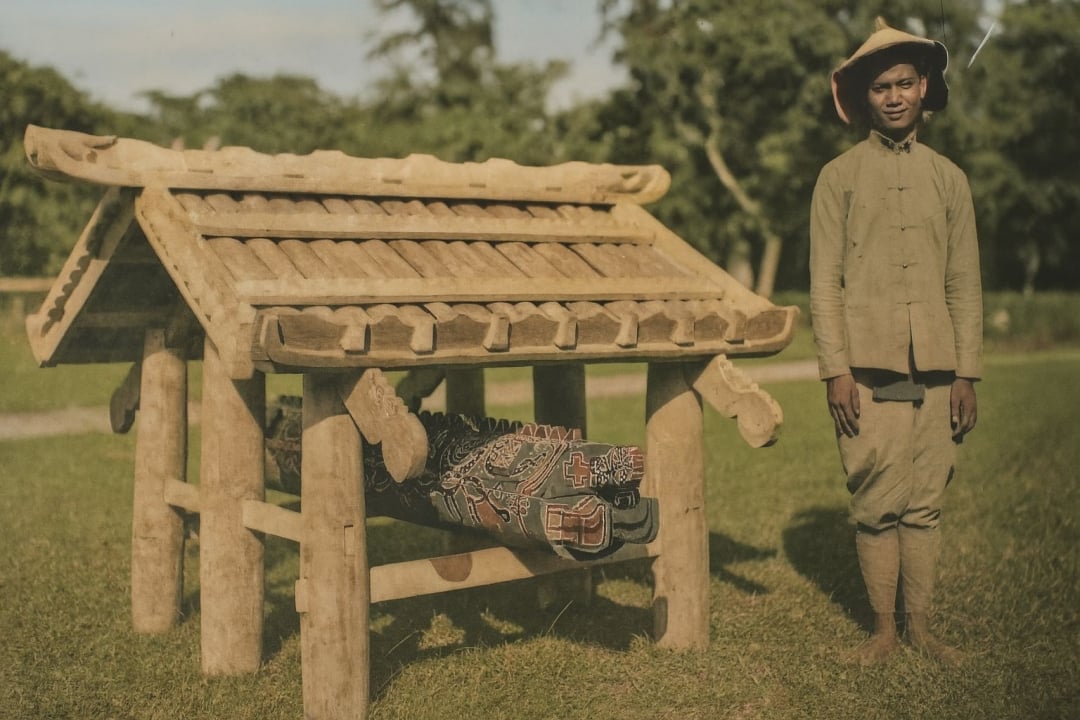
Most valuable is the author's collection of black-and-white photographs depicting the production, daily life, festivals, sculptures, costumes, jewelry, and burial houses of the Co Tu community nearly 90 years ago. Through these, researchers, especially the Co Tu people themselves, can identify the past heritage of their ethnic group, see the changes, and understand what remains and what has been lost.
The traditional Katu costumes in Le Pichon's photos have an ancient feel, especially the loincloths, shawls, skirts, and bodices. Today, these costumes have not disappeared but have been further innovated, becoming richer and more beautiful. The styles, colors, and patterns are more diverse and eye-catching than before. This shows that Katu costumes inherit and develop on the foundation of tradition, without interruption or loss. Jewelry such as copper anklets and bracelets, bead necklaces, agate necklaces, and animal tusks from the past are still worn by the people during festivals.
Sculptures such as dancing women, people smoking pipes, animal statues like tring birds, turtles, monitor lizards, wooden masks... decorating village houses; floral motifs and buffalo head statues decorating coffin lids... once described passionately and emotionally by Le Pichon in his work "Blood Hunters," this art form is still "alive" in the Co Tu villages today. Le Pichon also dedicated concise writings and clear, vivid photographs to Co Tu festivals and dances. The gong and drum rhythms of the Co Tu people today are still vibrant and captivating, drawing young men and women into the Tan Tung Da Da dance. This dance has been included in the National List of Intangible Cultural Heritage.
Meritorious Artist Kêr Tíc restored the wooden statue based on Le Pichon's photographic prototype. |

Besides Le Pichon, several other anthropologists have also been interested in researching and collecting information about the traditional culture of the Co Tu people. A notable example is the scholar Josué Hoffet, who has a collection of photographs of the Co Tu people in An Diem from the 1930s. This collection highlights the architecture of their houses, burial mounds, and daily life. Their thatched roofs still retain their original form today. Particularly noteworthy are the burial mounds with buffalo-headed coffins, elaborate carvings on the roof, harmonious roof structure, and rafters shaped like ferns... these are striking features in the architecture related to the spiritual culture of the ethnic group. In addition, there are a few valuable photographs of unknown authors, such as a sharp image taken in the 1920s depicting a soldier in green uniforms standing next to a burial mound with impressive architecture and a coffin decorated with intricate patterns. This may be one of the earliest photographs of the Co Tu people.
These aforementioned collections of images are valuable "documentary heritage." Based on them, some Co Tu artisans, notably artisan Ker Tic (in Hung Son commune, Da Nang city), have restored many wooden statues and decorative masks at the village house (gươl) and burial house (ping) at the Cultural Village of the Origins (Huong Thuy ward, Hue city).
Source: https://baodaklak.vn/van-hoa-du-lich-van-hoc-nghe-thuat/202507/van-hoa-co-tu-dau-xua-con-do-6c01235/





















![[Video] Sunset at Lap An Lagoon – Where the sun sets over the fishing nets](https://vphoto.vietnam.vn/thumb/340x192/vietnam/resource/IMAGE/2026/05/31/1780192137701_beach-landscape-sea-water-nature-grass-745871-pxhere-com.jpeg)


![[Photo] The General Secretary, President and his wife lay flowers at the Ho Chi Minh Monument in Manila.](https://vphoto.vietnam.vn/thumb/1200x675/vietnam/resource/IMAGE/2026/05/31/1780219759477_anh-man-hinh-2026-05-31-luc-16-29-07.png)




























































Comment (0)