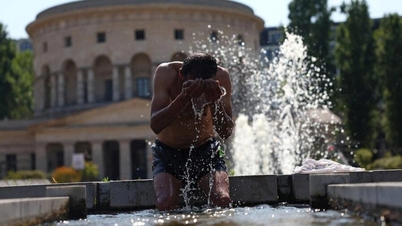
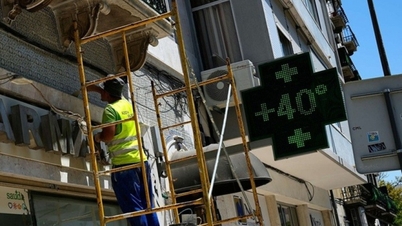
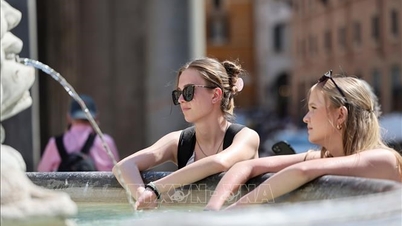
It's understandable; for a country with a temperate climate, where the average annual temperature ranges from 10-17°C like France , a sudden surge to 43°C is a disaster. Furthermore, the World Health Organization (WHO) has warned that the extreme temperatures currently occurring in Europe this summer are merely a "rehearsal" for even more severe events that could happen in the future. This is truly worrying!
How can we not worry when temperatures are rising and the weather and climate are becoming increasingly extreme? Having been accustomed to a temperate climate, we are now suddenly caught in a sweltering heat, and we lack air conditioning, something almost indispensable in hot climates.
Let's talk about air conditioning again. Incidentally, I read an article titled "Air Conditioning: Everyone Cools Their Own" by architect Trinh Phuong Quan on VnExpress. According to the author, Paris, a city that prides itself on its unwavering commitment to environmental protection, is deeply fractured by air conditioning. On one side are conservationists, determined to preserve the original neoclassical facades of the 19th century, resolutely rejecting mechanical devices to protect its reputation as a "carbon-neutral city." On the other side is the harsh reality of climate change, where the heat is no longer a romantic addition to afternoon coffee breaks along the Saint-Germain boulevard, but has become a natural disaster that can claim lives.
Paris's heritage conservation laws consider drilling into centuries-old limestone blocks to hang metal "boxes" and stringing wires across balconies a "visual crime." But when extreme weather strikes, these ancient structures immediately turn against their inhabitants, transforming into giant heat traps. The attics, home to students, the poor, and the elderly, become veritable incinerators. The price paid for this ecological steadfastness was once measured in 15,000 lives during the record-breaking heatwave of 2003. This is a sad chapter showing the helplessness of a heritage city in refusing to compromise with technology, pushing its people into a direct confrontation with the ferocity of nature.


According to author Trinh Phuong Quan, the situation in Singapore is different. Former Prime Minister Lee Kuan Yew once said that air conditioning is the greatest invention of the century. Without it, economic development would be difficult because people would lose productivity in the tropical climate. But in that island nation near the equator, air conditioning is used in a planned manner. For example, at Marina Bay, they built a District Cooling System, saving up to 40% energy compared to independent units. The equipment is hidden in technical boxes, calculated from the very beginning when the building was still in the design phase. Cooling technology is integrated into the overall space, so that indoor coolness does not come at the cost of the environment and landscape.
What about Vietnam?
"Vietnam doesn't strictly maintain architectural aesthetics like the French, nor does it have the infrastructure vision to completely conceal equipment like Singapore. Air conditioner condenser units in townhouses are hung haphazardly on the facade, with each person doing as they please," the author observes.
It's bitter, but we must frankly admit that the author is right. Selfish lifestyles, only caring about keeping one's own house cool while ignoring the neighbors, are not uncommon. It's no coincidence that on forums and social media, many heated debates erupt simply because "the neighbor's air conditioner unit—not just one, but five units—is pointing directly at my house."
But it's not just about air conditioning. "Self-centered living" has become "an everyday occurrence." When cleaning the house, people sweep trash onto the street (except during the three days of Tet, when they sweep it back inside to "keep the good fortune"); they casually throw wastewater onto the walkway, into the neighbor's yard, and countless other things, which are not uncommon at all.



Preserving heritage like in France is certainly not difficult. Planning like in Singapore is also possible if one has the vision. But eliminating selfish lifestyles is definitely not something that can be done overnight…
Source: https://baovanhoa.vn/the-gioi/van-hoa-dieu-hoa-242658.html


![[Image] Overview of the construction site for the underground station of metro line 5 at the Hanoi Ring Road 1 intersection.](https://vphoto.vietnam.vn/thumb/1200x675/vietnam/resource/IMAGE/2026/07/03/1783065595682_ndo_br_z7974930852369-100ca093c306e72675f1d3700966a86b-jpg.webp)