


"The First Leaf" is one of the most famous poems by poet Hoang Nhuan Cam, written about school days.
And as May approaches, Hoang Nhuan Cam's poem "The First Leaf" resonates with poignant nostalgia in the hearts of many generations of students. It can be said that "The First Leaf" is one of the most famous poems by the poet Hoang Nhuan Cam about school days. This poem has become a part of youthful memories, copied into notebooks by many generations of students born in the 70s, 80s, and 90s.
Poet Hoang Nhuan Cam once shared: “‘The First Leaf’ is a poem I wrote over more than 10 years, through the milestones of my life. The poem was initially titled ‘Goodbye, School.’ The first stanza was written very quickly, almost as a transcription of the intense emotions that were flowing. After returning from the war, he continued writing the unfinished verses. The final stanza of the poem was written after April 30, 1975, when the country was unified, and when poet Hoang Nhuan Cam returned to the Literature Faculty of the University to continue his student life.”
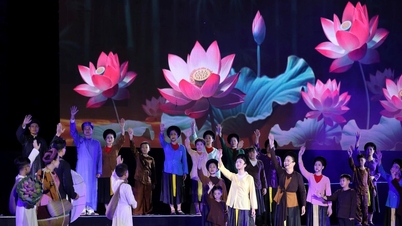
From the very opening lines, the poet takes the reader on a journey back in time, to a time of innocent, pure dreams: “Don’t you see, everything is gone now / In the very soft breath of time / Childhood departed so proudly / Purple water lilies in eyes filled with enchantment.” The “gone now” dissolves into the “very soft breath of time,” yet leaves a lasting, lingering feeling in the heart. Childhood departed “so proudly”—a playful expression of youth combined with the profound insight of an adult looking back on the past.
From the deepest recesses of memory, school-age memories emerge through "signs," subtle stirrings in the heart: "That beloved cluster of flamboyant flowers slips from my hand / The clear sound of cicadas tears the lake in two / The indifferent prophetic cicada foretells / Perhaps someone is beginning to fall in love." Some have remarked that poet Hoang Nhuan Cam is one of the best writers, possessing the most subtle perception of the sound of cicadas associated with school-age. Reading the above stanza, readers deeply feel the movement of the cicada's sound through layers of memory and emotion before it bursts forth into poetic language, imagery, and rhythm. The cicada's sound reveals the hidden stirrings in the heart, the pure and innocent love of school days. It is not clearly named, only "perhaps," just beginning to blossom like a young leaf at the start of the season. But it is precisely this ambiguity that makes it the most beautiful thing in everyone's memory.
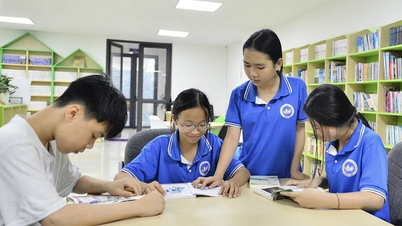
The poetic emotions become increasingly intense towards the end, like an uncontrollable stream of memories: “I want to say so much, I want to cry so much / The first song I sing is about my old school / A classroom with a wistful green hue / The schoolyard at night - the banyan fruit falls at night.” Poet Hoang Nhuan Cam evokes “a classroom with a wistful green hue” with all the tenderness of memory.
In particular, the image of "the schoolyard at night - the banyan fruit falling at night" is a striking and evocative detail. The sound of the banyan fruit falling in the late night sounds like time gently touching the heart, evoking a feeling of loneliness and endless regret. That quiet space further highlights the sadness of school life as one stands at the threshold of adulthood. Therefore, the stanza is not only a farewell to school, but also a sigh for the end of the most beautiful period of life – a period that, whenever remembered, evokes feelings of nostalgia and longing: "My first memory is of you / My heart remembers my mother / A memory I will never forget / Do you remember the school, the classroom, my name?"
A question that has stirred the hearts of generations of students. There are those who once passed through each other's lives, so dear, but time has gradually caused them all to fade away, leaving only memories behind, silently aching in the heart. The poet realizes that school days have truly come to an end: “The time of white braids sleeping peacefully is over / The time of carving nonsense on old desks and chairs with a knife is over / The fruit is sweet on the papaya branches / The flowers have turned yellow, oh my gourd flowers.” “It’s over” – a simple yet poignant farewell. The students of yesteryear have grown up, the fruit has ripened, the flowers have turned yellow, and those carefree years can never return.
The poem concludes with one of the most beautiful lines in Vietnamese school poetry: “I loved you, but you are gone / The banyan tree where we met keeps waving its branches / I miss you so much, but I only worry that if I turn around / I won't see the first leaf on the schoolyard.” At this moment, the banyan tree stands as a silent witness, and the “first leaf” has become a symbol of youth, the first stirrings of love, the purest moment that only happens once in a lifetime. The poet fears that if he turns around, he will no longer see it, just as people always fear that time will sweep away the most beautiful things in their hearts.
The verses of "The First Leaf" are etched in the hearts of generations of students not only because of their beautiful language and imagery, but also because each line touches the deepest recesses of their memories. Anyone who has experienced school days, who has loved, missed, or parted ways... can see themselves in that poem. And after reading it, one suddenly longs to return to a schoolyard, listen to the cicadas of yesteryear, and find their own "first leaf."
Text and photos: Hoang Linh
Source: https://baothanhhoa.vn/van-tho-in-dam-tren-trang-luu-but-hoc-tro-288654.htm























































































Comment (0)