

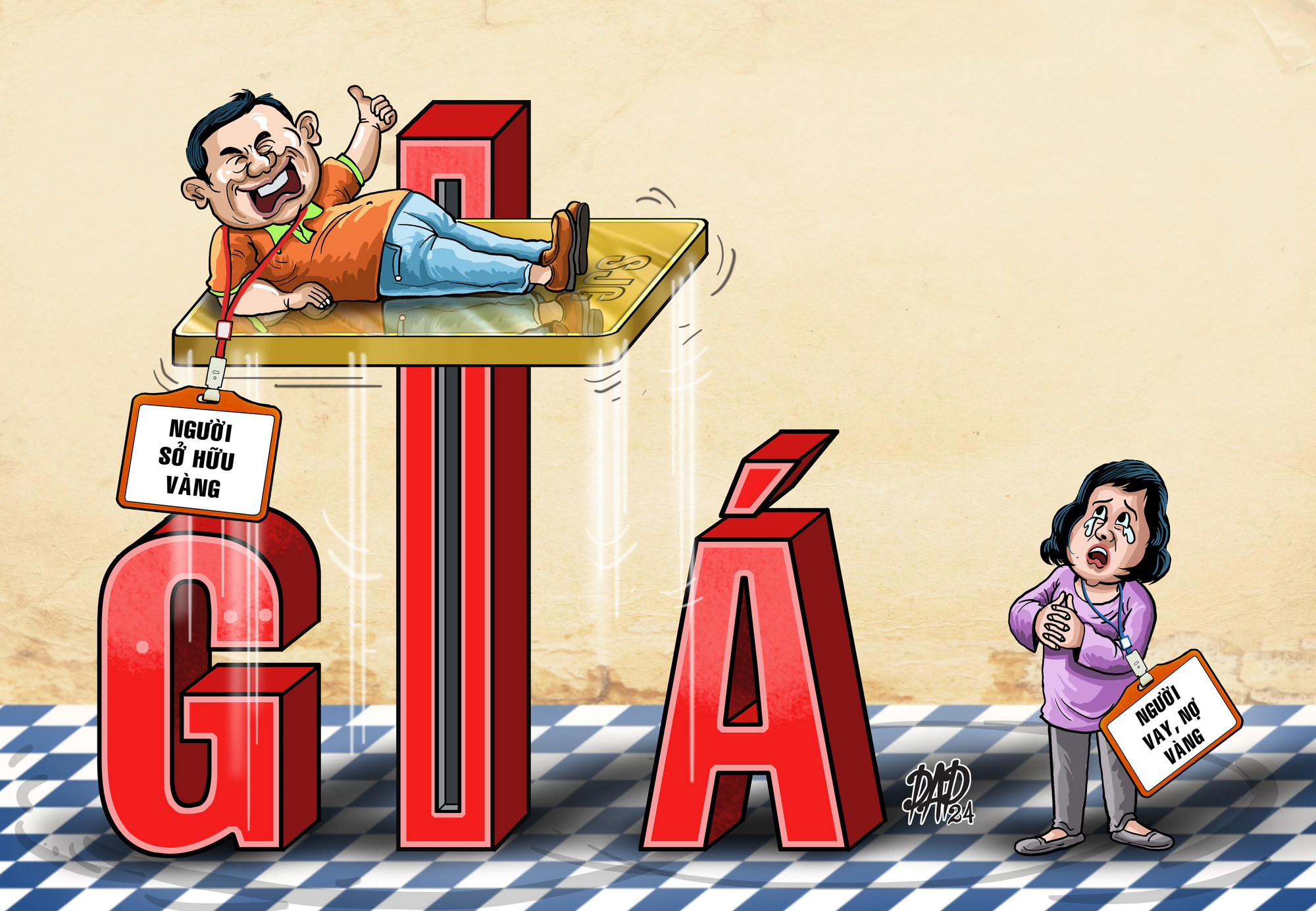
There are many stories about human nature and the ways of the world related to gold, but those related to "xi-C" and the curse of "xi" are far more dramatic.
Having followed the gold market for many years, it seems there's a curse called "xi-C". To get rich, you have to go through "xi-C", to escape losses, you also have to go through "xi-C", and bankruptcy and imprisonment are also due to "xi-C". Even the State Bank is "having a headache" because of "xi-C".
But the "xi-C" (a specific type of investment) is also associated with many ups and downs, causing discomfort to the economy and changing the fate of many families, leading to business bankruptcies, struggling banks, and businessmen facing imprisonment. These events have been evident over the past nearly 30 years, and especially when banks mobilized gold 20 years ago, the curse of the "xi-C" became fully apparent.
A decades-long curse
SJC gold bars, introduced in the late 1980s, have contributed significantly to the economy. The first director, who was also instrumental in creating SJC gold bars, accomplished something unprecedented that few Vietnamese businesses have achieved: creating the SJC 9999 gold brand, which consistently commands a higher price and is more sought after than even world- standard gold, such as Swiss gold.
Gold bars, gold nuggets... imported from around the world to Vietnam, if they want to be sold as gold bars, must be melted down and stamped into "X-C" form. Other well-known gold businesses, although they also have their own gold bar brands, mainly still trade in "X-C".
"C-grade" gold is the dream of many, a precious asset to hold. But over time, there have been so many fluctuations that at times no force can surpass "C-grade," and perhaps from that, a curse has formed from "C-grade," sometimes just as venomous.
How terrible is the "Xi-C" curse? It's not just now that SJC gold bars are more expensive than the world price. It's been like that for decades. Anyone who owns gold, whether it's raw gold or not, regardless of its origin (stored, officially imported, or from another source...), can bring it to SJC Company to have it minted into gold bars for a fee of only a few tens of thousands of dong per tael (approximately 37.5 grams).
Those who managed to mint gold bars made huge profits because they could always sell them at a higher price than the world market price. At that time, SJC's minting capacity was limited, so banks and businesses alike lined up to wait to have their gold minted into "X-C" bars. Many people were impatient because they had already paid for gold bars but hadn't received their "X-C" bars yet, so their big profits hadn't flowed into their pockets.
At that time, the State Bank prohibited gold imports to conserve foreign currency, but somehow gold still lined up in long queues to be minted into "X-C" stamps. Minting into "X-C" was a winning strategy. Holding Swiss gold or gold bars, however, risked losses if world prices fell.
Mobilizing gold: the price is too high.
But the curse of "xi-C" has had disastrous consequences since the State Bank allowed banks to mobilize and lend gold. People's gold was deposited into banks. Banks had too much gold, so they sold 30% to raise VND capital for lending.
Many tons of gold were sold on the market, causing gold prices to plummet, falling below world prices. As a result, "xi-C" gold was also melted down and sold across the border. But the September 11, 2001 terrorist attacks on the US caused world gold prices to only rise, at which point the "xi-C" curse swept through banks, businesses, and individuals who had borrowed "xi-C".
They frantically searched for "gold" to pay off their debts, but it was like being struck twice. First, world gold prices were steadily rising, and second, everyone was looking to buy "gold," not just tens of thousands of ounces but tons, to pay off debts, causing gold prices to skyrocket, potentially impacting the USD exchange rate and the entire economy.
Even with gold, if it's not "X-C" (a higher value), you can't repay the debt because "I lent you 'X-C', you have to repay with 'X-C', 'X-C' is worth more." Then, those gold debts grow from 1 to 5, then 10, even 15 over time, and the repayment never ends. How can you not go bankrupt!
When the "xi-C" curse spread to gold-mobilizing banks, it forced the State Bank of Vietnam to do something unprecedented. Nguyen Van Binh, then Governor of the State Bank of Vietnam, persuaded the Ho Chi Minh City People's Committee, the governing body of SJC Company, to transfer the SJC gold bar brand to the State Bank of Vietnam for management purposes.
The first step is to help banks gradually obtain "ci-C"—which they previously mobilized and lent but then melted down and sold across the border—to repay the public. The next step is to stop the gold-ization of bank capital (leaving only VND and foreign currencies) and, in the long term, to reduce the gold-ization of the economy.
Millions of dollars were spent importing gold to mint "xi-C" to pay the public. Even then, it took several years to completely remove "xi-C" from bank capital. But the losses persisted. Because they sold "xi-C" at low prices and bought it back at high prices, most people who borrowed gold at this time suffered losses. Mobilizing capital in gold, receiving "xi-C" and paying it back with "xi-C"—a price too high for both the economy and those involved.
When will the "xi" curse be broken?
After a rather costly cleanup by the State Bank, the gold was forgotten, but the "xi-C" curse remained. Although the "xi-C" stamping molds were carefully stored in sealed safes for many years—even SJC Company wasn't allowed to touch them, and breaking the seal required the approval of the State Bank—the "xi-C" curse resurfaced after a decade.
The price of "xi-C" gold is more than ten million dong/ounce higher than the world price. The media continuously reported on this, gold traders responded positively, and the State Bank of Vietnam had to sell "xi-C" to bring the price down to near the world price, despite receiving mixed opinions and the results not meeting the expectations of gold investors.
It can be said that the curse of "xi-C" has plagued the State Bank of Vietnam's foreign exchange management for many years. Even to the point of monopolizing the system, locking up the "xi" stamping dies and refusing to sell more "xi" to the market for years to combat gold hoarding, the situation remains unresolved. Recently, the price of "xi-C" has skyrocketed.
Now, we're using foreign currency to import gold to get "X-C" (a metaphor for a large, potentially lucrative investment). If domestic gold prices fall below world prices, the gold might end up flowing across the border. If we reduce imports, "X-C" will skyrocket again, rendering all our efforts futile. Foreign currency belongs to the entire population, serving the interests of the economy and contributing to inflation stability. Why should we pour it into gold?
Continuing to release and sell more "xi-C" onto the market also goes against the consistent policy of the Government against the "goldization" of the economy. The vicious cycle of the "xi-C" curse has yet to be broken.
Recently, through inspections by the State Bank of Vietnam of major gold businesses, the curse of "xi-C" has once again spoken out against businesses with violations. Perhaps from there, the irregularities will be exposed and the curse of "xi-C" will be lifted.
Only after the "xi-C" curse is lifted will the complexities of the gold trading system and the legal framework for the gold market (Decree 24), which is being criticized as being too restrictive, be changed. As long as the "xi-C" curse remains unresolved, many gold shops will continue to operate like an "underground economy," and the gold market will certainly continue to suffer under a restrictive legal framework. But it's better to have it restrictive than to have it open and let the "xi-C" curse affect everyone.
Restoring the SJC brand without allowing the import of gold would create a different kind of trouble, making it difficult to escape the "X-C" curse. That's the choice of the authorities. Even though it's known that businesses in the jewelry and handicraft industry are struggling due to a lack of gold for production, a few people who still care about gold complain about the unreasonable price. Ultimately, they too are victims of the "X-C" curse.
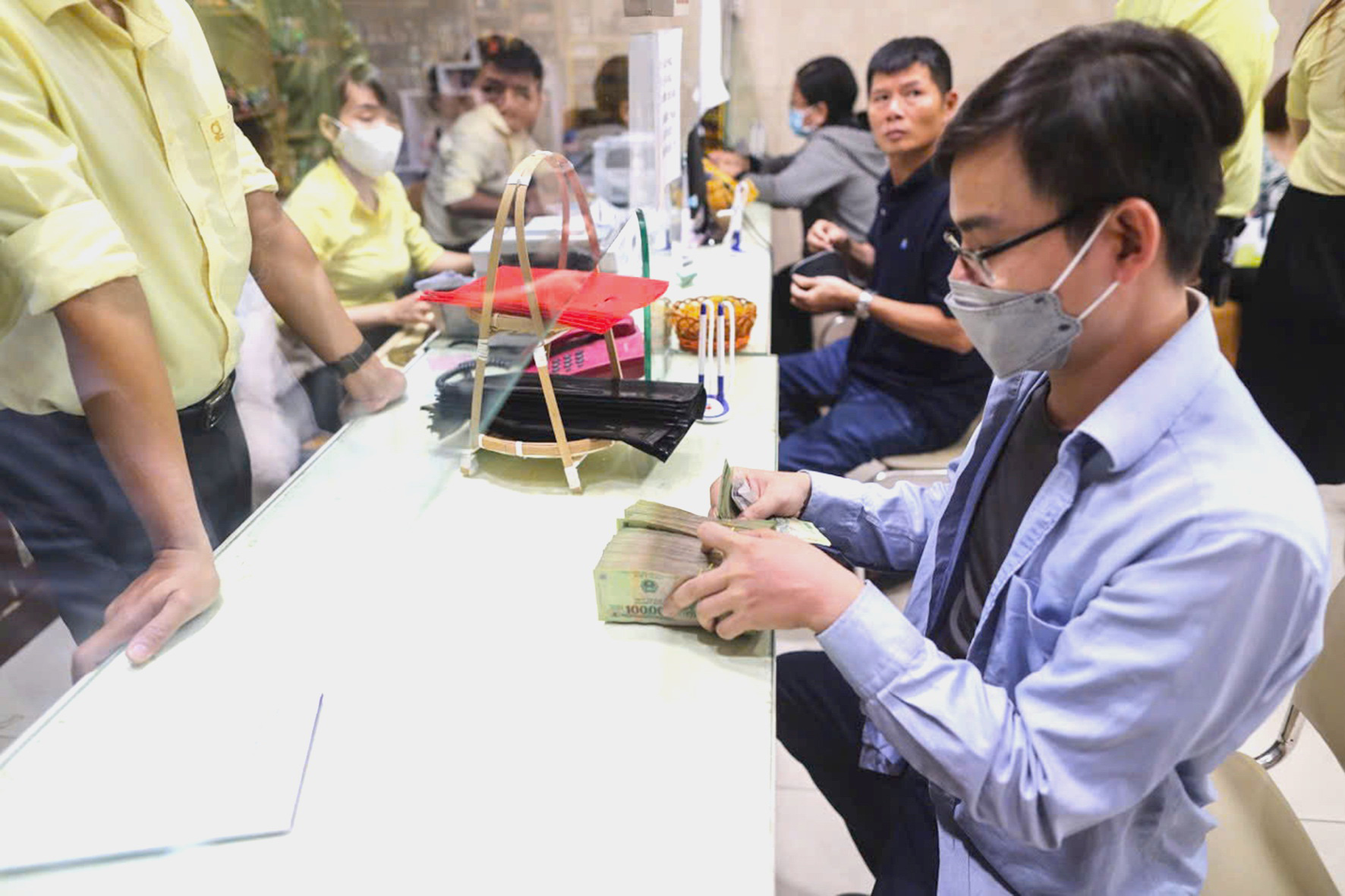
Customers trade gold bars at an SJC gold selling point (District 3, Ho Chi Minh City) - Photo: PHUONG QUYEN
Raising capital through gold: fear-inducing because it's difficult to overcome the "X-C" hurdle.
Recently, with SJC gold prices exceeding world prices, there have been many suggestions and proposals for managing the gold market and mobilizing gold capital, such as opening gold exchanges and gold account trading... These are practices that have been and are being implemented worldwide.
In Vietnam, some of these operations have been implemented, but they have all been unsuccessful. Because whether it's a gold trading floor or an online gold account, people still resort to using "X-C" (a type of currency). Even with an online gold account, withdrawals still require... "X-C".
The gold market had enormous consequences, causing many people to go bankrupt, many prominent tycoons to fall into decline, and some even facing legal troubles because of it. The gold market frenzy, then seen as a "gambling den," swept away the assets of many, put pressure on exchange rates, and created extremely high risks for the economy, forcing the government to order the closure of the gold market at the end of 2009.
Shortly thereafter, the State Bank of Vietnam decided to end gold-backed lending and deposit activities, focusing on cleaning up the system, which was supposed to end in May 2012. However, the repercussions of this have not been fully resolved even many years later.
As for gold in accounts, how many people would accept buying gold without actually holding the physical piece in their hands? In fact, nearly 30 years ago, the founders of the SJC gold bar brand learned from international experience and developed a plan for "paper gold" deposited with the State Bank of Ho Chi Minh City. This meant that instead of receiving a physical gold bar for safekeeping, buyers of SJC gold would be issued a certificate of ownership. This plan was not approved because issuing "paper gold" was also a form of capital mobilization, a function only banks could perform.
For many years, and even to this day, people have placed great trust in gold certificates or deposit certificates issued by banks, but "paper gold" issued by companies... not yet, or rather, not yet. This is because people understand that banks are much more strictly regulated than companies, and the risks are much greater. Therefore, if gold accounts were to be issued, only banks would do so, but the State Bank of Vietnam has long since banned them.
Therefore, so far, with the State Bank mobilizing gold capital from the people, the best approach is to encourage people to buy less gold and sell their stored gold to raise capital for business. The policy is clear: "combating the goldization of the economy," and this has been relatively successful. If society no longer uses gold for payments, will the State Bank return to selling more "gold-plated" gold, allowing the opening of gold accounts...?
Source: https://tuoitre.vn/vang-va-loi-nguyen-ten-xi-c-20240922080853434.htm


























































































Comment (0)