


The joy of... first times
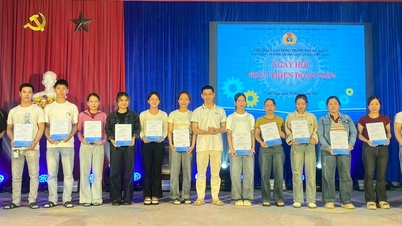
Joy was evident on the face of Ms. Ho Thi Nhan, a resident of Thanh Khe ward, on the day of the closing ceremony of the project "Strengthening the capacity and mobilizing the participation of women's recycling groups in the management, sorting, and processing of solid waste/plastic waste in Da Nang city," implemented by the Da Nang City Women's Union, the Global Environment Fund (GEF), the Small Grants Program (SGP), and the United Nations Development Program (UNDP) in Da Nang from the end of 2024 to the present.
The woman, who had a weathered appearance and had been collecting scrap metal for over 20 years, appeared very different that day. Her hair was neatly combed. She wore trousers and a blue t-shirt. Her lips were painted with bright red lipstick. Ms. Nhan smiled more than usual, although her eyes still held a hint of the nervousness of someone gradually stepping away from the familiar routine of her work.
"I've only ever been familiar with the cart full of scrap metal, and now I get to stand up and talk about my profession. I'm really nervous," she whispered as she adjusted her dress. Her hands, calloused from pulling carts and loading scrap, now fumbled with the paper she had written down for her speech. She arrived at the conference quite early, standing in a corner of the hall, reading and rereading her notes for fear of forgetting or stumbling. She shared that standing in front of a large crowd was already a challenge, let alone holding a microphone and talking about her profession.
This is the second time Ms. Nhan has spoken in a large auditorium. The first time was on March 8th, during a special event for women who collect scrap metal, organized by the City Women's Union.
That day, she was so nervous that she barely slept the night before. Every time she closed her eyes, she pictured herself standing before everyone, her hands shaking, her mouth stiff. But then, when the microphone was handed to her, she took a deep breath and slowly spoke about her days of struggling to make a living in the narrow alleys, about the heavy sacks of recyclable materials she carried on her back, about the times she was waved away, looked at with pity, or even suspicion.
Her story wasn't long, her voice was still shaky, and she occasionally paused. But when she finished, the whole hall applauded. After many years in the profession, Ms. Nhan clearly felt that she was listened to and recognized as a worker with a voice and a role in the community.
That joy didn't just come from being on stage, wearing nice clothes, or putting on lipstick like other women. More importantly, the project opened the door to confidence and understanding after training sessions on sorting and processing plastic waste, as well as group activities and sharing professional experiences.
"Before, I used to pick up whatever trash I saw and sell whatever I could find. Now I know how to sort it, which plastics are recyclable and which need different treatment. Seeing myself helping the city become cleaner makes me appreciate my job," Ms. Nhân confided.
Many of the women involved in the recycling project also had memorable "firsts." When she received the news that her name was on the list of participants in the study tour to learn about "Building a Community Model for Managing, Collecting, Sorting, and Processing Plastic Waste in the Coastal Area of Ha Long Bay," Ms. Le Thi Thu from Thanh Khe ward was both happy and worried.
Excited about traveling far for the first time in her life, but also worried because she had never set foot in an airport before, didn't know the procedures, or how to board the plane. On the day of departure, she woke up early. The handbag she had bought specifically for the trip was cherished like a special memento.
"Everything looked strange and new. I'm used to collecting scrap metal, I never thought I'd one day fly on an airplane and travel so far," Thu recalled.
The trip helped Ms. Thu understand the process of sorting waste at source as well as how to organize systematic and scientific waste collection in Ha Long Bay. She carefully took notes and asked about every small detail.
From a woman familiar with narrow alleyways and heavy bags of recyclable materials, she began to believe that she could learn and contribute more to the community. "Seeing others succeed, I believe that if I try, I can do it too," she said.

When the door of hope opens
The pilot project "Strengthening the capacity and mobilizing the participation of women's recycling groups in the management, sorting, and processing of solid waste/plastic waste in Da Nang city" has helped hundreds of women gain knowledge, skills, and above all, confidence to break free from their limitations.
After more than a year, the project established the "Women's Scrap Collectors" Club in Thanh Khe district (formerly), and strengthened the membership of the "Women's Scrap Collectors" Club in Ngu Hanh Son district (formerly). It also organized 12 communication points on waste sorting, provided health insurance, and offered livelihood support to women in difficult circumstances.
Specifically, the project organized two study tours to Binh Duong province and Ha Long Bay (Quang Ninh province) for members of the clubs and the community implementing the project.
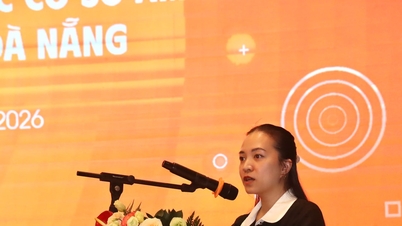
Ms. Hoang Thi Thu Huong, Head of the project's steering committee, said that the selection of women who collect scrap materials as the central target group stems not only from livelihood factors but also because they are the force directly involved in the process of collecting and sorting waste.
"We don't see women as a vulnerable group needing support, but rather as community partners. When equipped with knowledge, skills, and given opportunities, they can absolutely become positive contributors to urban plastic waste management," Ms. Huong emphasized.
Over the past period, the project has focused on three main objectives: strengthening the participation of women's recycling groups and the community, contributing to better organization of waste sorting for recycling and treatment, and preventing plastic waste from leaking into the environment.
Through this, we aim to build a core network and recommend policies to promote the rights, interests, and roles of women recycling collectors in waste management, including plastic waste.
Associate Professor Dr. Trinh Van Tung, Head of the Public Policy Department, Institute of Leadership and Public Administration, Vietnam National Academy of Ho Chi Minh City, affirmed that Da Nang has all the necessary conditions to develop the project on a large scale.
According to him, the project's merit lies in its people-centered approach, empowering a group of workers who have long been marginalized in urban policies.
"Women who collect scrap materials are key participants in waste management. When their role is recognized, the benefits for the environment and society will be very clear," Mr. Tung analyzed.
Based on its implementation in Da Nang, the project demonstrates a strong connection between environmental goals and social welfare.
The formation of clubs and core groups provides women who collect scrap with a common space for interaction and mutual support in their work, while also creating a point of contact for the government and organizations to easily connect, listen to, and support them.
This also provides an important foundation for developing policy recommendations that are more tailored to the specific characteristics of this group of workers.
Many women, who were once hesitant to interact with officials, are now confidently sharing their difficulties and proposing solutions based on their own professional experiences.
Recommendations regarding waste collection points, workplace safety, and waste sorting at source, stemming from practical experience, contribute to making policies more feasible and accessible to the people.
Mr. Vo Thanh, Head of the Environmental Protection Sub-Department, Department of Environment and Agriculture of the city, affirmed that the change in the mindset of women collecting scrap metal has created positive changes in people's awareness.
In fact, in many residential areas where the project has been implemented, people's awareness of waste sorting has clearly improved. Many households have started proactively asking the women collecting recyclable materials how to separate plastic, paper, and metal, and even keeping their waste cleaner to facilitate collection.
Perhaps the most profound impact of this humanitarian project is the shift in perception between the women who collect scrap and how the community views them. From quietly eking out a living behind bags of garbage, they gradually become an integral part of the urban environmental management ecosystem.
Now, as these scrap metal carts roll through the streets of Da Nang every day, there is renewed hope that, given the right opportunities and support, seemingly insignificant individuals can still contribute to making the city greener.
Source: https://baodanang.vn/ve-chai-doi-phan-3320573.html
![[Photo] Capturing the moment the tide recedes at Yen Binh Son rapids - a million-year-old scenic spot in Quang Ngai.](https://vphoto.vietnam.vn/thumb/1200x675/vietnam/resource/IMAGE/2026/05/19/1779175463885_yen9-1199-jpg.webp)
![[Photo] National Assembly Chairman Tran Thanh Man attends the groundbreaking ceremony for the National Highway 1A spatial axis project.](https://vphoto.vietnam.vn/thumb/1200x675/vietnam/resource/IMAGE/2026/05/19/1779161360398_ndo_br_bnd-1412-jpg.webp)














































![[Photo] General Secretary and President To Lam receives Indian Defense Minister Rajnath Singh](https://vphoto.vietnam.vn/thumb/402x226/vietnam/resource/IMAGE/2026/05/19/1779184046302_anh-man-hinh-2026-05-19-luc-16-46-58.png)















Comment (0)