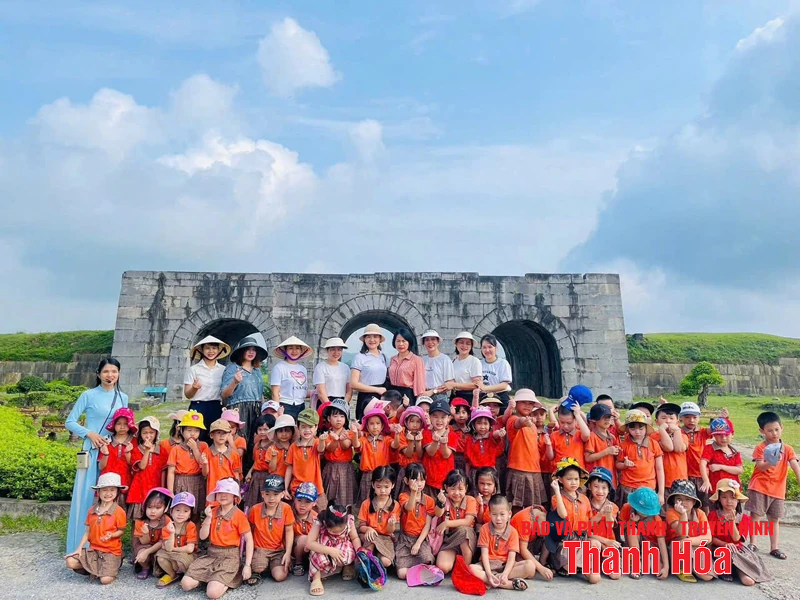
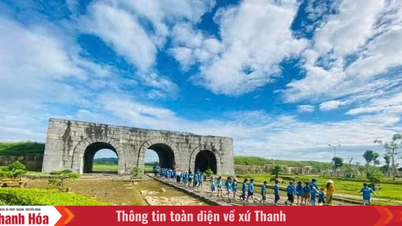
Tourists visit and take photos at Ho Dynasty Citadel.
When visiting Tay Do (Can Tho), one certainly cannot miss exploring Ho Citadel – a unique and large-scale stone architectural masterpiece, one of the most valuable and unique remaining in Southeast Asia. Ho Citadel was formerly considered the political , economic, cultural, social, and military center of Vietnam under the Ho Dynasty.
According to historical records, the citadel was built in 1397 by order of the Regent, Grand Tutor Ho Quy Ly, of the Tran Dynasty. During its construction, a massive amount of materials was used, estimated at over 20,000 cubic meters of stone and nearly 100,000 cubic meters of earth, yet it was completed in just three months, encompassing both the outer and inner citadels. The outer citadel was the external defense system, built of earth and planted with thorny bamboo. The inner citadel protected the royal court within, housing temples, palaces, and residences. The construction techniques reached a high level, as French scholar L. Bezacier stated in his book "Vietnamese Art": "The Ho Dynasty Citadel is one of the most unique architectural works in Southeast Asia. Indeed, the stacking of stone blocks into walls required truly skillful methods, given that the workers only had rudimentary tools like ropes, cords, rollers, and sticks."
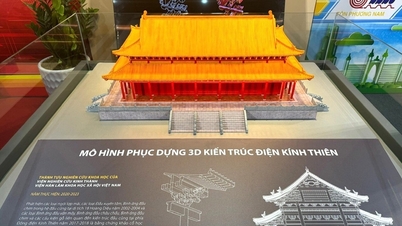
Over the centuries, the interior architecture of the citadel has been destroyed and buried, but the four city walls have remained relatively intact, most notably the four gates: South, North, East, and West. To promote the value of this heritage, the Ho Dynasty Citadel Heritage Conservation Center always focuses on preserving and restoring the heritage, developing new products and spaces to serve visitors, such as the "Western Capital Agricultural Culture Space"; the "Outdoor Artifact Exhibition Space"; utilizing the display space for the citadel building stones as a check-in point at the South gate; displaying models of cannons and reforms of the Ho Dynasty; and organizing heritage education programs for students...
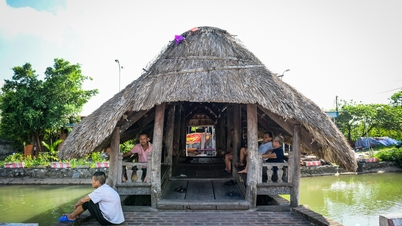
Leaving Ho Dynasty Citadel, visitors can also explore many other historical sites in the surrounding area, such as Binh Khuong Temple, the old house of Mr. Pham Ngoc Tung's family, Linh Giang Pagoda, Dong Mon communal house, etc.
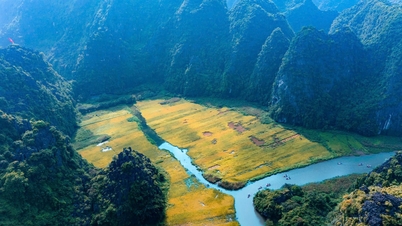
Visiting Binh Khuong Temple, tourists can enjoy the incredibly beautiful and lush natural scenery and learn about the heartbreaking story of Binh Khuong throwing herself against a rock to die in remembrance of her husband. According to historical records, during the construction of Ho Dynasty Citadel, the eastern section of the wall was behind schedule and frequently collapsed. At that time, Tran Cong Sinh (Binh Khuong's husband) was in charge of building the eastern section of the wall, but he himself did not know why the wall kept collapsing when it was almost completed. After several times of rebuilding and collapsing, Tran Cong Sinh was suspected by Ho Quy Ly of plotting rebellion, so he intentionally delayed the construction of the citadel. Tran Cong Sinh was accused of treason and buried in the eastern gate wall. Upon hearing of her husband's unjust death, Binh Khuong, overwhelmed with grief, threw herself against a rock on the citadel, committing suicide to follow her husband. Her head struck the rock, blood flowed, and she died, becoming a sacred rock. When constructing the tomb and temple, the villagers and stonecarvers, moved by her death and admiring her chastity, carved her head and hands into the stone slab. Through the vicissitudes of time, the story of Lady Binh Khuong remains deeply ingrained in the minds of generations of people in the Tay Do region, and the Binh Khuong temple has become a cultural and spiritual center for the local people and a must-see for visitors to Tay Do.
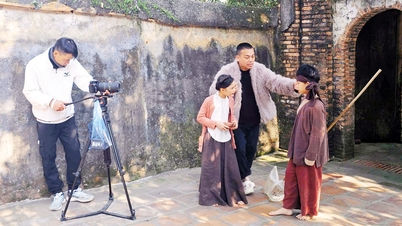
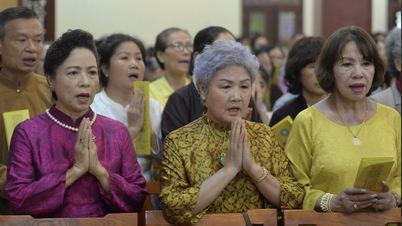
Returning to the land of Tay Do, visitors can also enjoy a "spiritual specialty": the songs and melodies of the local people. These include the smooth and heartfelt cheo (traditional Vietnamese opera) of Xuan Ang village, or the vibrant tuong (classical Vietnamese theater) of Beo village, a testament to the enduring love and dedication of the local people to traditional folk art forms. In the quiet night, amidst the simple stage space at the village cultural center, amateur artists from the Xuan Ang cheo Club and the Beo village tuong Club passionately and enthusiastically dedicate themselves to their roles, enhancing the cultural and spiritual life of the people and serving tourists.
Ms. Ha Thi Dien, Head of the Xuan Ang Cheo Club, said: "Cheo singing is a long-standing art form and an indispensable spiritual nourishment for the people here. That's why the Xuan Ang Cheo Club was established and has now attracted a large number of members. We actively create scripts that closely reflect the local situation, serving competitions and performances, and diligently practice to bring Cheo singing to the people and tourists at historical sites and scenic spots such as the Ho Dynasty Citadel World Heritage Site and the Kim Son National Scenic Area..."
Furthermore, the Tay Do region also hosts many festivals, notably the Dong Mon Village Traditional Festival and the Ky Phuc Festival, featuring unique cultural and sporting activities such as leather volleyball and inflatable volleyball competitions, folk games like blindfolded duck catching, blindfolded pot smashing, tug-of-war, sack racing, and cultural exchange activities... attracting a large number of locals and tourists.
Amidst the hustle and bustle of city life, returning to the land of Tay Do – where behind every place name, village name, mountain, scenic spot, temple, communal house, custom, ritual, belief, folk song, dance, and performance… lies countless legends and fairy tales of its own. This is precisely the beauty that makes this land, rich in cultural and historical significance, so attractive to tourists.
Text and photos: Nguyen Dat
(This article uses material from the book "Tay Do - A Historical and Cultural Perspective" by Nguyen Huy Mien).
Source: https://baothanhhoa.vn/ve-dep-dat-va-nguoi-tay-do-259199.htm


![[Photo] The General Secretary, President and his wife lay flowers at the Ho Chi Minh Monument in Manila.](https://vphoto.vietnam.vn/thumb/1200x675/vietnam/resource/IMAGE/2026/05/31/1780219759477_anh-man-hinh-2026-05-31-luc-16-29-07.png)








![[Video] Sunset at Lap An Lagoon – Where the sun sets over the fishing nets](https://vphoto.vietnam.vn/thumb/340x192/vietnam/resource/IMAGE/2026/05/31/1780192137701_beach-landscape-sea-water-nature-grass-745871-pxhere-com.jpeg)































































Comment (0)