

A TIME OF MAI TREE POTTERY
As the De Ngan area of old Saigon gradually became a key gathering place for the Five Clans Chinese community, Cay Mai pottery emerged as a distinctive landmark, not only present in daily life but also closely associated with the spiritual architectural spaces of temples, shrines, and assembly halls... with a prominent highlight being the unique collection of sculptural figures.

The collection of ceramic sculptures at Cay Mai in Tan Lan ancient communal house, Bien Hoa, was crafted by Buu Nguyen kiln.
PHOTO: PHONG AN
On the rooftop, tiny yet vibrant ceramic sculptures recount ancient stories from traditional plays or glimpses of everyday life. All are skillfully arranged, forming a lively ensemble, like a miniature stage in the open air.
Cây Mai pottery showcases the techniques of migrants from Foshan (Guangdong), but upon taking root in Southern Vietnam, it quickly acquired its own unique style. The clay, sourced from the Cholon area, creates pottery that combines foreign roots with a distinctly Southern character. Pottery kilns like Dong Hoa, Buu Nguyen, Mai Son, and Luong My Ngoc leave indelible marks on each product.
Time has passed, and the Cay Mai kiln is no more, but the ancient Cay Mai pottery remains, most notably in the collection of statues found in temples and shrines not only in Cho Lon but throughout Southern Vietnam. Through the ups and downs of time, exposed to the sun and rain, its beauty remains intact. This enduring quality has made this pottery style a familiar part of the remaining architectural heritage in the southern cities today.
THE ESSENCE OF LIFE ON THE GLAZED CERAMIC OF LAI THIEU
While Cay Mai pottery excels in architectural decoration, Lai Thieu pottery belongs to everyday life, close and familiar, reflecting the rhythm of life of the people of Southern Vietnam. From the early 20th century, a chain of pottery kilns flourished in Binh Duong, and the Ba Lua port in Lai Thieu became a hub for products from many different kilns, distributing them throughout the region. From then on, the name "Lai Thieu pottery" was born as a general term for the entire pottery-making area.

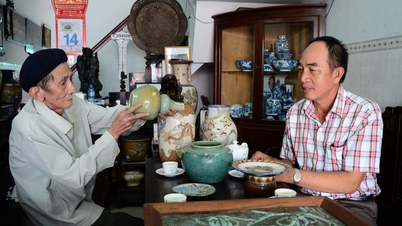
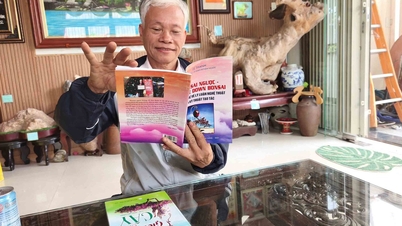
Dinh Cong Lai, known as the "king of pottery making" in Bien Hoa.
PHOTO: PHONG AN
In every kitchen, garden, ancestral altar, or dining table of the old Southern Vietnamese people, it was not difficult to find Lai Thieu pottery. These jars, pots, cups, bowls, basins, and other containers not only served daily life but also possessed a unique beauty: rustic yet refined.
In detail, Lai Thieu pottery is a blend of three styles: Fujian pottery, which focuses on household items and containers; Guangdong pottery, notable for its cutting, pasting, and molding techniques, creating vibrant decorative products; and Chaozhou pottery, with its blue and white glazes, three-color and five-color glazes, a convergence of technique and artistry, where brushstrokes, sometimes meticulous and sometimes unrestrained, create a soft and lively beauty.

Bien Hoa ceramic reliefs at Ben Thanh Market
PHOTO: PHONG AN
What makes Lai Thieu pottery special is its familiarity. The themes—chickens, banana trees, apricot blossoms—are not unfamiliar, but are taken from everyday life and incorporated into the pottery. The artisans create these objects, imbuing them with their perspective and feelings about the world around them. From Ba Lua port, boats carrying pottery travel back and forth throughout Southern Vietnam, even to Cambodia and Laos. Lai Thieu pottery is also exported further afield to Indonesia and the Philippines, carrying with it a part of the memories of Southern Vietnam beyond its borders.
BIEN HOA, GLORIFYING VIETNAMESE CERAMICS
In the history of modern Vietnamese ceramics, Bien Hoa ceramics are a unique style. Emerging later than Cay Mai and Lai Thieu ceramics, Bien Hoa ceramics followed a different path. After the Bien Hoa School of Fine Arts was established in 1903, the pottery craft there quickly entered a new phase of development. Not only serving domestic needs, Bien Hoa ceramics also reached the world, participating in international exhibitions and winning many prestigious awards from the 1920s to the 1950s.

Chopstick holder from Lai Thieu pottery (Guangdong style)
PHOTO: PHONG AN
Unlike the rustic charm of Lai Thieu pottery, Bien Hoa pottery possesses a profound yet refined beauty. The incised lines on the pottery body are both a technique and a way to create visual rhythm and divide color areas. Against this backdrop, the glaze is skillfully applied, creating rich shades, especially the characteristic copper-green color with floral patterns.
What makes Bien Hoa pottery so appealing is its blend of East and West. A vase might have a Western design, but it's decorated with motifs of bamboo, plum blossoms, flowers, and birds that are distinctly East Asian. This combination doesn't create a sense of contradiction; on the contrary, it brings a harmonious, fresh beauty, unlike anything seen before in the history of Vietnamese pottery.

A five-colored vase, in the Teochew ceramic style.
PHOTO: PHONG AN
Each Bien Hoa ceramic product is the result of a meticulous handcrafted process, from kneading the clay, shaping, carving, to glazing and firing. It is this meticulousness that creates a line of ceramics whose value lies not in absolute perfection, but in the depth of technique and emotion.
Cây Mai, Lái Thiêu, Biên Hòa – three pottery traditions, three distinct paths, yet sharing a commonality: a strong sense of local identity and the spirit of the South. Today, as these antique pottery pieces become collector's items, their value lies not only in their age or rarity. Each artifact is also a slice of memory, a story preserved through earth, fire, and human hands.

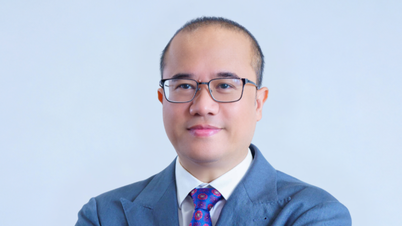
Mr. Nguyen Tri Dang, the person who installed the Bien Hoa ceramic reliefs at Ben Thanh Market.
PHOTO: PHONG AN
Amidst the hustle and bustle of modern life, perhaps what draws people back to traditional Southern Vietnamese pottery is not just to admire it, but also to listen to the stories that this heritage tells. For in every glaze, every line, the soul of the South still remains: slow-paced, profound, and full of evocative power.
Source: https://thanhnien.vn/ve-phuong-nam-xem-net-gom-ke-chuyen-185260427180824768.htm

































































Comment (0)