

Mr. Truong Viet Dong – Secretary of the Party Committee and Chairman of the Board of Members of VEC – shared an article about VEC's 20-year pioneering journey in road construction.
A pioneering model that places full responsibility on the product.
Faced with persistent traffic congestion on several national highways, most severely at the gateways to Hanoi , in 2000, the Ministry of Transport used surplus funds from the bidding process of the National Highway 1 upgrade project to pilot the construction of Vietnam's first two expressways: the Phap Van – Cau Gie section and the Hanoi – Bac Ninh section.

Recognizing the effectiveness and benefits of investing in highway construction, the Ministry of Transport proposed to the Government the implementation of highway sections such as: Ho Chi Minh City – Trung Luong, Lang – Hoa Lac, Da Nang – Quang Ngai, Hanoi – Hai Phong… A plan for building Vietnam's highway network by 2010, 2015 and 2020 was drawn up.
The biggest challenge was finding the funding to implement this ambitious plan. This is where the idea of establishing a highway investment and development company was born.
The plan to establish VEC clearly defined its development roadmap in stages. The first stage relied primarily on state capital – budget funds and bond issuance. In the next stage, the state provided support in structuring and guaranteeing loan sources. In the development stage, VEC collected tolls to recover capital and accumulated profits to invest in the construction of the expressway network according to the plan.
The project received the consensus of many agencies and units. In October 2004, the Ministry of Transport issued a decision to establish the Vietnam Expressway Investment and Development Company.
The establishment of VEC was an experiment by the Government and the transport sector. Moving away from the classic model of relying on budget funding, completing projects and then transferring them to operating units, VEC had to independently seek and mobilize capital, then implement investments in highways in the most efficient way to quickly recover capital and create resources for reinvestment in other expressway projects. This proactive approach and commitment to the quality of invested projects is one of the new features of the VEC model.
Over a period of about 10 years (2004 – 2013), starting with an initial charter capital of only 1,000 billion VND, with the guarantee of the Government, VEC has arranged capital sources to invest in expressway projects, with a total investment of up to 108 trillion VND.
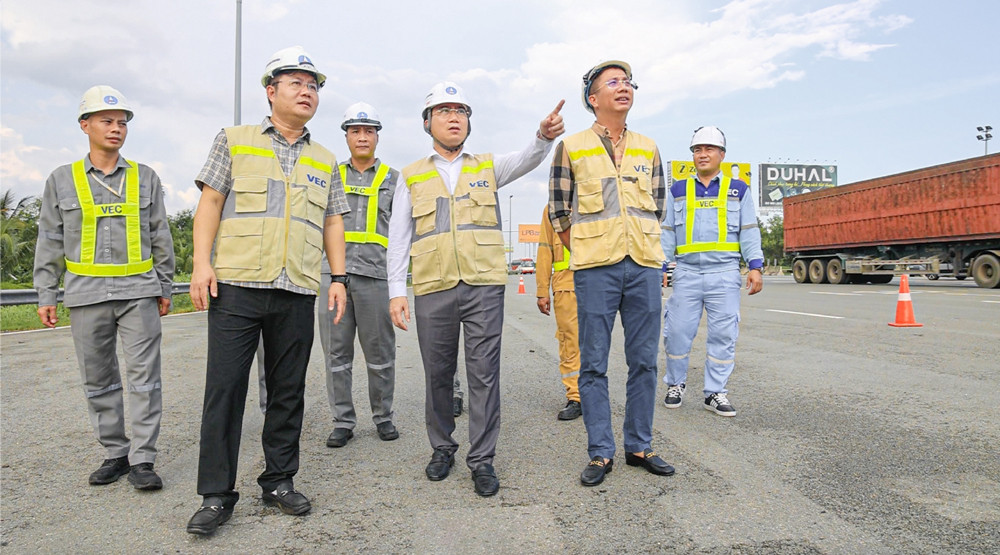
VEC has confidently undertaken larger-scale expressway projects. This includes the Noi Bai – Lao Cai expressway project, the largest in Vietnam, with a total length of 245km, passing through five provinces and cities: Hanoi, Vinh Phuc, Phu Tho, Yen Bai, and Lao Cai. The total investment is over 30,000 billion VND.
The Ho Chi Minh City – Long Thanh – Dau Giay expressway project is the first ODA-funded project, utilizing mixed capital sources, with a length of nearly 56km, connecting Ho Chi Minh City with the provinces of the Southeast region.
The Ben Luc – Long Thanh expressway project, with a total length of nearly 60km, passes through Ho Chi Minh City, Long An, and Dong Nai provinces. It is the largest infrastructure project in the South, with a total investment of over 31,000 billion VND.
The Da Nang – Quang Ngai expressway project, the first expressway in the Central region, has a total investment of over 31,500 billion VND.
With VEC's growth, in October 2010, the Ministry of Transport decided to transform VEC from a company into the Vietnam Expressway Investment and Development Corporation.
Strengthening linkages and participating in public-private partnership projects.
Affirming its leading role in investing in and developing Vietnam's expressway network, the Corporation continued to develop a plan to supplement its charter capital. Based on this, the Prime Minister decided to supplement and increase VEC's charter capital.
Aiming for sustainable development, VEC will develop a plan to utilize idle capital rationally and effectively to preserve and develop capital in accordance with regulations.
In the field of construction investment, parallel to accelerating progress and putting the Ben Luc - Long Thanh expressway into operation in 2025, VEC is completing the procedures to adjust the project in order to implement and complete the remaining items of the Da Nang - Quang Ngai expressway.
In addition, VEC will focus its resources and intensify its collaboration with relevant authorities through investment plans to expand existing expressways.

This includes the project to expand the Ho Chi Minh City – Long Thanh – Dau Giay expressway, specifically the Ho Chi Minh City – Long Thanh section, from 4 lanes to 10 lanes, which is expected to be implemented after 2035.
During the period 2024-2028, the project to expand the Noi Bai - Lao Cai expressway, specifically the Yen Bai - Lao Cai section, from 2 lanes to 4 lanes will be implemented.
The project involves expanding the Cau Gie – Ninh Binh expressway, specifically the Dai Xuyen – Liem Tuyen section, from 4 lanes to 6 lanes. The implementation period is from 2024 to 2027.
In addition, VEC will study the investment in several sections of the North-South expressway axis on a full scale. VEC is also studying some expressways that are significant for national defense and security, socio-economic development, and poverty reduction, but which are difficult to attract other economic sectors to participate in.
VEC aims to achieve toll revenue of 6,000 billion VND/year by 2025 and, by 2035, manage and operate 1,500km of expressways, effectively organize maintenance and repair work, and maximize the investment efficiency of projects.
Recognizing that attracting high-quality human resources is one of the "key" factors for VEC's successful implementation of its strategy, the Corporation has oriented itself towards reforming the salary, bonus, and remuneration mechanisms for employees, managers, and business executives to be reasonable, highly competitive, and linked to labor productivity and business efficiency; and strengthening training and professional development to improve the expertise of its management and workforce to promptly meet VEC's development needs in each stage. Truong Viet Dong - Secretary of the Party Committee, Chairman of the Board of Members of VEC |
Phuong Dung












































































Comment (0)