

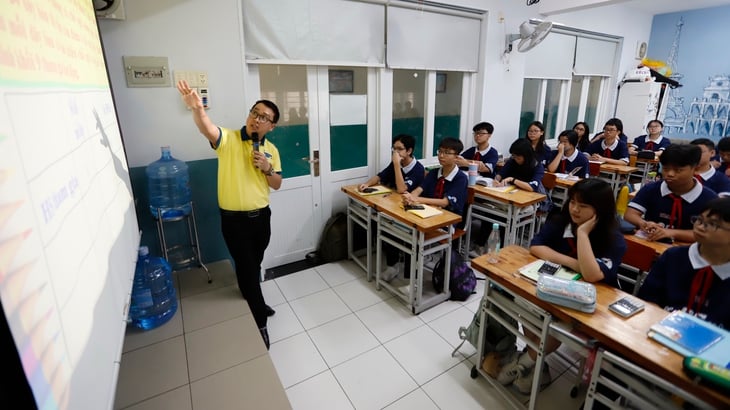
A math lesson taught by teacher Dang Huu Tri in class 9/6 at Nguyen Du Secondary School, Ben Thanh Ward, Ho Chi Minh City - Photo: NHU HUNG
Speaking to Tuoi Tre newspaper, Mr. Thai Van Tai, Director of the Department of General Education (Ministry of Education and Training), said: "This content is in the draft decree of the Government regulating the universalization of preschool education for children aged 5 to 6, compulsory education, and literacy eradication, which has just been published for public consultation. Previously, compulsory education was limited to the primary school level, but according to the draft, the compulsory education period will extend from primary school to lower secondary school."
How does compulsory education differ from universal education?
* Sir, currently the education sector is implementing universal education at the appropriate age level across all levels, including primary and secondary education. So, what are the differences between compulsory education regulations and universal education?

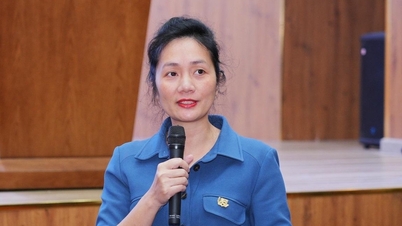
Mr. Thai Van Tai
- Previously, the implementation of the universal education mechanism aimed to ensure that the majority of people of school age achieved a minimum level of education. However, the draft decree will establish a clear legal basis to ensure that all children of school age exercise their right and obligation to study.
It also specifically defines the responsibilities of the State, local authorities, families, and society in ensuring that children complete compulsory education.
Universalization of lower secondary education is a crucial foundation for moving towards compulsory education at the lower secondary level. However, compulsory education has higher requirements than universal education, not only ensuring access to education but also guaranteeing that young people of the prescribed age complete the lower secondary education program.
So what changes will occur after the decree takes effect?
- The decree, once in effect, will serve as a basis for more clearly defining responsibilities for ensuring the conditions for implementing compulsory education, such as school networks, facilities, teaching equipment, teaching staff, and support policies for students from disadvantaged backgrounds.
Local authorities will have to organize, compile, update, and monitor the learning process of children from the completion of primary school to the end of lower secondary school, reduce school dropout rates, and ensure that all children have access to education.
What's the solution?
* Currently, the shortage of schools and classrooms, especially teachers at all levels, remains unresolved. So, what solutions are needed to overcome the difficulties regarding schools and teachers more quickly when implementing compulsory education?
- The Ministry of Education and Training recognizes that ensuring the necessary conditions regarding school networks, teaching staff, and infrastructure are crucial for the effective implementation of compulsory education.
The solutions mainly focus on several areas. Specifically, they will continue to review, plan, and reorganize the network of educational institutions to suit population changes, urbanization processes, and the conditions of each locality.
At the same time, priority will be given to investing in the development of schools, facilities, and teaching equipment for disadvantaged areas such as remote areas, mountainous regions, border areas, islands, and areas inhabited by ethnic minorities.
Regarding the teaching staff, the Ministry of Education and Training is coordinating with the Ministry of Interior and other relevant ministries and agencies to review needs and guide localities in gradually supplementing teacher positions according to regulations. Along with this, training and professional development will be strengthened to improve the capacity of teachers, especially for subjects with teacher shortages, ensuring that the requirements of the general education program are met.
The Ministry will establish requirements to ensure minimum quality standards for compulsory education. Specifically, this includes implementing standards for facilities and teaching equipment, promoting the application of information technology and the development of digital learning materials, and organizing flexible and appropriate educational methods to enable all students of school age to participate in learning and complete the lower secondary education program.
The State has been implementing numerous policies to waive or reduce tuition fees and provide financial assistance for students from disadvantaged backgrounds, ethnic minority communities, and particularly difficult areas, as well as ensuring access to education for people with disabilities and vulnerable groups.
The National Assembly and the Government have enacted numerous laws, resolutions, programs, and major projects to develop education and training, including the National Target Program for Breakthrough Development in Education. This program clearly defines the objectives, tasks, and resources for investing in the development of the education system, including strengthening infrastructure, developing the teaching staff, and improving the quality of education in the coming period.
* Could you please tell us about the roadmap for implementing compulsory education?
- By 2030, localities will continue to maintain and consolidate the achievements in universal primary and lower secondary education. At the same time, they must review and improve the conditions for ensuring compulsory education, such as: planning the school network, strengthening infrastructure and teaching equipment, developing the teaching staff, and ensuring minimum quality standards.
Based on this, localities will organize and implement compulsory education and strive to achieve the level of completion of compulsory education by 2030 according to specific criteria regarding the percentage of students completing primary and lower secondary education programs.
During the period from 2030 to 2035, after achieving the completion level, localities will continue to improve the quality of compulsory education implementation, maintain and consolidate the results achieved, and strive to reach an advanced level by 2035 with higher requirements for the percentage of students completing the program.
The design of two levels, "completion" and "enhancement," aims to ensure that the implementation roadmap is aligned with the actual conditions of each locality, providing necessary preparation time, avoiding sudden pressure, and gradually improving the quality and sustainability of compulsory education.
Local compliance criteria
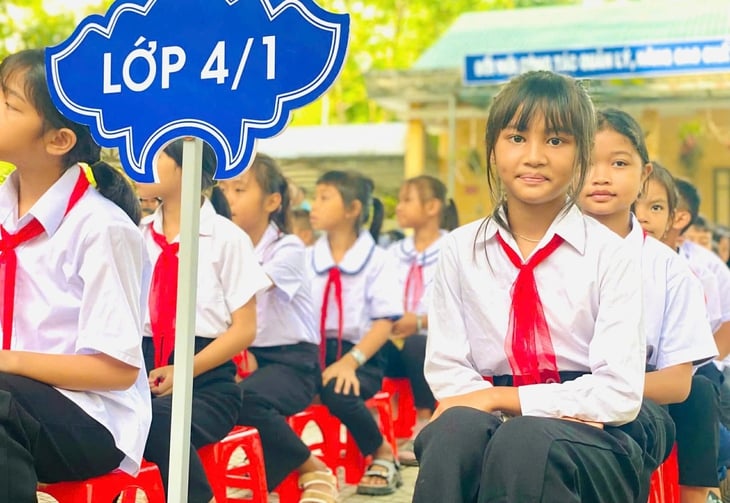
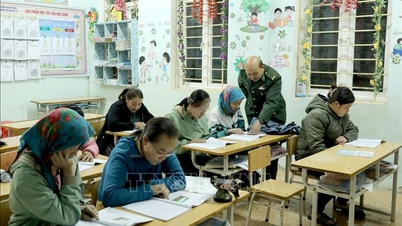
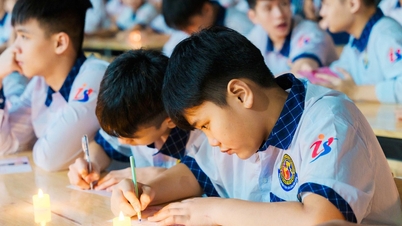
Students of Hong Thuy Primary and Secondary School (A Luoi 1 commune, Hue City) - Photo: BAO PHU
* What criteria must localities meet to achieve the required level of lower secondary education completion?
- At the commune level, it is necessary to ensure the standards for recognizing the completion of compulsory primary education at the required level and the standards for recognizing the achievement of literacy level 1. In addition, the percentage of young people aged 15 to 18 who have completed the lower secondary education program must reach at least 95%. For communes with particularly difficult socio-economic conditions, this figure must reach at least 90%.
The percentage of 18-year-old youths completing lower secondary education is 100%, except for some cases such as students who are unable to study due to particularly serious health conditions or severe disabilities.
At the provincial level, at least 95% of communes must be recognized as having completed compulsory lower secondary education. These criteria aim to ensure not only the maintenance of universal lower secondary education but also the improvement of the quality and sustainability of educational outcomes. Simultaneously, they create conditions for young people to continue their studies at higher levels or participate in vocational education.
Source: https://tuoitre.vn/vi-sao-bat-buoc-phai-hoc-het-bac-thcs-20260310095442114.htm

![[Image] A night of light, many layers of message](https://vphoto.vietnam.vn/thumb/1200x675/vietnam/resource/IMAGE/2026/03/10/1773158812907_hoa-nhac9-jpg.webp)












































































Comment (0)