2023 was a year of significant qualitative growth in our cooperative relations with key partners, including neighboring countries, major powers, and important countries in the region. This further strengthened and elevated Vietnam's position.
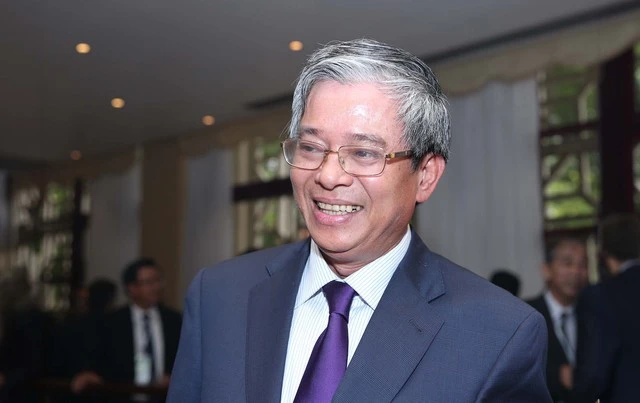
Speaking to Thanh Nien newspaper , Ambassador Pham Quang Vinh, former Deputy Minister of Foreign Affairs , stated that in 2023, Vietnam faced a series of difficulties, with global economic instability and potential risks, great power competition failing to foster greater regional and global cooperation, while both old and new crises continued, significantly impacting the overall global situation. In this context, along with effective pandemic control and macroeconomic stability, Vietnam's foreign relations activities in the past year have reached a new level.
"Through diplomatic activities, especially strengthening and promoting relations with major countries and countries in the region, we have created a new strategic position for the country. Through this, we have also taken advantage of what is most needed for economic recovery and development, while also seizing new development trends," said Mr. Pham Quang Vinh. According to him, this is the result of the very strong implementation of the "stepping stones" built from the previous year. It represents a shift from adaptation to strategic proactiveness in foreign affairs. "2023 is a milestone in Vietnam's strategic proactiveness in foreign affairs," Mr. Pham Quang Vinh emphasized.
A new strategic position for Vietnam
In the overall picture of impressive results in foreign affairs in 2023, what do you consider the most significant highlight? Ambassador Pham Quang Vinh: At the end of 2022, General Secretary Nguyen Phu Trong's visit to China marked a new phase in the development of relations and understanding between Vietnam and China. In 2023, we witnessed a series of visits, both bilateral and multilateral, creating new strategic stability and, consequently, new opportunities for cooperation with China. During the visit of General Secretary and President of China Xi Jinping, the two countries decided to issue a joint statement on further deepening and elevating the Comprehensive Strategic Partnership, building a community of shared future between Vietnam and China, which has strategic significance. In addition, the upgrading of relations between Vietnam and the US to a Comprehensive Strategic Partnership, and most recently with Japan, brings many new prospects for cooperation. At the same time, relations with key countries in the region, including ASEAN, and bilateral relations with South Korea, Australia, India, etc., have been promoted and deepened to a new level. To date, all five permanent members of the UN Security Council and major economic and political centers have strategic partnership-level relations with Vietnam… I consider these to be historical milestones in foreign affairs and diplomacy in 2023. In particular, strengthening and upgrading relations with China and the United States has created a new strategic position, strategic environment, and strategic opportunities for Vietnam. This will create opportunities for Vietnam to further promote cooperation and enhance its role and position both regionally and globally. Looking back at the first three years of the term, we see that despite the complex and competitive global situation, Vietnam has proactively opened up a strategic environment and strategic position by strengthening relations with neighboring countries while simultaneously upgrading relations with major powers and key partners. In the context of great power competition with many differences and a new alignment of forces in the region, Vietnam's ability to deepen relations with its two most important partners once again affirms our diversified, multilateral, and independent foreign policy. This also creates a strategic position, helping Vietnam avoid being "trapped" in the trap of great power competition with the pressure to "choose sides," while still taking advantage of initiatives from all sides. Furthermore, we have actively participated in regional and global cooperation and multilateral mechanisms to both seize opportunities to help economic recovery and development and contribute to maintaining world peace and stability. How should we view the "new strategic position of Vietnam" that you just mentioned? Vietnam is located in the heart of Southeast Asia, which is now more broadly considered the geostrategic center of the Indo-Pacific region. On the positive side, this is a region that is and will continue to develop dynamically, with a trend towards promoting cooperation and facilitating trade. It is also a focal point of great power strategic competition. This opens up many opportunities for economic, trade, investment, political, and security maneuvering, but also harbors challenges related to the traps of great power competition and the pressure to "choose sides." The ASEAN region also still has potential risks such as the South China Sea issue, the Taiwan Strait issue, and the Korean Peninsula… In such a region, the continued development of peace and stability, along with its role in ASEAN and the region, has created Vietnam's position. Furthermore, with an independent, self-reliant, diversified, and multilateral foreign policy, and a commitment to friendship with all countries, Vietnam strengthened its relations with China, the US, and Japan in 2023. We are also discussing deepening relations with key countries in the region such as Australia, Singapore, and Indonesia… This has created what we often call a “strategic environment” for Vietnam. To date, after the integration process, Vietnam has become an important and indispensable part of the regional and global supply chains. Countries need Vietnam, and Vietnam also enjoys sufficient reliability when countries consider issues of economic security and ensuring the sustainability of supply chains. Beyond political competition between major powers, even when supply chains are disrupted by pandemics or crises, Vietnam remains a reliable destination both politically and economically. It can be said that, by effectively managing relations with major countries and the region, and with a consistent policy of independence, self-reliance, and friendship with all countries, Vietnam has opened up a new geostrategic space in both economic and political terms to serve its development and integration.
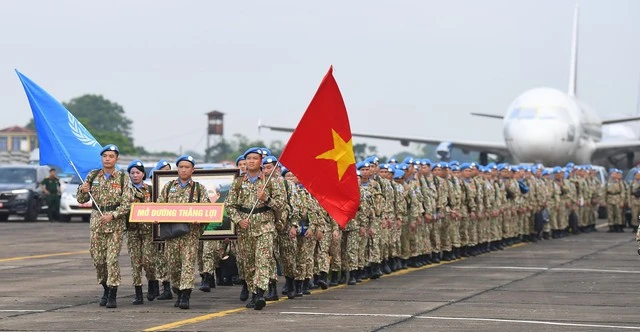
The 2nd Engineering Battalion departed for its United Nations peacekeeping mission on August 8, 2023, from Hanoi.
HOANG PHONG
There is still much to be done.
As you analyzed, the opportunities created are immense. So how do we turn those opportunities into tangible results? To be able to turn opportunities into results, it's clear that we still have much to do. Certainly, realizing the results in partnerships with China, the US, Japan, and other partners requires much discussion and effort. Similarly, taking advantage of new development trends in green transformation, digital transformation, or cooperation commitments in innovation, science and technology, including semiconductor chips, all require Vietnam to upgrade its internal capacity and prepare its workforce very carefully. And internal capacity remains nothing other than the three strategic breakthroughs identified in the Resolution of the 13th Party Congress: the policy framework (institutions); human resources; and infrastructure. Each area presents challenges and difficulties in the coming period, and to seize the opportunities, we must overcome them. For example, the transition to green and clean energy requires the implementation of the Power Development Plan 8, which is crucial. However, this implementation still faces many difficulties. Similarly, regarding the opportunities for cooperation in the semiconductor industry that we've discussed frequently, scientists in this field have emphasized the importance of preparing human resources. What about tax policies and infrastructure? We know that Vietnam isn't the only attractive country in the region seeking to attract investment… So, does this mean we still have a busy 2024 ahead, sir? With its new position, Vietnam can continue to exploit and enhance its role in international cooperation and integration in 2024. However, we must still recognize that the global and regional context in 2024 remains a complex picture of both opportunities and challenges. However, it is clear that Vietnam has a stronger position and we have had enough time to enter a more stable phase of recovery and development. Therefore, with a consistent foreign policy of independence, self-reliance, diversification, multilateralism, and friendship with all countries, I believe we will create a new quality for Vietnam's position in relations with major countries and the region. Another issue, I believe, is that diplomacy serving the economy in the coming context must also be elevated to a new level. The point here is that we must seize the best opportunities to develop the country. To achieve this, it requires not only foreign relations but also continued innovation and enhancement of national capacity. Without enhancing national capacity and improving the domestic investment and business environment, we cannot develop, nor can we take advantage of new development trends that we often talk about, such as green transformation and digital transformation. Alongside this, maintaining a peaceful and stable environment in the region is essential for development. Therefore, we must certainly continue to coordinate with countries in the region, particularly ASEAN, to ensure peace, stability, and cooperation in the region. These are issues I believe are major requirements for foreign policy in the coming period. Thank you!


![[Photo] Standing Committee member of the Party Central Committee Tran Cam Tu working with the Central Inspection Committee](https://vphoto.vietnam.vn/thumb/1200x675/vietnam/resource/IMAGE/2026/05/28/1779969579668_ndo_br_bnd-2495-jpg.webp)




























































Comment (0)