

A report on the Artificial Intelligence (AI) Readiness Index shows that Vietnam ranks 5th out of 10 in ASEAN, surpassing the Philippines.
The results were recently published in the " Government AI Readiness Index" report by Oxford Insights (UK). This is the sixth time the global AI Readiness Index report has been published, following those in 2017, 2019, 2020, 2021, and 2022.
In 2023, Vietnam's average score increased, reaching 54.48 points (compared to 53.96 in 2022 and 51.82 in 2021). Vietnam also surpassed the Philippines to reach 5th place out of 10 in the ASEAN region, an increase of one position compared to the previous year.
The report has expanded its ranking scope to include 193 countries/territories. Accordingly, globally, Vietnam ranks 59th out of 193 countries/territories (in 2022 this figure was 55th out of 181). This is the third year that Vietnam has surpassed the world average.
For its assessment, Oxford Insights is based on three pillars: government, technology, and access to databases and infrastructure. Government (regulations, policies, readiness to adapt to change) scored 69.04 points. The other two pillars, technology (37.82 points) and access to databases and infrastructure (56.58 points), scored 69.04 points.
2023 saw a surge in breakthroughs in artificial intelligence and actions in AI governance and ethics, such as the AI Act, and a rise in global AI conferences, bringing this technology to the forefront.
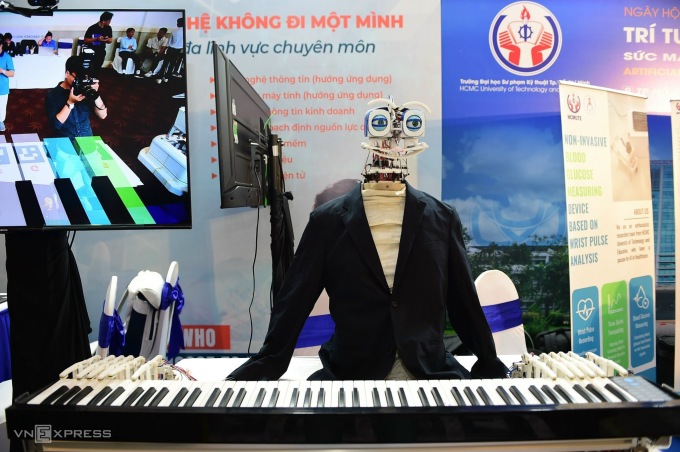
Robots perform playing musical instruments at AI Expo - an exhibition within the framework of the Vietnam Artificial Intelligence Festival (AI4VN 2023). Photo: Thanh Tung
The report divides the world into nine regions: North America, Latin America and the Caribbean, Western Europe, Eastern Europe, Sub-Saharan Africa, the Middle East and North Africa, South and Central Asia, and East Asia and the Pacific . The report analyzes expert opinions for each region, providing an overview, readiness levels across various indicators, leading countries, and future directions.
The US tops the global ranking with 84.80 points, thanks to high scores in all three pillars, particularly excelling in the speed of technological development. One of the most significant developments in the country's AI readiness is its AI policy, which includes the issuance of an executive order on the safe and secure development and use of AI, along with clear regulations and standards for AI in President Joe Biden's administration.
Singapore ranked second (81.97 points) as the "regional leader" in East Asia, and also led globally in both the Government (90.40) and Data and Infrastructure (89.32) pillars. This reflects the country's visionary score, through its focus on developing an AI risk framework, its own testing of chatbots similar to ChatGPT, and its large language model (LLM) to enhance user experience and support businesses in using and protecting data.
Other countries in the top 5 are from the Western European group, including the UK (third, 78.57 points), Finland (fourth, 77.37 points), and Canada (fifth, 77.07 points), reflecting the fact that North America and Western Europe are the regions with leading countries globally in this index. Among these, Canada is considered one of the countries that has adapted quickly to the boom in AI generative technology, through the enactment of rules for the responsible development and management of AI generative technology.
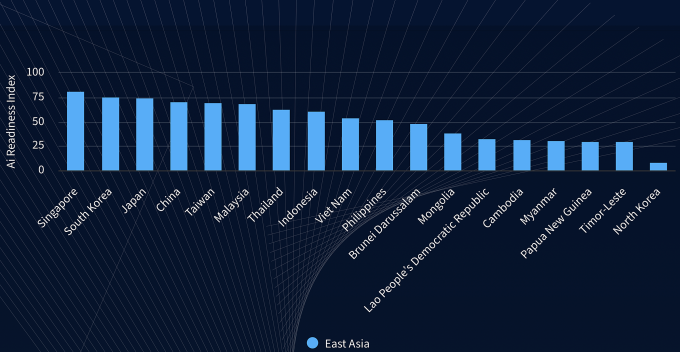
Ranking of East Asian governments' AI readiness index. Image: Oxford Insights
East Asia received particular attention this year with an average score of 51.41, ranking 4th out of 9 regions assessed, surpassing South and Central Asia as well as the Pacific. However, there is a significant disparity in rankings among countries in this region, for example, a difference of 52 points between Singapore (ranked 1st) and Timor-Leste (ranked 17th).
Nhu Quynh
Source link

![[Image] First Congress of the Vietnam Science and Technology Trade Union](/_next/image?url=https%3A%2F%2Fvphoto.vietnam.vn%2Fthumb%2F1200x675%2Fvietnam%2Fresource%2FIMAGE%2F2025%2F12%2F24%2F1766552551054_ndo_tr_img-1801-jpg.webp&w=3840&q=75)

![[Image] First UAV flight test in medical transport](/_next/image?url=https%3A%2F%2Fvphoto.vietnam.vn%2Fthumb%2F1200x675%2Fvietnam%2Fresource%2FIMAGE%2F2025%2F12%2F24%2F1766560655977_thunghiembay-3551-jpg.webp&w=3840&q=75)





![[Photo] Prime Minister Pham Minh Chinh presides over the conference announcing the establishment of the International Finance Centre in Vietnam.](https://vphoto.vietnam.vn/thumb/402x226/vietnam/resource/IMAGE/2025/12/21/1766309817714_ndo_br_dsc-3400-jpg.webp)






































































Comment (0)