

To understand the memories of a land, seek out its elders. Following that trail, we arrived in Muong Thanh ward, Dien Bien province. Sitting in his spacious new house in Chan Nuoi 2 village, we talked about the Battle of Dien Bien Phu with Mr. Lai Van Nam. When he recounted his family life, and told me he married in 1960, his wife, Mrs. Luu Thi Tam, quickly came out to correct him, saying they got married in 1962, not 1960 as he had said. It was a surprise, and we helped her sit down to continue listening to the love story of these two elderly people connected to Dien Bien Phu. Sixty or seventy years have passed – a long time, yet also very short in retrospect. The livestock department of the Dien Bien Phu State Farm, where they were once so close, is near Hong Cum airport, west of Dien Bien Phu, along the Nam Rom River. When he was a soldier fighting in the Dien Bien Phu liberation, Mr. Nam often patrolled this river to gather intelligence on the enemy. Working at the Dien Bien Phu Farm, he and his wife were initially allocated half a room in the collective housing area near the coffee plantation. Later, they and several other soldier-worker families were assigned to live there. The worker-farmer housing area has remained there for decades, neatly arranged, with clean and tidy roads. It's still called Livestock Area 2, just as it was back then.
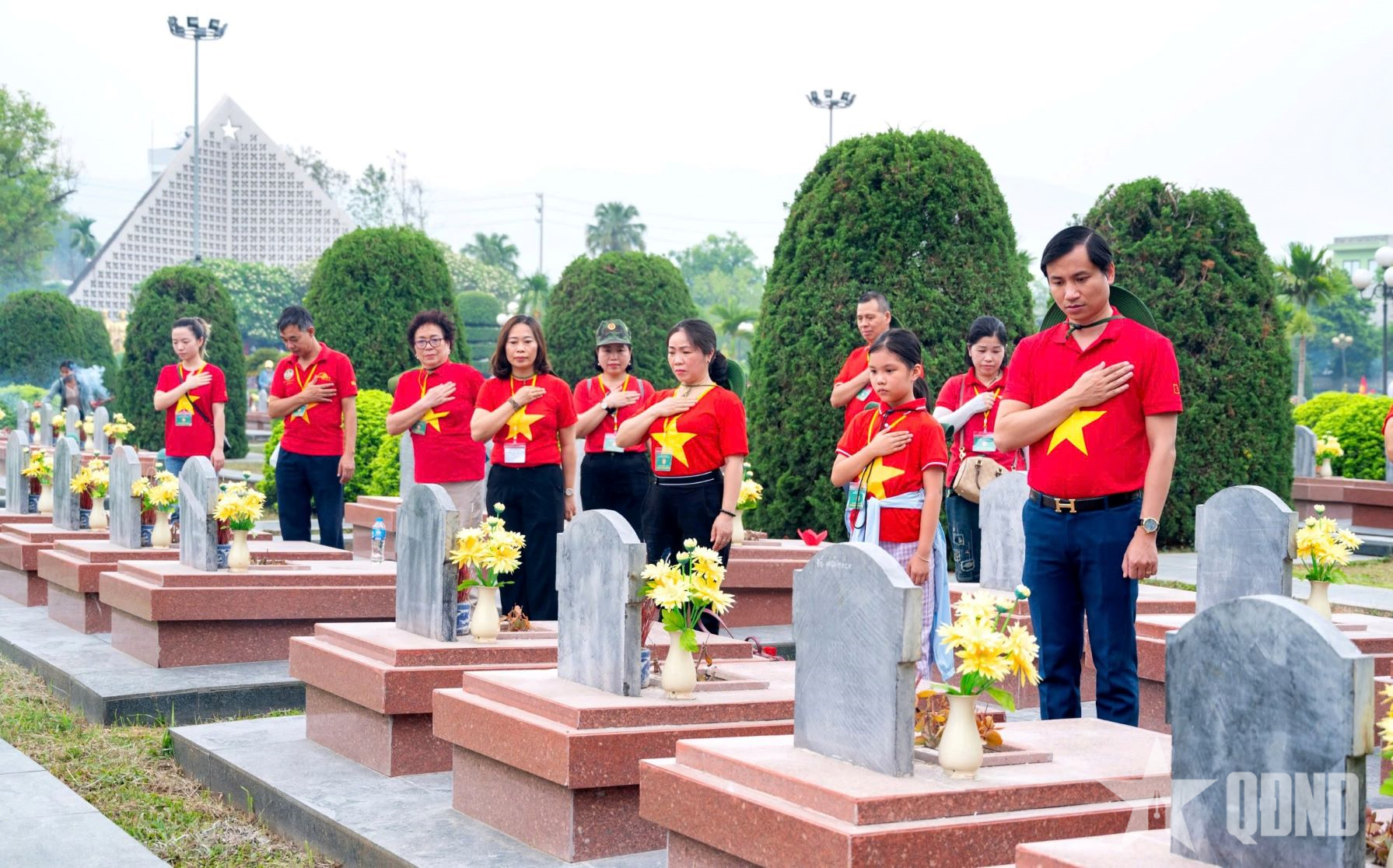
People pay tribute to the fallen heroes at the A1 National Martyrs' Cemetery in Dien Bien province. Photo: TRUNG THANH |
Not far from Mr. Nam and Mrs. Tam's house, along the same road, is the house of Mr. Nguyen Van Kha, adorned with beautiful flowering trees. Despite being 94 years old and having poor hearing, his eyesight remains sharp, and he can still read newspapers normally. Originally from the old Hai Duong province, he enlisted in 1951, underwent four months of military training, then returned to Song Lo, Phu Tho to fight the enemy. Afterward, his unit marched to Moc Chau, Son La, and then from that northwestern gateway region to Sam Neua and Xieng Khouang, fighting in Laos.
Gazing thoughtfully at the sun-drenched, multicolored fence, Mr. Kha recalled that when he received orders from Laos to participate in the Dien Bien Phu Campaign, each soldier was assigned to carry eight 82mm mortar shells. He threaded the shells onto his carrying pole, four on each end. While moving and engaging the enemy, he arrived in Dien Bien Phu with only four 82mm mortar shells left, while his squad had fired four. At this time, the Dien Bien Phu Campaign had entered its second phase of attack, and his unit was assigned the task of attacking the Hong Cum outpost. According to the battle plan, if they couldn't capture the outpost, his unit would be tasked with blocking the Nam Rom River to cause the water level to rise and flood the enemy's trenches and fortifications, forcing them out so that the Vietnamese forces could easily shoot them down. At this time, he was the commander of the 82mm mortar squad. The entire squad had 21 shells left, and after firing continuously for two nights, the enemy retreated to the central area, abandoning their tanks and artillery. The plan to block the Nam Rom River was therefore not needed.
Through the specific stories of the elderly, witnesses of Dien Bien Phu, we felt as if we could touch and feel what belonged to history. As my conversation with Mr. and Mrs. Nam-Tam neared its end, as if to corroborate what they had just told, they invited us to the old kitchen on the side of their new house, showing me the table the Party cell had given them before their wedding, and taking out a Rang Dong thermos flask with a somewhat rusty casing. In the corner of the garden, a ceramic jar stood silently, as if containing over 60 years of history. Even more remarkably, Mr. Nam showed us a mortar shell casing. He had removed the propellant from this shell and used it as an anvil to sharpen hoe and shovel blades for tilling the farmland. Because of this, the middle section of the casing was worn down. The hoes and shovels of the Dien Bien Phu farm of yesteryear, thanks to the harsh conditions they faced, became sharper, contributing to the development of this land, producing rice and potatoes to supply the people and the front lines, fighting alongside the people of the whole country against the American invaders and liberating the South. Seeing how the elderly couple treated their war relics, I realized that the past has never truly ended on this land. The 82mm mortar shell casing, heavy with the memories of a Dien Bien Phu veteran's life, seems to have absorbed the very spirit of this historical land.
I arrived in Dien Bien Phu on the full moon, the moon perfectly round, a deep red like the accumulated sediment of this land. That night, while strolling around 7-5 Square, my colleague and I came up with the idea of trying to climb Hill A1 at night. In a special way, we were there, on this hilltop, everything quiet, only the moon illuminating the hillside. The road up the hill passed the "Stubborn Banyan Tree" bunker, still called "The Man's Mound" by the soldiers who fought on Hill A1 years ago because its shape closely resembled a lying person. This formidable bunker, with its anti-aircraft gun emplacements, protected the enemy from the assault and claimed the lives of so many of our soldiers. Near the hilltop lies a fortified underground command bunker that tormented the then-commander of the 174th Regiment, Nguyen Huu An. Inside was a French Bazeille tank, which was destroyed by Company 674, Battalion 251, 174th Regiment, 316th Division – the unit tasked with attacking Hill A1 during the third phase of the operation – on the morning of April 1, 1954. At night, Hill A1 is deserted; the lights are off, and the tanks, gun emplacements, bunkers, and bunkers cast silent shadows. The shadow of history, both literally and figuratively, hangs over this land.
Hill A1 also had flame trees, which burst into a fiery red bloom every May, a poignant metaphor. Now, everything before our eyes faded and blurred. From here, we could see the city of Dien Bien Phu dotted with lights. From Hill A1, following the moonlight, we went to Hill F. This is a promontory jutting out next to Hill A1, but at a higher point, capable of controlling a crucial strategic position. Therefore, Hill F was the site of fierce fighting between our forces and the enemy, a last-ditch defense by the French in protecting the center of Muong Thanh, the heart of the Dien Bien Phu fortified complex. Countless of our soldiers sacrificed their lives to capture this high ground. The memorial to the martyrs who died in the Dien Bien Phu battlefield was built here in 2018. I don't know if the density of martyrs here is the highest in the Dien Bien Phu battlefield, but I do know that when the memorial was being built, the construction unit still found the remains of martyrs; six sets of remains were exhumed from Hill F and reburied at the Independence Hill Cemetery.
The following morning, upon returning to Hill F, I was struck speechless by the sight of the frail veterans before the martyrs' shrine, their hands trembling as they lit incense, their eyes blurred by the couplets faintly visible in the smoke: "Their bodies fell to become the soil of the Fatherland / Their souls ascended to become the spiritual essence of the Nation." Dien Bien has become a spiritual focal point of this land, where thousands of sons and daughters from all over the country fell, where thousands of families lost loved ones; it is a great pain that will never fade.
I stood at the foot of the Dien Bien Phu Victory Monument late that afternoon, as the sun was setting over the Nam Rom River, painting the landscape in a surreal golden hue. Locals were strolling and enjoying the beauty of Dien Bien Phu in the twilight, many of them descendants of the Dien Bien Phu soldiers. In the distance, the Muong Thanh plain remained lush green. This is the largest plain in Northwest Vietnam, considered the rice granary of Dien Bien Phu, producing its famously delicious rice. The green today seemed to be infused with the vigor of the past, a symbol of post-war rebirth in this land stained with the blood of fallen heroes.
To achieve this great victory, thousands of Vietnamese sons and daughters fell, their flesh and blood mingling with the soil and vegetation. Throughout the cemeteries of Dien Bien Phu lie hundreds, even thousands, of unidentified graves. These are truly unspoken messages to those living today. If you want to understand the memories of Dien Bien Phu, come to this land, where history is within easy reach.
Notes by NGUYEN XUAN THUY
Source: https://www.qdnd.vn/chinh-polit/tiep-lua-truyen-thong/voi-tay-la-cham-vao-lich-su-843897
![[Image] Expediting land clearance at Alley 310 Nghi Tam to facilitate the construction of Tu Lien Bridge](https://vphoto.vietnam.vn/thumb/1200x675/vietnam/resource/IMAGE/2026/04/14/1776160406551_ndo_br_z7724148990408-9e5d4777e3c4504998b4286178b2e66e-jpg.webp)


![[Photo] General Secretary and President To Lam visits and delivers a policy speech at Tsinghua University.](https://vphoto.vietnam.vn/thumb/1200x675/vietnam/resource/IMAGE/2026/04/14/1776164592318_vna-potal-tong-bi-thu-chu-tich-nuoc-tham-va-phat-bieu-chinh-sach-tai-dai-hoc-thanh-hoa-trung-quoc-8700658-5437-jpg.webp)
















![[Video] General Secretary and President To Lam delivers a policy speech at Tsinghua University (China)](https://vphoto.vietnam.vn/thumb/402x226/vietnam/resource/IMAGE/2026/04/14/1776180611009_tong-bi-thu-jpg.webp)





![[Photo] General Secretary and President To Lam and his wife begin their state visit to China.](https://vphoto.vietnam.vn/thumb/1200x675/vietnam/resource/IMAGE/2026/04/14/1776133794926_z7723148772587-ffefa3c4b1e54e100de1554593a862c6-jpg.webp)



















































Comment (0)