Iranian citizens protest against the US and Israel. Photo: Reuters
On the evening of June 7th, Iran launched 11 ballistic missiles into northern Israel in a series of attacks within an hour. The Israel Defense Forces (IDF) stated that all of the Iranian missiles were either intercepted or landed in empty space, causing no direct impact.
This was Tehran's first attack on Israeli territory since the fragile ceasefire between the US and Iran came into effect on April 8. Iran argued that the latest missile launch was a "warning" following an Israeli airstrike on the southern suburbs of Beirut, Lebanon, and warned that any further escalation would be met with a "broader" response targeting all US and Israeli targets in the region. Earlier, the Khatam al-Anbiya Central Command of the Iranian military issued a statement accusing Israel's recent attack on Lebanon of "crossing all red lines."

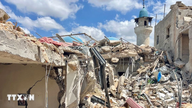

Hours after Iran's missile attack, the Israeli air force retaliated against military targets in central and western Iran. Iranian state television reported explosions in the capital Tehran and several cities such as Isfahan, Tabriz, and Karaj. Iran was forced to close its airspace around Imam Khomeini International Airport in Tehran. Significantly, the Israeli attack occurred after US President Donald Trump stated he would urge Prime Minister Benjamin Netanyahu not to retaliate to avoid an endless cycle of conflict. Furthermore, Trump expressed displeasure with Netanyahu over recent Israeli attacks on Hezbollah forces in Lebanon.
Speaking on Israel's Channel 12 after Iran's latest missile attack, President Trump stated: "Iran's latest attacks didn't cause any casualties. Hopefully Israel won't retaliate. If Bibi (Nemantha's nickname) retaliates, this situation will continue as it has for the past 47 years, or 3,000 years." Trump added that the US and Iran are very close to reaching a final agreement, and it's a good deal that he doesn't want to fall apart because of what's happening.
Specifically, in a telephone interview with the Financial Times, President Trump stated that Prime Minister Netanyahu had no choice but to accept any nuclear deal between Washington and Tehran.
In fact, the news site Axios, citing senior US and Israeli officials, confirmed that Trump had a phone call with Netanyahu. Prime Minister Netanyahu reportedly tried to persuade President Trump to allow Israel to retaliate against Iran, but ultimately reluctantly accepted the American leader's request. President Trump also recently called Netanyahu to ask him to refrain from airstrikes on Lebanon, but the result was not as he hoped.
New information regarding President Trump and Prime Minister Netanyahu once again reveals that the US and Israel are currently facing different political pressures, even though both are facing a predictedly difficult upcoming election. Netanyahu wants to demonstrate maximum toughness against any external security threats, while Trump needs a good deal with Iran after more than 100 days of conflict with many repercussions.



DUC TRUNG
Source: https://baocantho.com.vn/vong-xoay-xung-dot-o-trung-dong-a206637.html