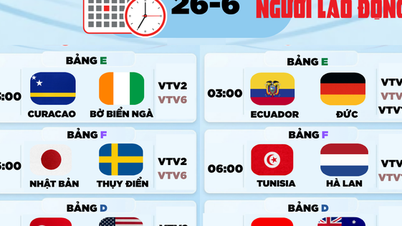
The stars will gather at the 2026 World Cup finals.
Part 1: FIFA's Profit-Driven Strategy
The 2026 World Cup had been the subject of much discussion long before its opening, due to a historic decision. On January 10, 2017, following a vote at a FIFA Council meeting in Zurich, Switzerland, the organization decided to expand the number of participating national teams from 32 to 48. This event sparked considerable controversy among football fans worldwide.
The "pie" of television broadcasting rights
At the time of announcement, FIFA planned to divide 48 teams into 16 groups of 3 teams each (a total of 80 matches). However, after reassessing the professional risks (such as the risk of match-fixing in the final round), FIFA adjusted the format to 12 groups of 4 teams each, thus increasing the total number of matches to a record 104.
At that time, the world had become accustomed to the 32-team World Cup format (established since France 1998), and a wave of protests erupted, despite the FIFA president's humane explanation of "giving a chance to dream for weaker nations." Experts analyzed that a scale of 48 teams was too large for such an elite event in world football, potentially diluting the quality of the tournament and increasing fatigue for participating teams.
In reality, this is a real consequence. Due to the drastic increase in the number of teams, the "group of death" has disappeared from the 2026 World Cup, making the group stage much less attractive. The inclusion of "unfamiliar" names (such as Haiti, Curacao, Cape Verde, Uzbekistan, and Jordan), instead of being expected to bring a breath of fresh air, has been met with skepticism about one-sided matches.
However, from a sports economics perspective, this is a carefully calculated commercial move by FIFA, led by Gianni Infantino. By increasing the number of matches from 64 (at Qatar 2022) to 104, FIFA has created 40 additional premium "content packages" to sell to global media corporations. More matches mean thousands of additional broadcast hours, maximizing direct advertising time and expanding coverage into prime time slots in lucrative markets from Asia and Europe to the Americas.
According to the latest financial report from FIFA, analyzed by The Guardian, projected revenue for the entire four-year cycle (2023-2026) has been raised to a record $13 billion, a dramatic increase of 72% compared to the previous four-year cycle ending in Qatar 2022 (“only” reaching $7.5 billion).
Within this massive revenue structure, television broadcasting rights continue to be a "golden goose" for the world's football governing body. For the 2026 tournament alone, FIFA announced a revenue budget from broadcasting of $3.925 billion, accounting for approximately 44% of the year's total income ($8.9 billion). This figure clearly reflects the effect of the increased number of matches and the strong shift from traditional television to mobile digital streaming platforms.



According to AP, in the US alone, FIFA has pocketed nearly $1.1 billion from selling television broadcasting rights for the 2026 World Cup to Fox Corp ($485 million) and Telemundo ($600 million), the largest Spanish-language channel in the US. Beyond profiting from traditional television channels, FIFA has also expanded its partnerships with major social media platforms such as TikTok (exclusive video content partner) and YouTube (platform for showcasing featured content bundles with dynamic advertising).
At the 2026 World Cup, FIFA transformed a sporting event into a multi-platform digital content business structure. The 40 additional matches were likened to 40 "shows," forcing broadcasters to open their wallets and turning every smartphone of billions of global viewers into advertising revenue-generating devices for FIFA.
The transnational "logistical" challenge
With the 2026 World Cup taking place in the United States, Mexico, and Canada, it will be the first World Cup in history to have three co-hosting nations. Prior to this, only the 2002 World Cup was held in two countries (South Korea and Japan). In the European Championship (EURO), this trend seems more common, with EURO 2000 held in Belgium and the Netherlands; EURO 2008 in Austria and Switzerland; and EURO 2012 in Poland and Ukraine. Notably, EURO 2020 (postponed for a year due to the Covid-19 pandemic) was a "crazy" idea from former UEFA President Michel Platini to celebrate the tournament's 60th anniversary, when it was held in… 11 European countries.
The multinational hosting model has the advantage of dispersing financial risks, sharing a global consumer base, and fully utilizing existing infrastructure. However, looking back at history, with the exception of EURO 2020 (which became a logistical and travel "nightmare" for the teams), all previous host alliances have been between two countries sharing a border and with relatively compact geographical areas.
Based on that perspective, the 2026 World Cup, with its scale dramatically expanding to three countries across the vast expanse of North America, presents an unprecedented logistical challenge in the history of world sports. To put it into perspective, the distance between Mexico City, Mexico (where the opening match will take place) and New York, USA (where the final match will be held) is approximately 3,360 km, with an average flight time of about 5 hours. According to international time zones, New York is 2 hours ahead of Mexico City, so a team flying from Mexico City to New York will lose 2 hours on their clock upon landing.
Of the 16 cities hosting the World Cup, the United States naturally has the largest number with 11 cities, hosting 78 matches. Mexico has 3 cities and Canada has 2 cities, sharing the remaining 26 matches. Each country has its own way of mobilizing resources to prepare for the World Cup.
The U.S. government did not directly fund the event. Instead, 11 cities established their own "hosting committees" as non-profit organizations to raise capital from private sponsors, combined with budgets for transportation and security from state governments. The total cost of hosting the World Cup across the United States is estimated to exceed $1 billion, with a large portion dedicated to renovating and upgrading stadiums originally used for American football.
In Canada, a report from the Parliamentary Budget Office (PBO) indicates that the country's planned total cost for the 13 World Cup matches has soared to 1.066 billion Canadian dollars (CAD), approximately 780 million USD. Due to rising inflation and stringent FIFA requirements, host cities Toronto and Vancouver are both facing significant cost overruns.
In Mexico, the investment cost was considered the lowest, at only around $150-200 million. The country chose a shrewd approach by mobilizing mixed funding, largely through private corporations funding the upgrades to their stadiums, thereby spreading the immediate financial pressure off the public budget.
Reuters noted that, unlike Qatar at the 2022 World Cup (which spent $220 billion to build entirely new stadiums and numerous roads and airports), the North American alliance utilized 100% of its existing stadiums and infrastructure. Therefore, the investment was much more "modest" and largely contributed by private capital, primarily invested in technical renovations, enhanced security, and upgraded public transportation.
According to FIFA's forecast, the 2026 World Cup is expected to attract a total of 6.5 million international visitors; total direct spending by tourists (on food, accommodation, transportation) is estimated at around $14 billion, and the total economic output generated for the entire North American region will reach $80.1 billion.


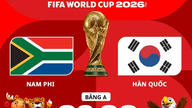
Ahead of the 2026 World Cup, the FIFA Council officially approved a record financial contribution package of up to $871 million, nearly double the $440 million allocated for Qatar 2022. This is seen as a strategic move to alleviate the logistical cost pressure weighing on the 48 football federations with teams participating in the World Cup.
According to the distribution structure, the total prize money directly allocated to the teams is set at $655 million. Of this, the new world champion will receive $50 million, the highest in the tournament's history. The remaining more than $200 million is reserved for "support" the logistical needs of the teams.
FIFA's last-minute decision to inject an additional 15% into the budget came after pressure from powerful European football federations. Previously, observers had warned of a paradox: the further teams progressed in the tournament, the greater the risk of cost overruns due to expensive accommodation and private jet travel, coupled with the burden of strict US tax policies.
(To be continued)
According to Nhandan.vn
Source: https://baoangiang.com.vn/world-cup-guong-quay-ty-do-ky-1--a488713.html
![[Image] Schools organize meetings and introduce teaching models to students admitted to grade 10.](https://vphoto.vietnam.vn/thumb/1200x675/vietnam/resource/IMAGE/2026/06/25/1782368077271_ndo_br_z7970052192242-1ec8daeb77a6eed1a4e9f58c564ddd3e-jpg.webp)


![[Image] Ho Chi Minh City: Ma Lang area, Chicken-Rice Market about to change its appearance](https://vphoto.vietnam.vn/thumb/1200x675/vietnam/resource/IMAGE/2026/06/25/1782377698627_ndo_br_m1-jpg.webp)
![[Photo] General Secretary and President To Lam receives Palestinian Ambassador Saadi Salama](https://vphoto.vietnam.vn/thumb/1200x675/vietnam/resource/IMAGE/2026/06/25/1782365384740_a1-bnd-9423-8322-jpg.webp)