

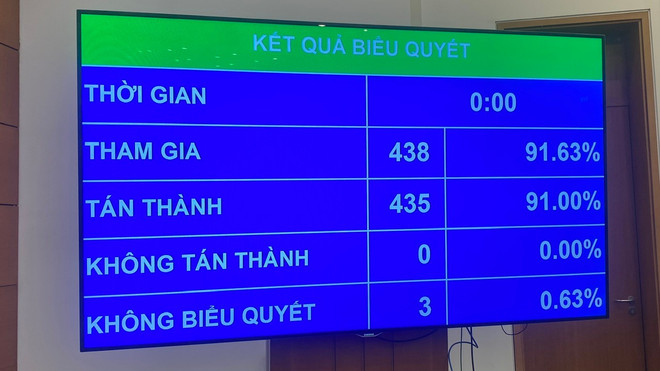
With a majority of delegates voting in favor, the National Assembly passed the amended Law on Science , Technology and Innovation this morning, June 27th.
Earlier, the Chairman of the Committee on Science, Technology and Environment, Le Quang Huy, reported on the explanation, acceptance, and revision of the draft Law on Science, Technology (amended) and Innovation.
According to Mr. Le Quang Huy, incorporating the opinions of National Assembly deputies, the draft Law has established the principle of accepting risks in science, technology, and innovation activities, linked with appropriate risk management measures, and assigned the Government to regulate the criteria for identifying acceptable risks, the process for evaluating compliance with procedures and regulations; at the same time, it establishes a legal framework for a controlled testing mechanism, ensuring both the encouragement of innovation and the protection of public interests.
Regarding the special mechanism for decoding technology and purchasing technological know-how (Article 31), the Standing Committee of the National Assembly believes that, institutionalizing this content in Resolution No. 57-NQ/TW, the draft Law stipulates that the organization in charge of science, technology and innovation tasks is entitled to apply a special mechanism in appointing and paying experts, and directly purchasing technology and products at agreed prices for decoding technology in strategic technology development and purchasing technological know-how.
Regarding support for businesses investing in the development of strategic technologies (Article 36), incorporating the opinions of National Assembly deputies, the draft Law has revised the content of the State's policy of support, investment, cooperation, and assignment of tasks to businesses for the development of strategic technologies as stipulated in Article 36 as follows: Investing in the construction of specialized infrastructure and support services in industrial parks and high-tech zones to attract businesses to invest in building shared testing and research facilities; Investing in the construction of physical facilities and equipment for shared testing and research facilities to attract businesses to participate in their operation and exploitation.
Regarding the role of the Chief Engineer for Science, Technology and Innovation (Article 53), after receiving feedback, the Standing Committee of the National Assembly directed the addition of regulations on the Chief Engineer for Science, Technology and Innovation in Article 53. The Law stipulates that a "Chief Engineer" is an individual with outstanding prestige and capabilities, empowered to comprehensively coordinate large-scale strategic science, technology and innovation programs and tasks; and is entitled to special incentives and the right to proactively manage resources to maximize their leading role in these programs and tasks.
Regarding the financial mechanisms, asset management, and research results in science, technology, and innovation activities, incorporating the opinions of National Assembly deputies and institutionalizing Resolution No. 57-NQ/TW and Resolution No. 68-NQ/TW, the Standing Committee of the National Assembly directed the amendment and revision of the draft Law, shifting strongly from "expenditure management" to "results-based governance."
Accordingly, expenditure will be based on final results, increasing flexibility and autonomy; ownership of assets and research results will be transferred to the lead organization upon formation, without reimbursement to the budget or increase in state capital;
Commercialization of research results should be flexible, with profits reinvested or used to encourage innovation; allocation should be based on output efficiency; a synchronized financial fund system should be established, with controlled risk acceptance and flexible support for innovation activities.
Source: https://www.vietnamplus.vn/xac-lap-nguyen-tac-chap-nhan-rui-ro-trong-hoat-dong-kh-cn-va-doi-moi-sang-tao-post1046671.vnp

![[Photo] Prime Minister Pham Minh Chinh presides over a meeting on private sector economic development.](/_next/image?url=https%3A%2F%2Fvphoto.vietnam.vn%2Fthumb%2F1200x675%2Fvietnam%2Fresource%2FIMAGE%2F2025%2F12%2F20%2F1766237501876_thiet-ke-chua-co-ten-40-png.webp&w=3840&q=75)











































































Comment (0)