

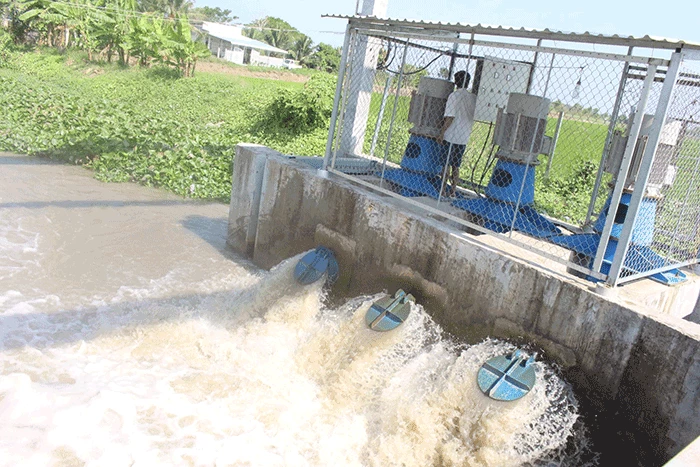
Pumping and water storage efforts to support agricultural production have been intensified in Can Tho City.
From now until March-April, saltwater intrusion will increase significantly, with salinity levels exceeding 4 g/l penetrating deep inland, 40-50 km or more from the river mouth. Specifically, in the Ham Luong river branch, salinity will penetrate 55-60 km inland (from the river mouth). Local authorities in the Mekong Delta region should be prepared for unusually high salinity levels due to the northeast monsoon. In some Mekong Delta river mouths, water quality should be carefully checked before intake, and water should be collected whenever possible.
Furthermore, in early April 2025, in the upper Mekong Delta region, including parts of An Giang, Dong Thap, upstream Long An, Kien Giang provinces and Can Tho City, water resources were ensured; in the middle Mekong Delta region, including parts of Can Tho City, Tien Giang, Long An, Kien Giang, Hau Giang, Dong Thap, Vinh Long provinces and the salinity-controlled areas in Bac Lieu, Soc Trang, Tra Vinh , and Ben Tre, salinity levels returned; in the coastal areas of the Mekong Delta (Long An, Ben Tre, Tra Vinh, Soc Trang, Bac Lieu, Ca Mau and Kien Giang provinces), salinity has affected coastal areas, water reserves are rapidly decreasing, and opportunities for supplementary water extraction are scarce. To ensure production during the upcoming dry season months, it is necessary to strengthen salinity monitoring, take advantage of opportunities to store water whenever possible, pump out freshwater when the tide recedes, and update weather forecasts to store water appropriately.
Water levels at hydropower plants in the Mekong River basin are currently higher than during the same period in previous years. The Southern Institute of Water Resources Science stated that the rational operation of these reservoirs will facilitate agricultural production in the Mekong Delta this year. Conversely, abnormal water storage operations could cause adverse impacts. The increased water release from Chinese hydropower plants from February 21st to the present is considered to have had a positive impact on reducing saltwater intrusion in the latter half of March. Currently, water release has returned to average levels, however, it will still have a significant impact on saltwater intrusion from mid-March to mid-April 2025. Local authorities in the region need to strengthen salinity monitoring before storing water for domestic use and agricultural production.
Text and photos: HA VAN
Source: https://baocantho.com.vn/xam-nhap-man-tang-cao-trong-dot-trieu-cuong-dau-thang-3-am-lich-a185013.html


![[Photo] Prime Minister Pham Minh Chinh presides over a meeting on private sector economic development.](/_next/image?url=https%3A%2F%2Fvphoto.vietnam.vn%2Fthumb%2F1200x675%2Fvietnam%2Fresource%2FIMAGE%2F2025%2F12%2F20%2F1766237501876_thiet-ke-chua-co-ten-40-png.webp&w=3840&q=75)


































































![[Infographic] Controlling rabies in pet dogs and cats](https://vphoto.vietnam.vn/thumb/402x226/vietnam/resource/IMAGE/2025/12/21/1766288809667_infographic-kiem-soat-benh-dai-tren-dan-cho-meo-nuoi20251221091138.webp)


















Comment (0)