Building a militia force that meets the requirements and tasks in the new situation.
(GLO) - Editorial Note: Ninety years ago, on March 28, 1935, the First Congress of the Party issued a Resolution on the Self-Defense Force. This was the Party's first resolution on the organization, direction, training, and operation of the self-defense force.
Báo Gia Lai•28/03/2025
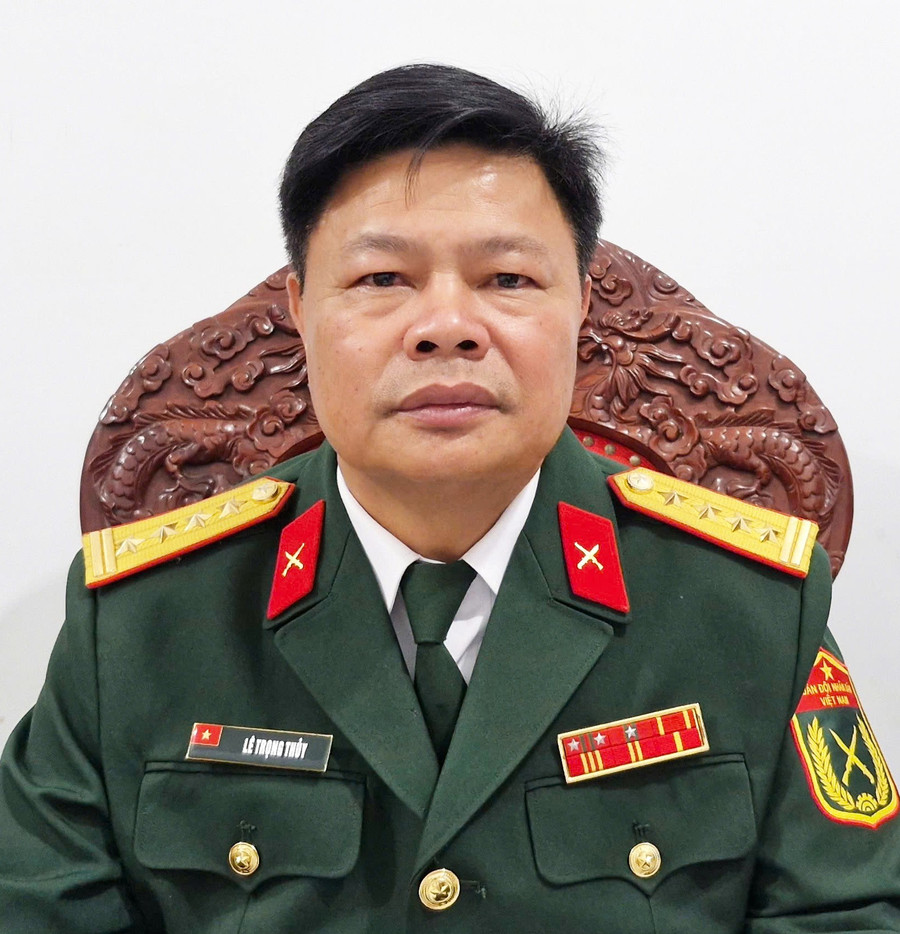
And March 28th each year has become the Traditional Day of the Vietnamese Militia and Self-Defense Forces (DQTV). Since its inception, the DQTV force has always affirmed its important strategic position and role in people's war and national defense. On this occasion, a reporter from Gia Lai Newspaper interviewed Colonel Le Trong Thuy, Deputy Commander and Chief of Staff of the Provincial Military Command, about the work of building the DQTV force in the province.
* Reporter:Comrade, how has the militia force in the province been built, strengthened, and developed over the years?
Colonel Le Trong Thuy. Photo: VH
- Colonel LE TRONG THUY: Throughout 90 years of building, fighting, and maturing, generations of militia officers and soldiers have always been loyal to the Party, the Fatherland, and the People; fighting tenaciously, intelligently, and bravely; working, studying, and performing their duties effectively and creatively; and achieving many great victories, contributing to building an increasingly strong armed forces nationwide.
Along with the development and maturation of the militia forces nationwide, the provincial militia force has been built, strengthened, and developed, gradually meeting the requirements of the mission in the new situation.
Currently, the militia forces in the province have met the requirements in terms of quantity, quality, organizational structure, and appropriate weaponry. Local military agencies in the province always proactively and strictly implement the review, registration, management, and recruitment of new militia members, ensuring proper rotation according to regulations.
In particular, in training, the district and commune-level military commands focus on innovating the content and methods of militia training, gradually improving the quality, capabilities, and skills of the militia force in performing their duties.
To build a strong and widespread militia force in accordance with the spirit of Directive No. 16-CT/TW dated October 5, 2002, of the Secretariat of the Central Committee (9th term) and the Militia Law of 2019, the Provincial People's Committee directed the Provincial Military Command to advise on and submit to the Provincial People's Council for promulgation Resolution No. 285/NQ-HĐND dated December 10, 2020, on the Project for organizing, training, operating, and ensuring policies and benefits for militia forces in the province for the period 2021-2025; and Resolution No. 131/2020/NQ-HĐND dated December 10, 2020, of the Provincial People's Council on regulating the monthly allowance for village team leaders and the daily labor allowance for militia members when performing duties in the province.
Each year, the provincial militia force contributes thousands of man-days to help localities build new rural areas, alleviate poverty, and propagate and mobilize people to correctly implement the Party's guidelines and policies, and the State's laws. The militia force is also always present when the area experiences natural disasters, storms, and floods to participate in rescue and relief efforts.
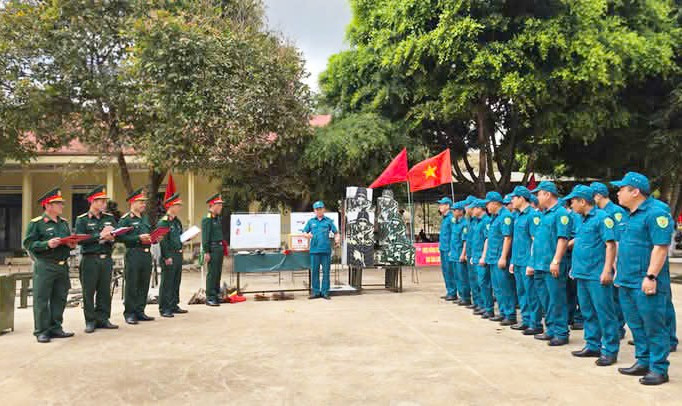
Militia forces prepare for training. Photo: VH
* Interviewer:Could you summarize the key achievements in building the militia force in the province?
- Colonel LE TRONG THUY: In recent times, the province has focused on building a militia force with an appropriate ratio, a rational organizational structure, ensuring sufficient force components, organizational scale, and staffing levels suitable for each locality, each residential area, and various types of production and business organizations such as: building mobile militia, artillery, air defense, communications, reconnaissance, medical ...
The militia forces in the province are organized into 442 units, including 218 militia units and 224 self-defense units. The militia forces include: mobile militia at the district and commune levels, permanent militia, local militia, and specialized militia units. The self-defense forces include: local self-defense units, air defense self-defense units, and artillery self-defense units.
To date, the provincial militia force accounts for nearly 1.35% of the population (of which, the militia accounts for over 1.15%, and the self-defense force accounts for nearly 13.64%). The proportion of female militia members is over 10% of the total militia force. Militia training is conducted correctly and fully according to the prescribed program content, with participation rates exceeding 95%. The Provincial Military Command has directed localities to effectively implement the planning, training, and appointment of commune-level military command officers, achieving a 97.5% success rate. The province has also invested hundreds of billions of VND in the construction and repair of 218/218 commune-level military command offices.
Party membership development within the militia force has always been a priority for Party committees at all levels. To date, 100% of commune-level military Party branches have Party committees, with Party members accounting for 31% of the militia force's personnel. Of these, Party members in the militia force account for 26.4% of the personnel, and in the self-defense force account for 55.4% of the personnel.
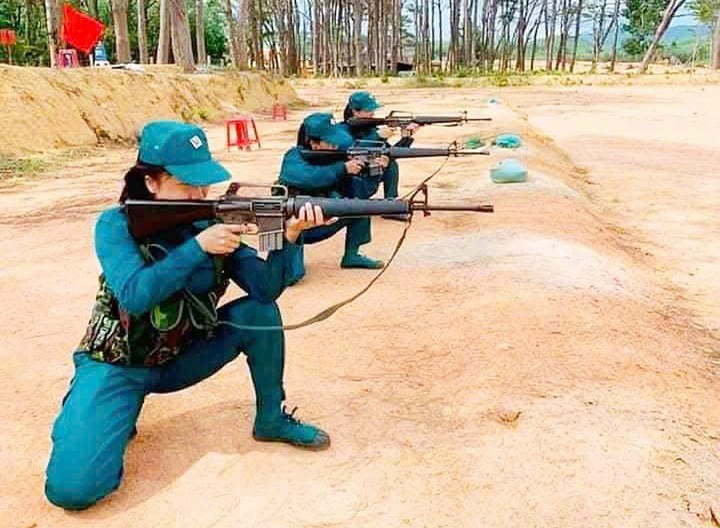
The self-defense militia of Pleiku City is training in infantry shooting. Photo: VH
* PV:To build a strong and widespread militia force that meets the requirements and tasks in the new situation, what solutions will the province focus on, Comrade?
- Colonel LE TRONG THUY: To build a strong and widespread militia force that meets the requirements and tasks in the new situation, in the coming time it is necessary to strengthen the leadership of Party committees and the management and operation of the government over the activities of the militia force.
Furthermore, it is essential to leverage the core role of military agencies at all levels in advising and proposing solutions to help Party committees and governments at all levels issue resolutions, directives, and plans to lead military and national defense work in accordance with the actual situation. Focus on educating and raising awareness among cadres, Party members, and the people about the position, role, and importance of the militia in the cause of national construction and defense in the current situation.
At the same time, strengthen the inspection of the building of militia forces in the area, promptly identify difficulties and obstacles, and propose and advise local Party committees and authorities on resolving difficulties and obstacles in building militia forces to meet immediate and long-term requirements.
To ensure that the militia truly becomes a reliable political force for Party committees, government, and people at the grassroots level, it is necessary to consolidate, strengthen, and improve the quality of operation of the militia command boards of agencies, organizations, and commune-level militia command boards according to regulations.
Strictly implement the registration and management system for militia forces; regularly review and consolidate the militia organization and personnel in a streamlined, efficient, and strong manner, with a reasonable ratio and structure between core and broad forces; focus on building militia forces in key areas, remote and disadvantaged regions.
The selection and recruitment of citizens into the militia force must be carried out strictly according to the principle of Party committee leadership, government direction, and the commune-level military command advising and organizing implementation according to the motto "The people know, the people discuss, the people elect, the people care".
Focus on building and improving the quality of operation of commune-level military Party branches; promulgate the functions, tasks, powers, working relationships, and operational regulations of Party committees and branches; prioritize leadership in developing Party members within the militia, meeting the requirements for political quality.
Furthermore, focus on improving the quality of training and operational efficiency of the militia force, closely integrating political and legal education, mass mobilization work with military training, officer training and development, and enhancing the combat readiness of local militia forces, mobile militia forces, and other branches. Emphasis should be placed on coordinated training between the militia and other forces in the area in combat operations and in carrying out tasks related to disaster prevention and mitigation, and handling situations to protect social order and security in the locality.
Local authorities need to strictly implement the Law on Militia and Self-Defense Forces, especially the regulations on budget; collect, manage, and use the national defense and security fund for its intended purpose, in order to ensure timely provision of benefits and policies for the militia and self-defense forces. At the same time, policy work should be linked with organizational and ideological work; good policy work should be done for families of militia and self-defense force officers and soldiers facing difficulties, ensuring that militia and self-defense force soldiers can confidently perform their duties when mobilized.
Building upon the glorious traditions of 90 years of development, combat, and growth, along with the joint efforts and involvement of all levels and sectors, and the attention and care of Party committees and authorities at all levels, the provincial militia force has truly become a solid foundation in maintaining political security, social order and safety, safeguarding national sovereignty and border security, and creating conditions for local socio-economic development. Through this, it contributes to building a national defense system and a strong security posture, strengthening the province's defense zone.


![[Photo] Prime Minister Pham Minh Chinh presides over a meeting on private sector economic development.](/_next/image?url=https%3A%2F%2Fvphoto.vietnam.vn%2Fthumb%2F1200x675%2Fvietnam%2Fresource%2FIMAGE%2F2025%2F12%2F20%2F1766237501876_thiet-ke-chua-co-ten-40-png.webp&w=3840&q=75)


























































Comment (0)