

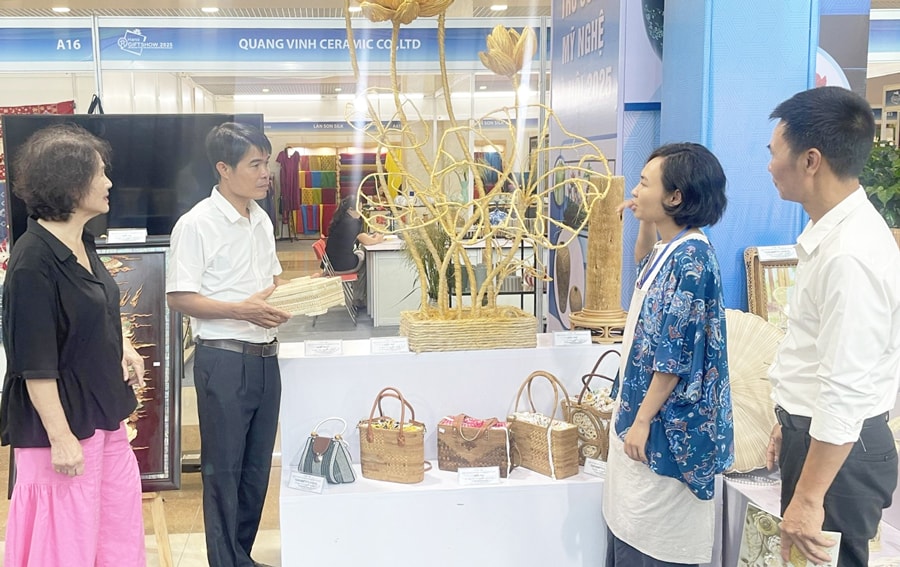
Potential not yet fully realized.
According to the Hanoi Department of Industry and Trade, the city currently has 1,350 craft villages producing handicrafts, including wooden products, rattan and bamboo weaving, ceramics, glass, textiles, yarn, embroidery, and basket weaving. While Hanoi's handicraft products have reached many international markets such as Japan, the United States, and the European Union (EU), the handicraft industry has not yet fully exploited its potential and strengths, lacking outstanding competitiveness compared to similar products from countries in the region such as China, India, and the Philippines.
The reasons include slow innovation in product designs. Some products are made using pre-existing market templates, lacking creativity. Furthermore, many handicraft designs possess high levels of creativity and artistic merit but are not suitable for customer tastes or are difficult to produce in large quantities…
Notably, consumer awareness of traditional craft villages, their products, and their brands, despite their unique values, remains limited. Brand building has not received adequate attention or systematic investment. Many small-scale production facilities offer repetitive designs and lack investment in brand identity, packaging, and product storytelling. Standards such as FSC, ISO, CE, and FDA, which are mandatory in many demanding markets, have not been widely adopted in production. Furthermore, the lack of strategic design, marketing, and e-commerce capabilities also hinders the access of craft village products to international customers, even with good quality and competitive prices.
As the locality accounting for 45% of traditional craft villages nationwide, Hanoi, with approximately 176,000 households engaged in these crafts, has recently begun to focus on brand development. Maintaining and promoting craft village brands has been a priority for communes and wards. Most products from these villages now share a common name related to the village's geographical location, such as Bat Trang pottery, Dai Bai bronze, and Van Phuc silk.
According to Dr. Dao Cao Son (University of Commerce), many production and business establishments in craft villages have initially made certain investments in branding, from naming brands, designing logos, slogans, and signs to creating catalogs and building websites to introduce products. However, brand building for products at many establishments remains limited; most brands lack any identifying elements beyond the name displayed on the sign.
A measure of quality, building consumer trust.
According to Trinh Quoc Dat, Chairman of the Vietnam Handicraft Village Association, in the context of a market flooded with similar products, strong brands help distinguish traditional handicrafts from industrial goods and imitations. Brands also serve as a measure of quality and origin, building trust among domestic and international consumers.
Branding not only creates differentiation but also opens doors for products to access modern distribution channels such as supermarkets, e-commerce, and global retail chains. With a brand, products are priced more accurately, sales are more stable, workers' incomes increase, and rural economic development is contributed to.
Brand protection is crucial for preventing counterfeiting and maintaining the reputation of traditional craft villages. For products with deep cultural value, such as wooden furniture, lacquerware, and mother-of-pearl inlay, branding is also a tool for preserving and promoting cultural identity.
Faced with increasingly demanding market requirements, many craft villages and businesses have proactively changed towards professionalization. A prime example is the Dong Ky fine art woodcraft village ( Bac Ninh province ), which has registered the collective trademark "Dong Ky," built a showroom, and boosted exports to South Korea and Japan.
The La Xuyen craft village (Ninh Binh province) is famous for its exquisitely carved wooden furniture used in cultural and religious projects, and some of its products have already achieved OCOP 4-star certification. Truong Son Company (Hanoi) applies FSC standards – the internationally recognized legal timber source – paving the way for exports to the EU. Several businesses have also adopted e-commerce, listing their products on e-commerce platforms such as Amazon, Etsy, and Alibaba, contributing to promoting Vietnamese wood products to the world.
To raise awareness about brand development in Vietnamese craft villages, Dr. Dao Cao Son suggested that these villages need to improve their brand identity systems and the brands of their production and business establishments. Accordingly, a common brand identity system for craft villages requires the unification and standardization of important elements such as brand name, logo, trademark design, and the establishment of common regulations for the use of collective trademarks… as a prerequisite for registration and protection, helping to create a consistent brand image and increase customer recognition.
Simultaneously, a comprehensive development plan for craft villages needs to be established, along with support measures and promotional programs to ensure the synchronized and effective development of these villages. Linking craft village brands with tourism development is also crucial. Currently, this model has been implemented in several craft villages and has yielded positive results, helping to enhance the reputation of craft villages and boost local economic development.
To elevate the brand image of handicrafts to international standards, the Department of Industry and Trade proposes supporting the development of a professional brand identity system with logo and slogan design, standardized packaging and labels; and forming a brand story based on the unique characteristics of the craft village. In addition, it will support businesses in obtaining ISO, FSC, CE, and FDA certifications; implementing green production and transparent traceability; and providing comprehensive intellectual property protection.
Source: https://hanoimoi.vn/xay-dung-thuong-hieu-dat-chuan-quoc-te-don-bay-cho-hang-thu-cong-my-nghe-725933.html


































































































Comment (0)