

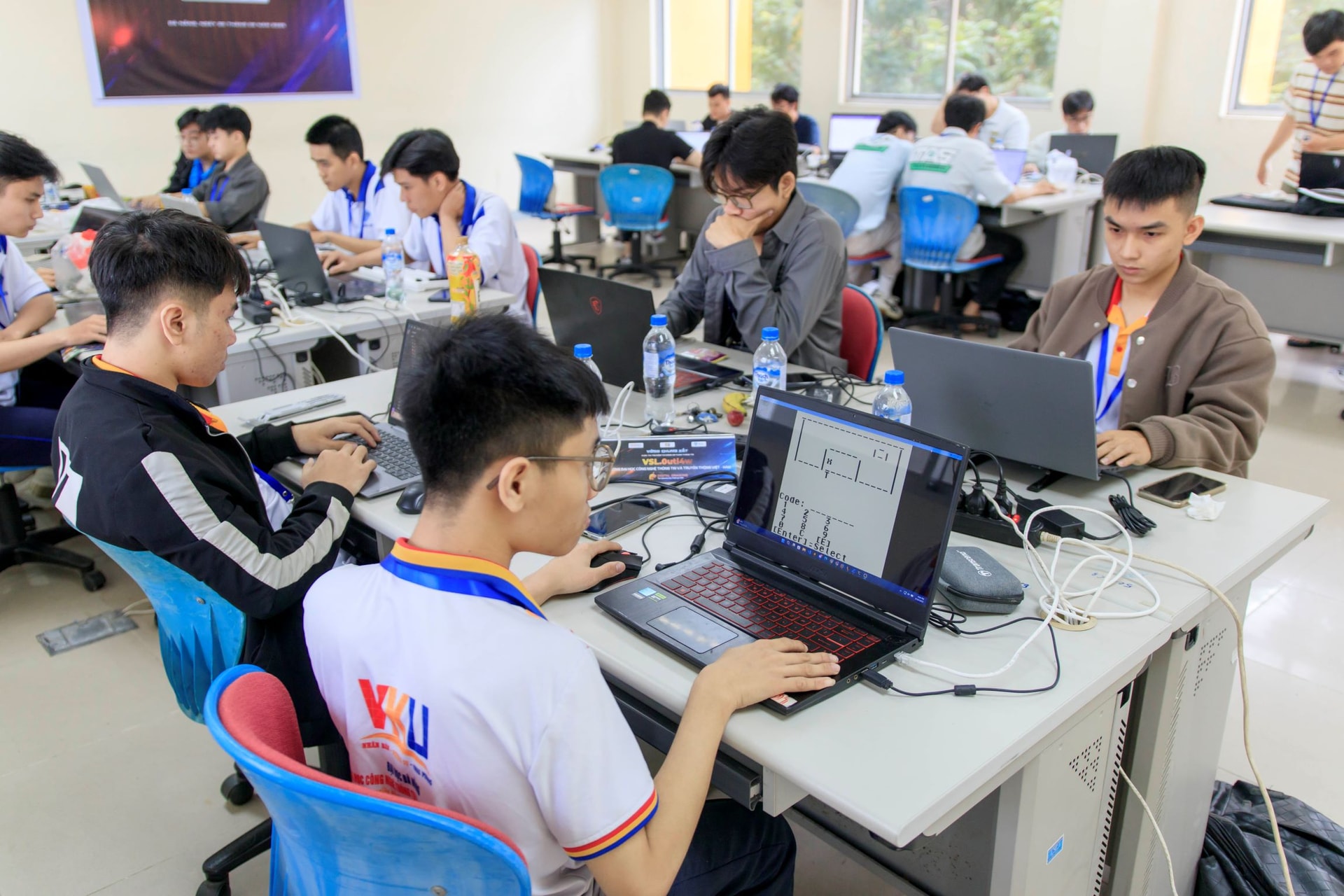
Primary and secondary schools and universities in the city have begun integrating digital skills into their curricula, gradually equipping students with the capacity to adapt to digital transformation.
Shaping the digital citizens of the future.
On October 18, 2024, the People's Committee of Da Nang City issued Decision No. 2242/QD-UBND on the digital competency framework for citizens in Da Nang City. Accordingly, the digital competency framework for citizens in the city comprises five areas: Information and data; communication and collaboration; digital content creation; protection and safety; and the digital environment.
Da Nang is also the first locality in the country to issue a digital competency framework for citizens, contributing to the formation of "digital citizens" adapting to digital transformation. Education plays a fundamental role in this framework. Primary and secondary schools and universities in the city have begun integrating digital skills into their curricula, enabling students to gradually adapt to the digital environment in the future.
At Nguyen Hue Secondary School (Hai Chau Ward), Principal Vo Thanh Phuoc stated that the school prioritizes and implements digital skills development for students early on, focusing on five key components: using and managing information and communication technology; behaving appropriately in the digital environment; problem-solving with the support of technology; applying information technology in learning and self-learning; and collaborating in the digital environment through various content topics. In addition, the school equips students with digital skills, including providing knowledge, facilities, and creating an environment for practicing and developing these skills.

During the past school year, Nguyen Hue Secondary School incorporated digital skills into its teaching through four methods: teaching the Computer Science subject according to the 2018 general education curriculum; integrating digital citizenship skills education into the teaching of various subjects and educational activities; enhancing digital citizenship skills education through teaching; and organizing digital citizenship skills education clubs.
In addition, the school collaborates in organizing thematic activities to equip students with civilized online behavior rules; providing them with knowledge about the benefits and security threats in the virtual world . This equips students with the skills to use social media safely and effectively, and the skills to respond to and handle situations such as online bullying, psychological abuse, or other negative behaviors.
According to Dr. Tran The Son, Vice Rector of the Vietnam-Korea University of Information and Communication Technology (Da Nang University), building and training safe digital citizens with a sense of personal data protection is a crucial link in the overall solutions for cybersecurity.
Training citizens in safe digital citizenship should be incorporated into the high school curriculum to raise awareness and equip citizens with the necessary skills from an early age. Additionally, there should be training programs at various levels for different segments of the population, potentially through courses and workshops to enhance awareness and skills in online information security.
Switch from warning to skill equipping
Associate Professor Dr. Nguyen Gia Nhu, Rector of the School of Technology and Engineering (Duy Tan University), believes that humans are the weakest link in the security chain but have the potential to become the strongest line of defense, the most intelligent and flexible threat detection system. The importance of building a safe digital citizenry lies in the shift from passive awareness to proactive capabilities. The most notable achievement of Da Nang is its pioneering leadership in issuing the "Digital Competency Framework for Citizens," which has shifted the focus from "warning" citizens to equipping and measuring their capabilities.

Based on a solid foundation of the digital competency framework, Associate Professor Dr. Nguyen Gia Nhu suggested that the city could implement specific and synchronized solutions to build a generation of truly safe digital citizens. This includes deep integration into the general education system. The content of the Cybersecurity Law should be included in the National Defense and Security Education subject at high schools. The Department of Education and Training should play a leading role in incorporating these programs into the main curriculum, ensuring all students are equipped with fundamental knowledge.
In addition, there should be a suitable information security skills training program for adults, which could include the development of free online courses and mobile applications on the DaNang Smart City platform. Simultaneously, a reliable and simple reporting channel should be created, turning each citizen into a "sensor" for the city's security network.
According to representatives from the Department of Education and Training, based on Resolution No. 57-NQ/TW of the Politburo on building and developing Da Nang city until 2030, with a vision to 2045, the city will implement groundbreaking solutions and apply modern technology to management and teaching. This includes building a large database (Big Data) on education, synchronously connecting electronic student records and digital student and teacher profiles; developing an open digital learning resource ecosystem for all schools, encouraging teachers and students to participate in creating digital content, and fostering a digital learning culture.
Simultaneously, pilot digital school models will be implemented at all educational levels, gradually popularizing smart classrooms with interactive whiteboards, 3D simulation systems, and augmented reality/virtual reality (AR/VR) technology, thereby creating a visual and dynamic digital environment for students to practice digital skills in accordance with the competency framework.
The goal by 2030 is for all secondary schools to apply digital technology in management and teaching; at least 50% of lectures to be digitized, and 70% of students to have access to internationally recognized quality online courses.
These steps not only ensure the effective implementation of the digital competency framework for citizens but also contribute to making Da Nang a center of educational innovation, a pioneer in building a comprehensive digital society and digital citizens.
Source: https://baodanang.vn/xay-nen-cho-cong-dan-thoi-dai-so-3303428.html


































































































Comment (0)