

Many educators believe that ranking students helps track results and create a competitive spirit, so there's nothing wrong with it, just that it shouldn't be made public.
At the end of the first semester last year, Huy, currently an 11th-grade student in Ha Nam , achieved an average academic score of 7.8, ranking 19th out of 42 students in his class. This result was announced by his homeroom teacher at the parent-teacher meeting, along with a detailed report card.
Huy wasn't shocked by the result because he knew his own abilities. But Huy's mother was stunned that her son had lost his title as an excellent student and his scores were significantly lower than those of their neighbors' children.
"I got scolded a lot. My whole family expected me to do better," Huy recalled, adding that this wasn't new because he had been ranked lower since middle school.
Gia Bình, a 12th-grade student in Bac Giang , is ranked every three months. His school adds up the scores from the mock exams in three subjects based on the university entrance exam combination and ranks students from top to bottom. Bình registered for the D01 combination (Mathematics, Literature, English) with nearly 400 other students, usually ranking between 100-150, while his goal is to be in the top 70.
"Every time I fail an exam, I lose sleep and appetite until the results are announced, and my parents always nag me," Binh said.
Eliminating the practice of ranking students and announcing their results at parent-teacher meetings was a proposal made by Mr. Pham Khac Chung, principal of Nguyen Ba Ngoc Primary School in Dak Nong province, at a "Happy School" seminar at the end of October. Mr. Chung argued that parents all want their children to excel and achieve high rankings, but not all students have academic strengths. He believes that ranking and publicly announcing these results harms students and puts pressure on them and their families.
According to a VnExpress survey conducted on October 21st, 70% of over 2,700 respondents supported this practice. However, many educators believe that ranking students is not inherently bad; on the contrary, it is a tool for monitoring students' academic performance and creating a competitive spirit. The issue lies in the method used.
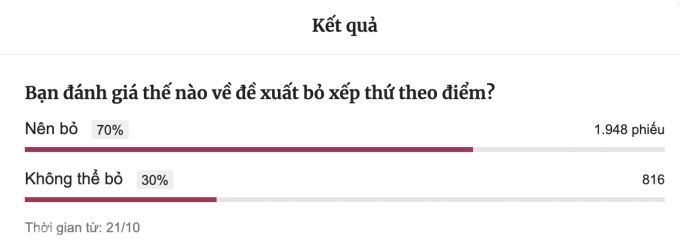
The survey results were conducted by VnExpress from October 21 to 31. (Screenshot)
The principal of a junior high school in Ba Dinh district, Hanoi , believes that any activity needs to be evaluated.
"Even countries have rankings to see where they stand in relation to the world. Why shouldn't education have the same?", this person questioned.
Concurring, Ms. Van Thuy Duong, Principal of Luong The Vinh Secondary and High School in Hanoi, observed that "without pressure, there are no diamonds." According to her, education shouldn't always be about pampering and completely abandoning competition.
"Workplaces always have deadlines, rankings, and rewards. If students aren't prepared for these things, how will they face the realities of life?", Ms. Duong said.
Taking the example of entrance exams for 200 students with 2,000 applicants, Ms. Duong argued that while many people say it's a 1 in 10 chance, in reality, to be selected, students must rank from 1st to 200th. Similarly, when forming a team of gifted students, teachers must base their selection on screening tests, choosing the highest-scoring students. Therefore, ranking always exists in education and cannot be completely eliminated.
In many countries, ranking students by grades remains common and significant in high school. For example, in the US, public schools often have two ranking systems: school-level and state-level. Higher-achieving students are more likely to attend better schools or receive higher financial aid. Some American universities even have specific requirements regarding student ranking within their class or school.
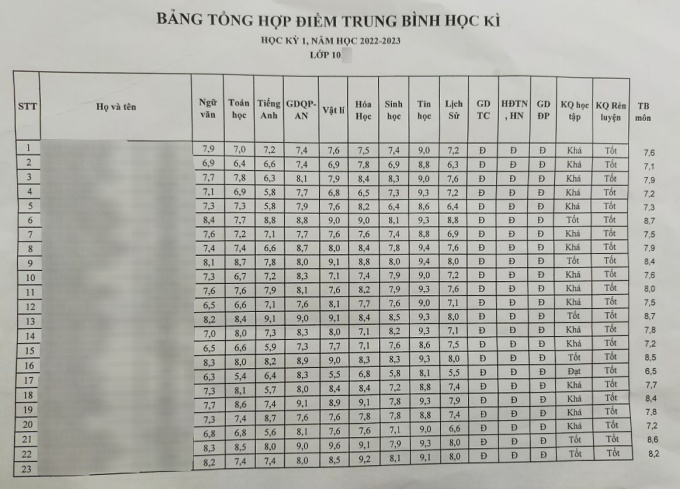
A summary report card for a 10th-grade class, distributed to parents at the end-of-semester meeting for the 2023-2024 school year. Photo: Provided by a parent.
In Vietnam, ranking students is not a mandatory requirement of the Ministry of Education and Training or any local authority. However, schools still maintain student ranking data to monitor and evaluate academic performance.
Ms. Nguyen Boi Quynh, Principal of Viet Duc High School in Hanoi, said that without this data, teachers would not know which students are making progress and which need more effort, so they could provide appropriate and timely educational support. This data is also significant in advising students on choosing universities that are within their reach.
This is also Ms. Thuy Duong's view. However, according to Ms. Quynh and Ms. Duong, the appropriate approach is that instead of publicly releasing the class list and distributing it to parents, teachers could notify each student and their parents individually.
"We are committed to avoiding embarrassing or humiliating students and their families. Teachers must be there for them, sharing their experiences, because if students feel afraid and distant from their teachers, it will be very difficult to implement positive educational methods," Ms. Duong said.
Ms. Thu Oanh, the mother of a 6th-grade student in Thu Duc City, Ho Chi Minh City, is also relieved to know her child's ranking through the learning tracking software. After each test, the teacher will notify her so she can check the results.
"I think ranking is normal, to encourage children to try harder, provided the school doesn't publish the rankings or comments publicly, to avoid comparisons between children or parents," Ms. Oanh said.

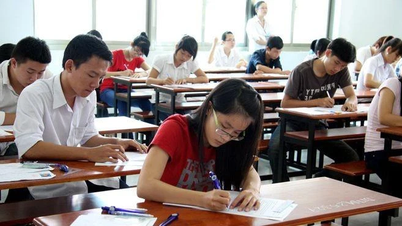
Students line up in the courtyard of Tran Dai Nghia High School before entering the examination room, competing for a spot in 6th grade, June 2022. Photo: Thu Huong .
If the ranking system is maintained, Hoang Huy hopes that this information will only be communicated privately to parents.
"Giving private notifications helps me avoid being compared to my classmates, but I still get scolded if I don't meet expectations," Huy observed.
Principals believe it's crucial for teachers to work closely with parents, guiding them towards positive parenting methods, rather than resorting to scolding children whenever they don't get the desired results.
"If you're constantly criticizing your child for their academic results, then keeping or discarding rankings is meaningless," said the principal in Ba Dinh district.
Thanh Hang - Le Nguyen
*Student's name has been changed
Source link


![[Image] National Assembly discusses the implementation of the socio-economic development plan.](https://vphoto.vietnam.vn/thumb/1200x675/vietnam/resource/IMAGE/2026/04/20/1776696707422_ndo_br_img-20260420-185419-jpg.webp)
![[Photo] General Secretary and President To Lam meets with National Assembly delegates from ethnic minorities.](https://vphoto.vietnam.vn/thumb/1200x675/vietnam/resource/IMAGE/2026/04/20/1776696701056_a1-bnd-8331-3342-jpg.webp)



































































































Comment (0)