Quick overview:
- What kind of flower doesn't grow on a tree?
- What animal stands still the faster it runs?
- What kind of car never goes on sale?
- Which bridge does not cross a river?
- What animal lies down when it walks, lies down when it stands, and lies down even when it sits?
- What kind of pants does nobody wear?
- What kind of eyes aren't used for seeing?
- Which foot isn't walking?
- Which mouth doesn't eat?
- What kind of poison is it that the more you hit it, the more you like it?
What kind of flower doesn't grow on a tree?
Answer: Earrings
Earrings are a piece of jewelry worn on the ears. They can be made from precious metals (9999 gold, silver, platinum, etc.), alloys, stones, or gemstones, each offering unique value and style.
Many people think that "bông tai" is just another name for "kính tai," however, "kính tai" usually refers to ear jewelry that requires piercing, while "bông tai" can be worn as a clip or hook onto the earlobe.

What animal stands still the faster it runs?
Answer: Spinning top
Spinning tops are familiar folk toys, yet they hold many interesting aspects related to culture, science , and entertainment.
In culture, the spinning top is an ancient toy that has existed for thousands of years in many Asian and European cultures. In Vietnam, many regions still consider the spinning top a game associated with childhood, used to cultivate dexterity and patience.
In science, the faster a spinning top spins, the more stable it remains due to its moment of inertia. This is the basis of modern devices such as gyroscopes in airplanes, spacecraft, and smartphones. The fact that a spinning top can tilt but not immediately fall creates an interesting physical effect that students are often shown in dynamics lessons.
Today, in addition to the traditional wooden spinning top, there are many other types of spinning tops such as light-up spinning tops and spinners, creating a global trend. Spinning tops are also promoted as a stress reliever and concentration improver.

What kind of car never goes on sale?
Answer: Tank
Tanks are one of the most famous military vehicles, with origins dating back to 1916. When Britain built its first tanks in World War I, they used the word "tank" to maintain secrecy, leading the enemy to believe they were simply mobile water containers. The British Mark I tank, first appearing in the Somme (France, 1916), was the first battle tank used, marking a turning point in the war.
The Nazi German Panzer VIII Maus (World War II), weighing 188 tons, was the heaviest tank ever built. However, it was too heavy to be truly effective, so only a few prototypes were produced. The Soviet T-34 tank is considered the most influential tank of World War II due to its low cost, ease of production, and high combat effectiveness.
In Vietnam, the image of tanks 390 and 843 of the South Vietnamese Liberation Army crashing into the Independence Palace on the afternoon of April 30, 1975, has become a symbol of the day of national reunification.

The image shows a T-90 military tank of the Vietnamese Armored Corps on display at the exhibition "80 Years of the Journey to Independence - Freedom - Happiness" held at the Vietnam Exhibition Center ( Hanoi ) in September 2025.
Which bridge does not cross a river?
Answer: Fuse
Fuses are the "gatekeepers" in electrical systems: when the current exceeds a safe level, the lead wire inside melts and interrupts the circuit, protecting the equipment from fire and explosion. They are the cheapest yet most effective protective device, still used in conjunction with circuit breakers (CBs).
The fuse was introduced by Thomas Edison in 1890 to protect the wiring in incandescent light bulbs. Since then, its basic structure has remained almost unchanged: a easily fusible metal wire placed inside a protective tube.
A fuse wire is typically made of a lead-tin-zinc alloy, designed to melt at a specific current level. When a fuse blows, the circuit is interrupted, preventing damage from an overload current. This is a typical application of the Joule-Lenz phenomenon (heat released when an electric current flows through a conductor).
There are many types of fuses: ceramic fuses in households, glass tube fuses in electronics, and high-voltage fuses used in substations. In Vietnam, especially in rural areas, the image of a ceramic "fuse box" is a familiar memory, often mounted on utility poles in front of houses.

What animal lies down when it walks, lies down when it stands, and lies down even when it sits?
Answer: The snake
Here are some interesting facts about snakes that you might not know:
A wide variety of species: There are over 3,000 species of snakes worldwide, living in a variety of environments: forests, deserts, seas, and some even prefer to live in cold regions.
Despite lacking legs, snakes are highly agile: they use their belly scales in combination with their coiled bodies to slither and climb. Some species can even "fly" by extending their bodies from a height and then gliding downwards (like flying snakes in tropical forests).
Exceptional sense of smell: Snakes use their forked tongues to pick up scents from the air and then transfer them to the Jacobson's organ for "smelling." Therefore, a snake sticking out its tongue is not to assess immediate danger but to identify its environment.
Snakes don't blink: Instead of eyelids, snake eyes are protected by a transparent outer layer, like a "shield," which prevents dust and other impurities from harming them.
Flexible adaptation to food: Depending on the species, snakes can eat small animals such as mice, birds, crabs, and fish, or larger species can swallow animals larger than their own bodies. Their jawbones and mouth structure are very special, allowing them to expand widely.
Snakes shed their skin multiple times: As snakes grow, their old skin becomes tight, dull, and damaged, so they shed the outer layer to replace it with a new, shinier one.
Important ecological role: Snakes help control the populations of rats and insects, thereby benefiting agriculture; they are also an important link in the natural food chain.
Colored warning signs: Some snake species are brightly colored – this is a way of signaling "keep away" to predators, as they may be venomous or dangerous.
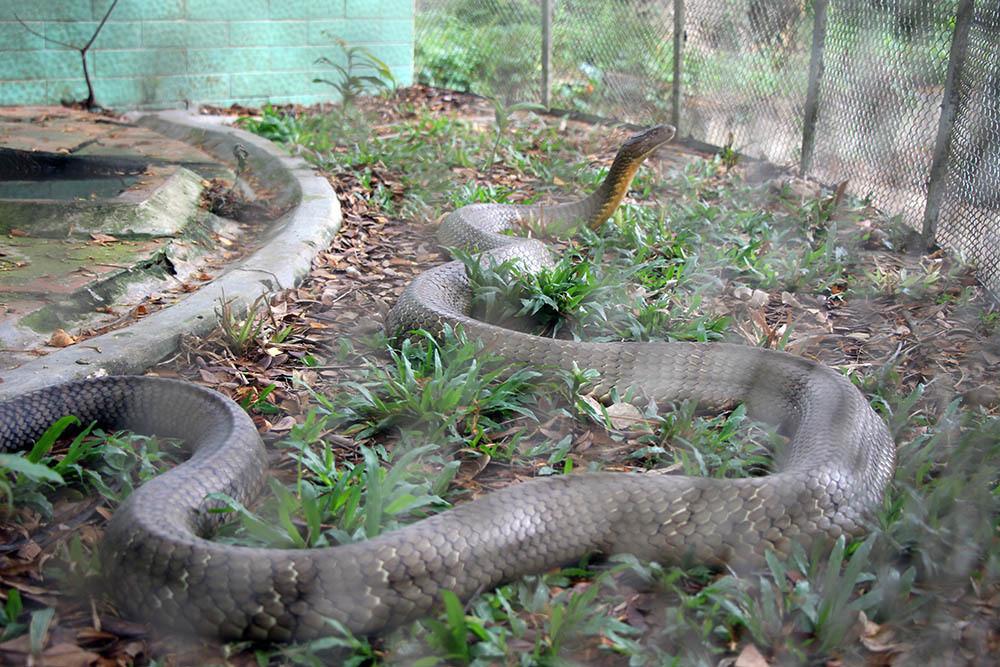
Cobras at Dong Tam Snake Farm - the largest snake farm in Vietnam.
What kind of pants does nobody wear?
Answer: Islands
Here are some facts you might not know about the islands in Vietnam and around the world:
Indonesia can be considered the world's largest archipelago, with over 17,000 islands of varying sizes, spread across a vast area.
The Maldives archipelago in the Indian Ocean is the world's lowest archipelago, with an average elevation of only about 1.5 meters above sea level.
Java (Indonesia) is the world's most populous island, with over 140 million people, more than the population of many countries. Conversely, there are archipelagos that are almost uninhabited, such as the Svalbard archipelago (Norway), which is mainly inhabited by polar bears.
The Galápagos Islands (Ecuador) are famous for Charles Darwin's research expedition, which led to the development of his theory of evolution.
The Ryukyu Islands (Japan) were once a separate kingdom before being incorporated into Japan, with their own culture and language.
The Philippine archipelago comprises over 7,600 islands, many of which are uninhabited, boasting pristine landscapes and exceptional biodiversity.
The Hawaiian Islands (USA) were formed entirely from underwater volcanoes, which are still active today, creating new landmasses every year.
The Spratly and Paracel Islands are two famous archipelagos of Vietnam, important not only geopolitically but also possessing diverse marine ecosystems.
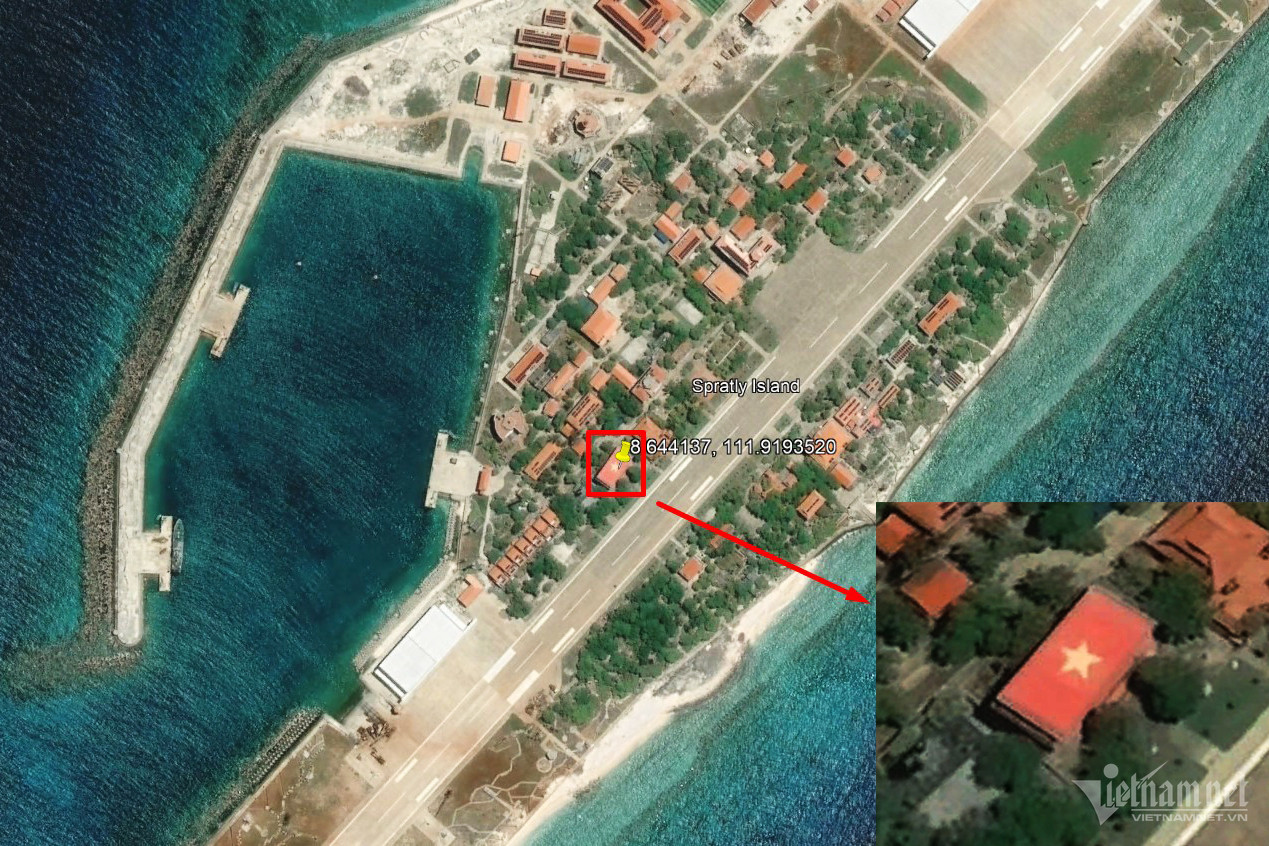
Satellite image of Truong Sa Lon Island on Google Maps
What kind of eyes aren't used for seeing?
Answer: Chain link, Mesh link
In the Vietnamese dictionary, besides being the organ of sight in humans or animals, "eye" can also refer to a protruding or recessed area bearing buds in some plants (sugar cane eye, pineapple eye) or a hole or gap in objects that are hooked together (mesh, chain link).
Which foot isn't walking?
Answer: Chair legs, Table legs
In the Vietnamese dictionary, "outer leg" refers to a part of the human or animal body used for walking, standing, running, and jumping. It also refers to the bottom part of certain objects, which supports other parts or makes contact with and firmly grips the surface.
This riddle can also be applied in English because human legs, which are used for walking, are also called legs, and table legs are also called table legs.
Which mouth doesn't eat?
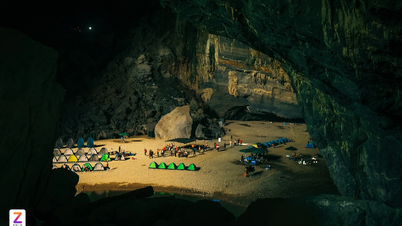
Answer: Mountain mouth, cave mouth, well mouth
In the Vietnamese dictionary, "mouth" or "mouth" can both refer to a part of the face of a person or animal used for eating or making sounds. However, the word "mouth" also has another meaning: the uppermost part of an object that has depth and is connected to the outside.
What kind of poison is it that the more you hit it, the more you like it?
Answer: Jackpot
The jackpot is the term used for the largest prize in a lottery.
In Vietnam, there are interesting stories like winning the lottery jackpot because a neighbor encouraged them to buy lottery tickets together for good luck, a bubble tea vendor winning the jackpot and immediately using the money to pay off debts and offer free drinks to customers, or a lottery winner whose wife only gives them 150,000 dong to spend each day.
Besides, winning the lottery can also lead many families into tragic situations such as theft, addiction, and financial ruin. Readers can find more news about lottery jackpots on VietNamNet.
Source: https://vietnamnet.vn/10-cau-do-meo-co-dap-an-cuc-hack-nao-2444952.html


















































































Comment (0)