

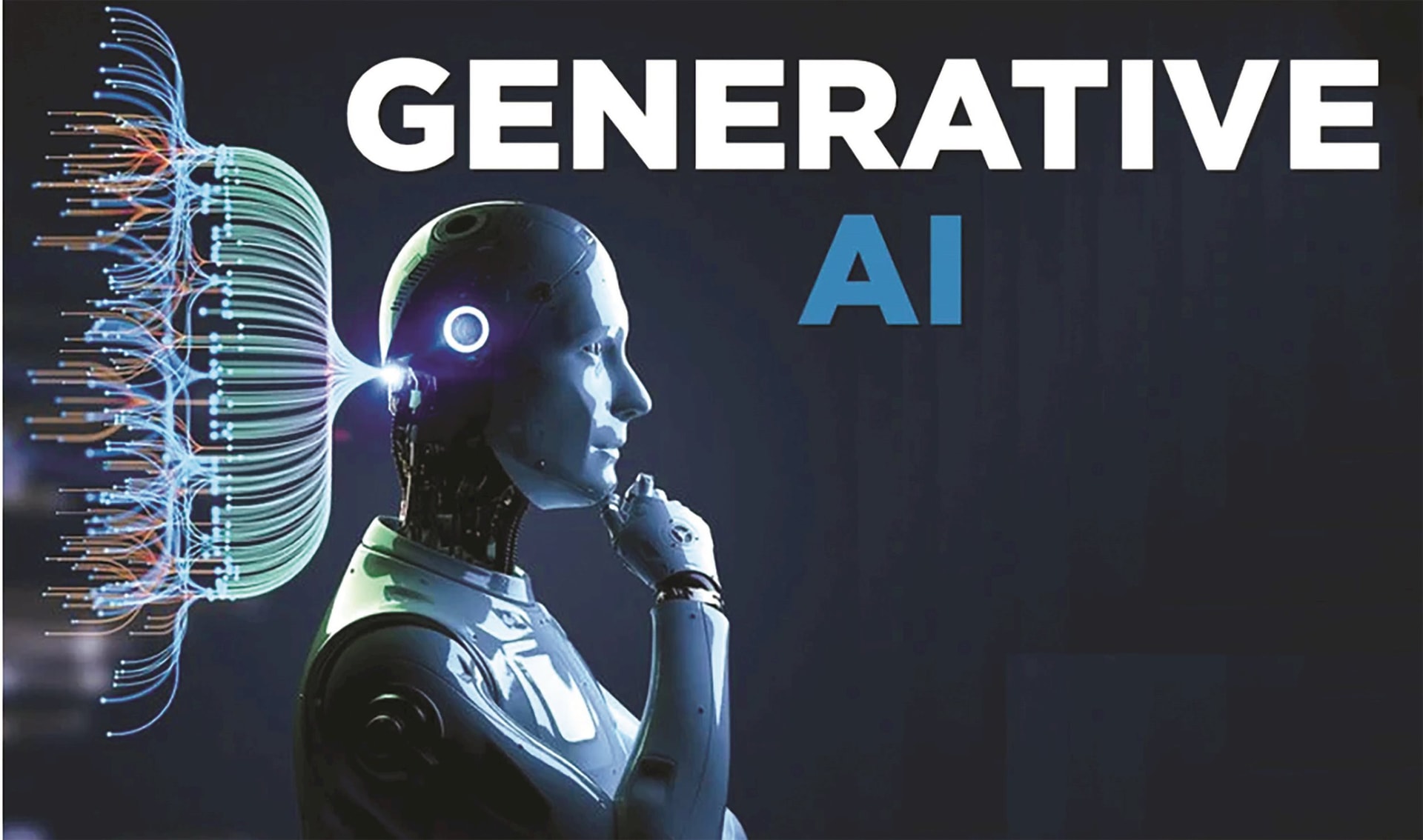
1. Generating AI
At the top of the list of emerging technology trends is none other than generative AI. Generative AI is a type of artificial intelligence designed to generate new content, such as text, images, audio, or video , based on patterns and information it has learned from training data. Unlike traditional AI systems, which only perform pre-programmed tasks, generative AI has the ability to be creative and generate new products from nothing, or from input data.
This technology continues to be a mainstream trend in 2025, with its incredible ability to create human-like content, from text, images, and audio to complex simulations.
The development of consumer-grade AI platforms like Google Bard and OpenAI's ChatGPT is driving strong market growth. According to Bloomberg Intelligence (BI), this market is projected to grow from $137 billion in 2024 to $1.3 trillion within the next decade.
Innovations in generative modeling, including GPTs and multimodal systems, are unlocking new possibilities in areas such as content creation, automated design, and immersive interactive experiences.
This transformative technology not only enhances efficiency but also changes business strategies in problem-solving, customer interaction, and innovation development. By 2025, organizations will increasingly integrate AI generation into their operations, driving innovation and delivering personalized services on a large scale.
2. Artificial AI
While generative AI is driving an increase in AI adoption in businesses, agent AI is expected to drive revolutionary change across industries.
Agent AI is a type of artificial intelligence capable of acting independently and performing tasks automatically without constant human intervention. This AI system can make decisions and take actions within a specific environment to achieve goals that it has been programmed or learned to achieve.
According to Emergen Research, the agent AI market is expected to reach $30.89 billion in 2024, with a strong compound annual growth rate (CAGR) of 31.68%.
Agent AI marks a significant leap forward in artificial intelligence, enabling systems to operate with a higher degree of automation. These systems are designed to perform complex tasks independently, making decisions and adapting to new challenges without human supervision.
Unlike current AI tools and large-scale language models, agent AI opens up a new paradigm. It allows systems to proactively plan and act to achieve user-defined goals, paving the way for virtual agents to enhance, automate, and improve existing human workloads or applications.

3. AI Management Platform
As AI becomes increasingly integrated into critical infrastructures, 80% of data professionals acknowledge that it exacerbates data security challenges, underscoring the need for robust governance and security frameworks. This trend highlights the urgent need to develop rigorous standards and regulations to ensure AI systems operate safely, reliably, and ethically across industries.
Key elements in responsible AI deployment include minimizing algorithmic bias to avoid unfair or harmful outcomes, enhancing transparency to build trust by clarifying how AI decisions are made, and ensuring accountability to uphold ethical and legal standards.
As AI continues to be integrated into the fabric of society, building a safe and trustworthy AI environment is not just a priority, but a necessity to maintain confidence in the transformative role of these technologies.
4. Internet of Things (IoT) in Smart Cities
The global market for IoT (Internet of Things) in smart cities is projected to reach $312.2 billion by 2026, with a strong compound annual growth rate (CAGR) of 19.0%.
IoT technology in smart cities integrates sensors and devices to collect data, enabling efficient management of assets, resources, and services. This includes optimizing traffic flow and public transportation, improving energy efficiency with smart grids, and deploying connected systems for public security and emergency response. As urban areas expand, IoT plays a crucial role in addressing complexities and improving the quality of life for residents.
5. Edge Computing
Edge computing is a computing model where data is processed near its origin or "edge" of the network, rather than being sent to distant data centers (clouds) for processing. The goal of edge computing is to reduce latency, decrease network bandwidth, and increase performance by processing data right where it is generated, for example, on devices or network nodes near end users.
The global edge computing market is projected to expand significantly, from $13.66 billion in 2024 to $181.96 billion in 2032, with an impressive compound annual growth rate (CAGR) of 38.2% throughout the forecast period.
Edge computing processes data close to its point of origin, eliminating reliance on centralized data centers. This approach is crucial for applications requiring real-time processing and rapid decision-making, avoiding the delays often associated with cloud computing. Key applications include self-driving cars, industrial IoT, and data management in remote areas.
Edge computing plays a crucial role in self-driving vehicles by enabling real-time data processing right inside the car. Companies like Tesla and Waymo use this technology to enhance safety and ensure efficient operation.

6. 5G Network
5G networks continue to be deployed globally, creating a fast and reliable connectivity infrastructure that can provide high transmission speeds and low latency for services and applications. The 5G market is expected to reach a value of $667.90 billion by 2027, with a compound annual growth rate (CAGR) of 43.9% between 2020 and 2027.
With 5G networks becoming increasingly prevalent, the widespread adoption of applications such as virtual reality (VR), augmented reality (AR), and real-time cloud services will become a reality. Businesses can leverage 5G to improve work efficiency, increase productivity, and reduce operating costs.
5G will bring about an explosion in IoT applications, with connected devices able to interact in real time, while also supporting advanced technologies such as self-driving cars and telehealth services.
7. Blockchain technology and digital currencies
Blockchain technology will continue to have a significant impact in 2025, not only in the financial sector but also in many other industries such as healthcare, supply chains, and identity management. Blockchain provides a distributed and transparent data storage system, helping to minimize fraud and improve security.
Digital currencies, especially central bank currencies, will also continue to develop strongly. Governments and central banks around the world are experimenting with and deploying digital currencies to improve international payments, reduce transaction costs, and enhance efficiency in the financial system.
Blockchain technology can also support smart contract platforms, enabling automated transactions and reducing reliance on intermediaries.
8. Augmented reality (AR) and virtual reality (VR) technologies
AR and VR technologies are changing the way we interact with the digital and real worlds. AR applications in retail, education , and entertainment will continue to expand, allowing users to interact with 3D objects and experience virtual environments.
The AR/VR market is projected to reach $296 billion by 2025, driving the growth of applications in fields such as training, healthcare, tourism, and manufacturing. This technology will not only enable users to experience complex simulations but also support professional and educational activities through virtual environments.
Both AR and VR have the potential to revolutionize the gaming industry, with games becoming more immersive and lifelike than ever before.
9. Robotics and automation technology
With automation becoming increasingly important in fields such as manufacturing, logistics, and healthcare, autonomous robots will continue to thrive. Modern robotic systems can not only perform simple tasks but also handle complex ones such as surgery, cleaning, and even participate in the creative process.
According to some forecasts, the industrial robotics market will reach $80 billion by 2027, with strong growth in robots serving industries ranging from healthcare to manufacturing and logistics.
10. Machine learning and data analysis
Machine learning and data analytics technologies will continue to grow strongly in 2025. Companies are increasingly using big data to make smarter decisions and optimize their operations.
Advanced data analytics tools will help businesses predict trends, consumer behavior, and market changes, thereby enabling them to develop timely strategies to maintain a competitive advantage.
Source: https://daidoanket.vn/10-xu-huong-cong-nghe-trong-nam-2025-10299025.html






































































































Comment (0)