

The upcoming pedestrian bridges across the Saigon River, Thu Thiem 4, and Can Gio are expected to not only improve transportation connectivity for many areas but also create a landmark thanks to their unique design.
The pedestrian bridge is the third project to be built connecting the Thu Thiem area of Thu Duc City to District 1, following the Saigon River tunnel and the Ba Son bridge, which are already in operation. With a total investment of approximately 1,000 billion VND, the bridge will be about 500 meters long, spanning the Saigon River and connecting the Bach Dang Wharf park area in District 1 to the riverside park south of the central square of the Thu Thiem urban area.
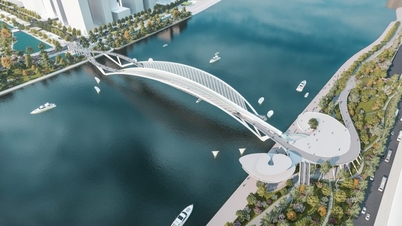
According to the architectural plan approved by the city, the pedestrian bridge is shaped like a water coconut leaf – a characteristic image of Southern Vietnam. This design is expected to make a strong impression when viewed from above, with the giant coconut leaf standing out in the middle of the river, connecting the existing city center to the future new city center – the Thu Thiem urban area.
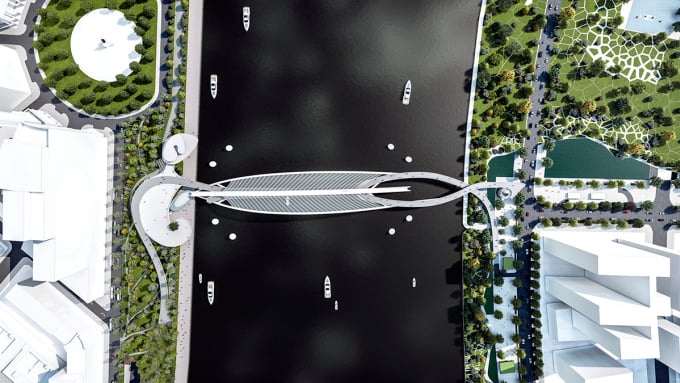
The proposed pedestrian bridge design is inspired by the shape of a water coconut leaf. Photo: Consulting consortium .
The design team proposed placing the bridge piers close to the riverbank to create clear air and open space on the river, facilitating the movement of ships and boats. The bridge also features a circulating waterfall, artistic lighting, landscaped areas, and other amenities.
The pedestrian bridge design, assessed by the Ho Chi Minh City Department of Planning and Architecture as unique, impressive, original, and simple, is expected to attract residents and tourists to the city. Once operational, the bridge will not only serve pedestrians but also become a destination for sightseeing and community recreation, given the current shortage of open spaces in the city center.
Besides its unique architecture, the pedestrian bridge is also the largest project ever fully funded by a single business. Construction is expected to begin in early 2025.
Also a key project connecting Thu Thiem, the Thu Thiem 4 bridge across the Saigon River to District 7 is currently being promoted for investment by the city's transportation sector. The bridge will be 2 km long, with 6 lanes, and an investment of over 6,000 billion VND. The proposed project will have its starting point connecting to Nguyen Van Linh Boulevard at the intersection with the Tan Thuan 2 bridge access road in District 7. The end point will connect to Nguyen Co Thach Street at the intersection with the R4 route in the Thu Thiem New Urban Area.
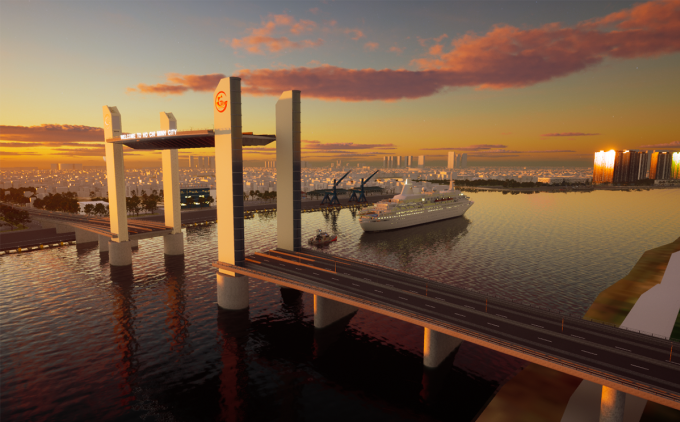
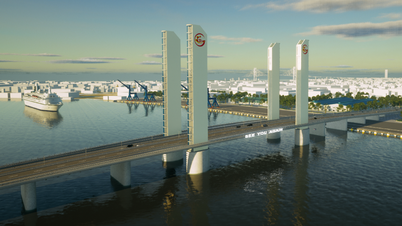
Perspective view of Thu Thiem 4 Bridge, a project designed with a lift-and-lower main span. Photo: Portcoast
Unlike other bridges already built in the area, Thu Thiem 4 has a unique design where the main span for navigation can be raised and lowered from 15 meters to 45 meters. This solution was implemented to facilitate the passage of large ships, helping to develop waterway transportation and tourism . This also creates conditions for exploiting urban space at Nha Rong - Khanh Hoi port, which is planned to become an international passenger port in the future.
Although some expressed concerns that the design might cause traffic congestion when raising and lowering the bridge, the Department of Transportation believes this is not a major issue because the bridge is only raised and lowered at night when there is less traffic. "With current technology, the process is automated, taking about 10 minutes for each raising and lowering operation, which will not significantly impact surrounding traffic," a representative from the Department stated.
Dr. Chu Cong Minh, a specialist in bridges and roads at Ho Chi Minh City University of Technology, said that the pedestrian bridge and Thu Thiem 4 bridge are located on the "front facade" of the city center, so in addition to serving transportation needs, they require high aesthetic value. Specifically, with Thu Thiem 4 bridge, situated at the gateway to Nha Rong Port, building it low would significantly hinder activities in the area. Conversely, building it high would require long access roads, disrupting the landscape of the area.
"Building a tunnel under the river is also not an ideal solution because the construction costs are too high," he said, adding that the design for raising and lowering the span of the Thu Thiem 4 bridge is not yet available in Vietnam, but some countries have adopted it, such as the Pont Jacques Chaban-Delmas bridge in France. This is a famous structure in that country, attracting tourists with its unique design.
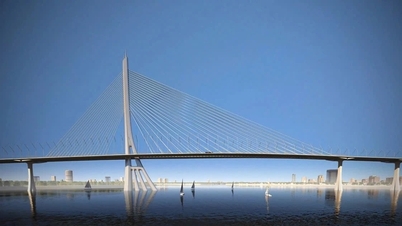
In the southern part of the city, a bridge connecting the two districts of Can Gio and Nha Be is expected to begin construction in 2025. (Can Gio Bridge) The studied route has a total length of approximately 7.3 km, connecting from Road 15B (parallel to Huynh Tan Phat Street, Nha Be District), then crossing the Soai Rap River to connect to the Rung Sac Road in Can Gio.
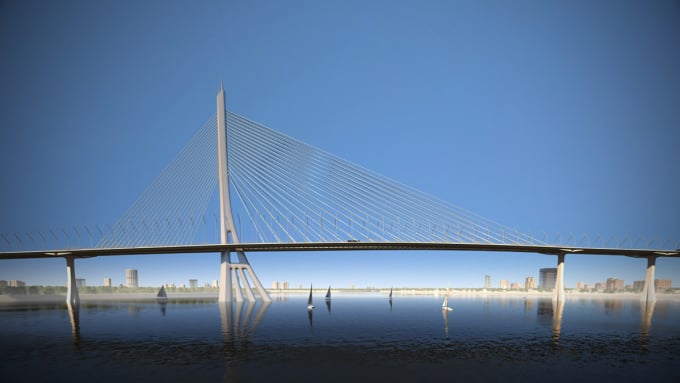
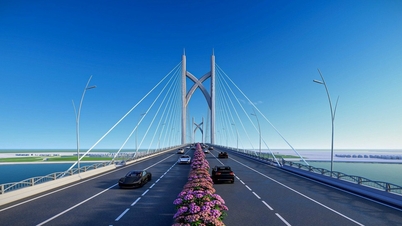
The architectural design for the Can Gio Bridge was selected in April 2019. Photo: Ho Chi Minh City Department of Planning and Architecture.
According to the design chosen by the Ho Chi Minh City People's Committee, the Can Gio cable-stayed bridge is designed to resemble the mangrove tree – a characteristic feature of Can Gio district – creating an architectural highlight in South Saigon. Upon completion, the project will also be the longest cable-stayed bridge in Ho Chi Minh City, surpassing the already constructed Phu My (over 2 km) and Ba Son (nearly 1.5 km) bridges.
According to the Department of Transportation, the Can Gio Bridge is expected to be implemented under the BOT (build-operate-transfer) model, with a total investment of over 10,500 billion VND, and is scheduled for completion in 2028. Once operational, the bridge will create a vital transportation artery connecting South Saigon with the city center, breaking the monopoly of the overloaded Binh Khanh ferry.
Mr. Luong Minh Phuc, Director of the Ho Chi Minh City Traffic Construction Investment Project Management Board, said that traffic projects in the city are now focusing more on design and aesthetics, instead of primarily on technical aspects and quality as before. Many bridges and major intersections in the city are subject to architectural design competitions as the city aims to create iconic structures, including pedestrian bridges and Thu Thiem 4.
According to Mr. Phuc, these bridges are not simply transportation infrastructure but also carry cultural significance and represent a vision for development, especially as the city aims to exploit the tourism and economic potential of the Saigon River. "The pedestrian bridge, Thu Thiem 4, and Can Gio will not only be good, high-quality projects but are also expected to be architectural highlights and symbols of the city's modernity," he said.
Gia Minh
Source link











































![[Photo] Closing Ceremony of the 15th Conference of the Central Committee of the 13th Party Congress](https://vphoto.vietnam.vn/thumb/402x226/vietnam/resource/IMAGE/2025/12/23/1766462841764_a1-bnd-3731-1647-jpg.webp)

















Comment (0)