


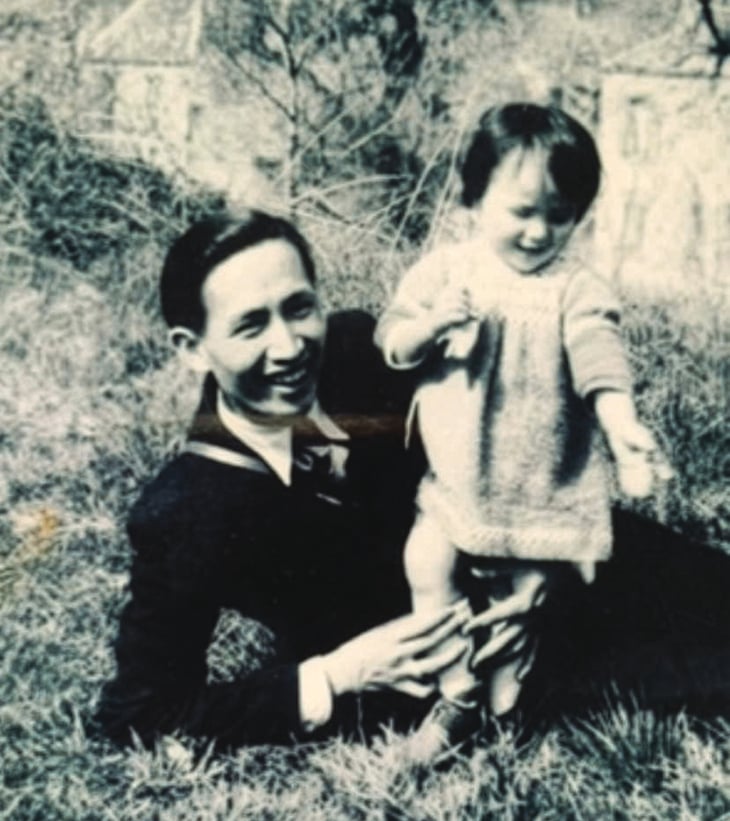
Mr. Vo Qui Huan and his daughter Vo Qui Viet Nga when he was in France.
On the ship departing from France to Vietnam in October 1946, President Ho Chi Minh's delegation included four Vietnamese expatriate intellectuals: Tran Dai Nghia, Tran Huu Tuoc, Vo Dinh Quynh, and Vo Qui Huan. They volunteered to leave the glamorous "City of Light" to return home and help the fledgling government embark on the resistance war that would erupt just two months later.
Their contributions to Vietnam's independence and unification have been recorded in history, but alongside their public lives, they also had personal struggles and lingering regrets. Like the story of Mr. Vo Qui Huan, whose wounds could only be healed decades later by the love of his daughter…
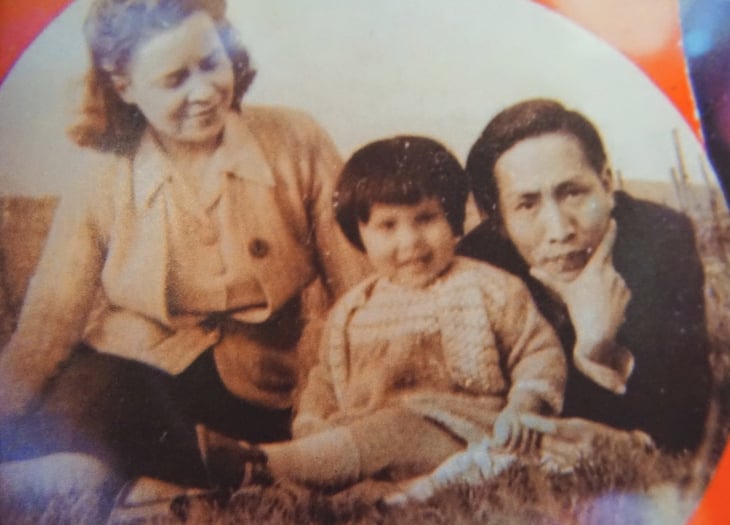
Mr. Vo Qui Huan, his wife Iréne Vo Qui, and their daughter Vo Qui Viet Nga in Paris in 1945.
An unfulfilled promise
Professor Tran Dai Nghia's memoirs also record the story from that year: "Back then, I, along with Mr. Tuoc and Mr. Quynh, were still single, without wives, so we weren't burdened by family matters. But Mr. Vo Qui Huan already had his own family; his wife was a doctor of linguistics, a French woman of Russian origin, and their daughter was only 2 years old."
Mr. Huân showed us a photo of President Ho Chi Minh holding his granddaughter Viet Nga in Paris in July 1946. On the ship, we occasionally saw Mr. Huân looking somewhat pensive, gazing into the distance at sea. We all greatly admired and respected Mr. Vo Qui Huân.
"Surely he must have gone through hours of deliberation and consideration, and being away from his young wife and child was not easy. And Mr. Vo Qui Huan returned to his country at the call of his homeland, his heart heavy with love for his country."
Besides his wife and children, Vo Qui Huan also had another worry: he was pursuing his doctorate and only had one year left to complete it. But in the end, torn between personal and professional matters, he agreed to return to Vietnam with President Ho Chi Minh.
The ocean crossing was announced only two days in advance, while his wife was defending her doctoral thesis in another city. He only had time to quickly call his wife, leave the children with a friend, and hastily prepare to leave, promising to return in a few months.
That promise was true. The original plan was for him to return to his country for a few months to study some issues of national reconstruction, then return to France to take care of family matters, and after that, decide whether to stay or return. But the resistance war broke out soon after, making this plan impossible. He continued to stay and study the casting of iron and steel, making weapons to serve the national resistance.
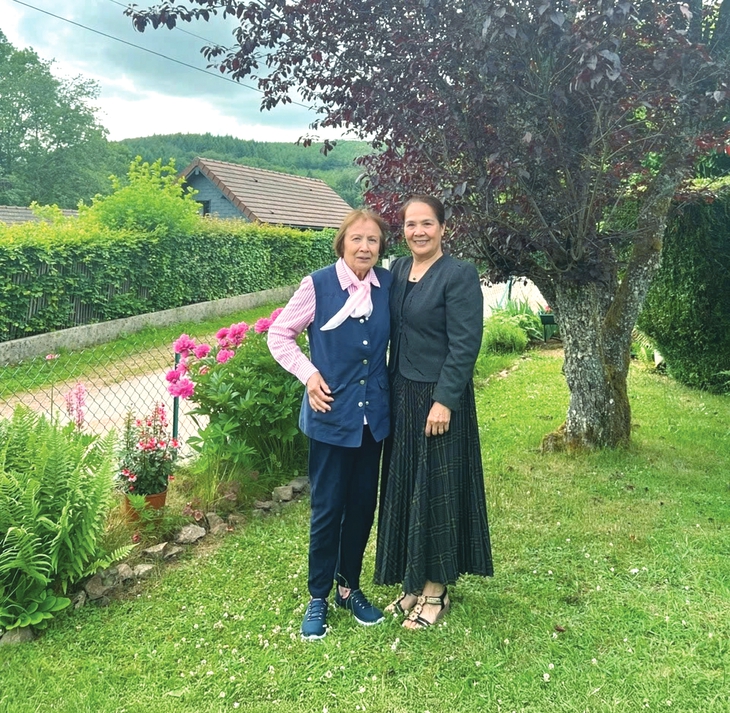
Ms. Vo Qui Hoa Binh and her sister Vo Qui Viet Nga reunited in France in 2025.
Vo Qui Huan's long-lost daughter is Vo Qui Viet Nga, the pretty two-year-old girl of French descent sitting in President Ho Chi Minh's arms in Paris in 1946 in the famous photograph.
The traditional exhibition room of the Hanoi Children's Palace displays many photos of President Ho Chi Minh with children, among which this photo is particularly noteworthy for the special intimacy and closeness the President showed to the little girl. The photographer of the photo is the girl's father - engineer Vo Qui Huan.
He was also the author of invaluable documentary films recording images of President Ho Chi Minh's delegation and the Government and National Assembly delegations of the Democratic Republic of Vietnam during their time in France in 1946, along with the artist Mai Trung Thu.
That day, Mr. Vo Qui Huan hugged his daughter and whispered, "Be a good girl, stay home with your mother. Your father will be gone for a few months, then he'll come back…" Those words resonated deeply in the heart of the little girl, who was just over two years old, and became a lingering pain for decades.
Nine years of resistance and the years that followed, until Mr. Vo Qui Huan passed away from a serious illness in 1967, he was still unable to fulfill his promise from years ago. War, heavy responsibilities, and numerous difficulties and obstacles related to diplomatic relations, law, and even geography…

Ms. Vo Qui Viet Nga gives her younger sister, Vo Qui Hoa Binh, a warm hug and kiss. (Photo: GĐCC)
In Vietnam, Mr. Vo Qui Huan remarried and had four more children, including his daughter, Vo Qui Hoa Binh. Mr. Huan was especially close to and fond of his daughter, always taking her with him wherever he went. Later, Mrs. Hoa Binh understood that her father's love for her was perhaps also due to his longing for his firstborn daughter, whom he had been separated from when she was just over two years old.
She still vividly remembers the days she cared for her father in the hospital, when Hoa Binh was a 14-year-old girl. In his final days, as he sensed his impending death, her father told her about another aspect of his life, about the agonizing pain that tormented his heart, more than any physical pain. "Later, I occasionally received letters from your sister."
She often reproached her father, saying things like, "He doesn't love me, he abandoned me"; "He didn't keep his promise"; "He said he'd only be back home for a few months. But were those few months actually decades?"; "My sister is very sad and angry with Dad. She got married and Dad wasn't there and couldn't help her at all, and he's also regretful and heartbroken"...
Mrs. Hoa Binh had promised her father. But that path was more arduous than she imagined.
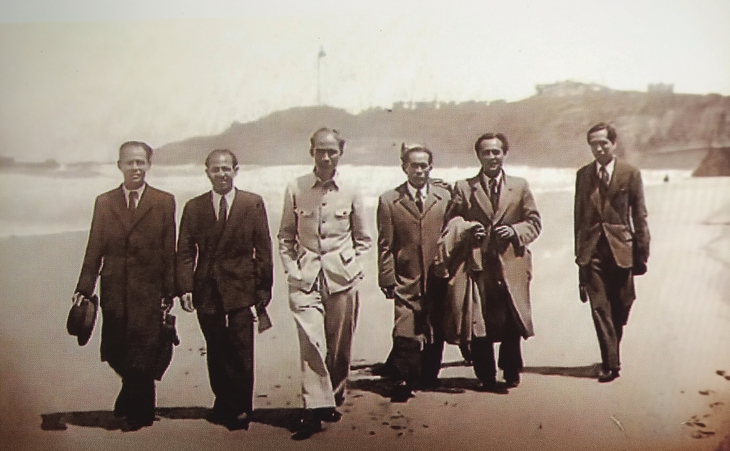
Mr. Vo Qui Huan (far right) accompanied President Ho Chi Minh's delegation to France in 1946 - Photo: GĐCC
40 years for a reunion.
In 1975, amidst the joy of national reunification and the reunion of North and South Vietnam, Mrs. Hoa Binh was filled with hope for her family's reunion. Searching through old documents, she discovered a collection of letters addressed to her father, bearing the name Irène—his French wife—and the address of Viet Nga.
Unable to speak French, Mrs. Hoa Binh asked a French teacher to write a letter for her, including photos of her sister Viet Nga as a child and photos of her siblings in Vietnam. She later received a reply from her sister Viet Nga, but it was a distant letter. "It's not easy for me to overcome the pain of the past to meet you all..." Reading those words from her sister, Mrs. Hoa Binh was saddened but did not give up her plan to meet her.
After getting married and having children, Mrs. Hoa Binh had her children learn French with the intention of giving them the opportunity to study in France later, hoping that this would give her a chance to find her older sister. Understanding their mother's feelings, the children all worked hard to support her in her search for her family.
Both her daughter and son went to France to study, and they all tried to contact their aunt through letters, but their dream meeting remained only a series of polite correspondence. While her children were studying in France, Mrs. Hoa Binh visited them, but each time she called to request a meeting, her sister refused.
In a reply letter to Mrs. Hoa Binh's daughter, Mrs. Viet Nga once again affirmed: "It would be very painful for me to reconnect with my family in Vietnam. I cannot do this because it causes me too much heartache."
"I really want to write to you occasionally. That's all!" Reading those words, her children advised Mrs. Hoa Binh to give up, because once the French don't want something, it's very difficult to change their minds; they highly respect privacy.
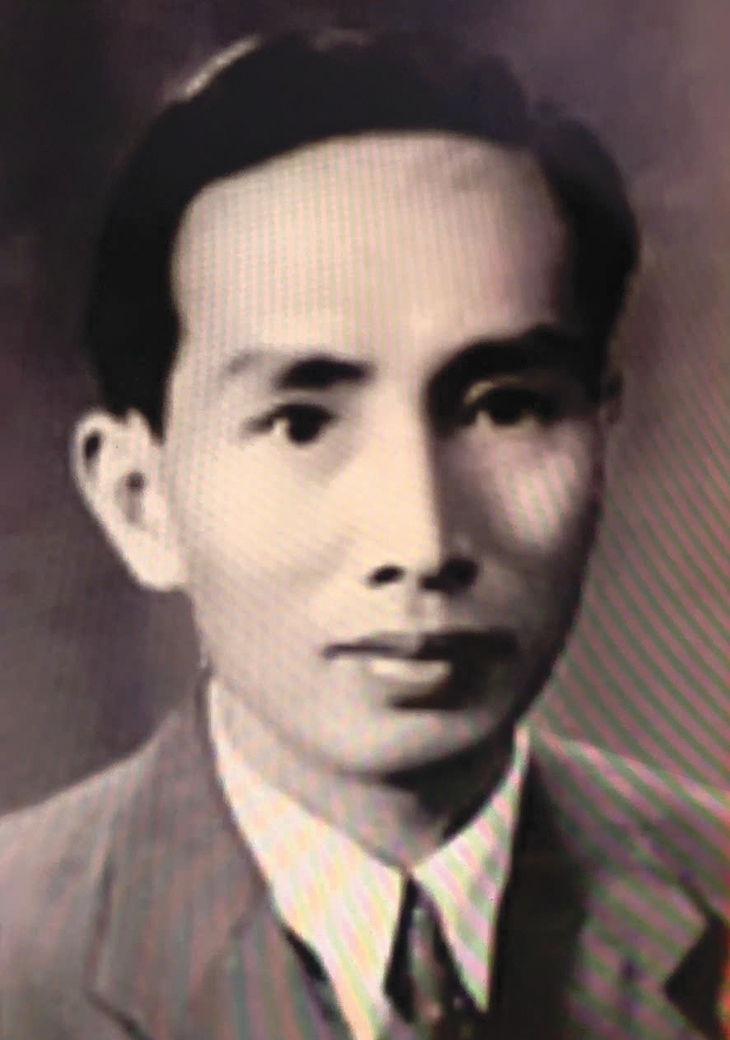
Mr. Vo Qui Huan - Photo: Director of the Department of Finance
But her father's heartfelt words from years ago echoed in her mind, making Mrs. Hoa Binh determined not to back down: "You know, for a two-year-old child, that promise is very important. And yet, I couldn't keep it, and I deeply regret it."
Irène never remarried, and your sister also had a very hard time without a father, only finishing high school, and her life after that was very difficult. Your father always lived with regret, feeling deeply guilty towards Irène and your sister. You must find her and your sister Việt Nga so that your father can rest in peace."
In October 2007, exactly 40 years after her father's death, Ms. Hoa Binh set foot in France for the fourth time. Her son was about to finish his studies and return home, so Ms. Hoa Binh considered this her last chance to go to France and decided to go find her sister without asking permission beforehand.
The mother and son made their way to the remote village 500km from Paris where Ms. Viet Nga lived. After much effort, they finally stopped in front of her sister's house. She sat in the taxi waiting for her son to arrive at the door and ring the doorbell, anxiously watching her sister come out. After a long moment of stunned silence, she invited her nephew inside.
At that moment, Mrs. Hoa Binh's son introduced his mother, who was sitting in the taxi. Mrs. Viet Nga was silent for a long time before finally agreeing to invite her sister into the house.
In the first moment of reunion, Ms. Hoa Binh rushed to embrace her sister, whom she had searched for for 40 years. After a few moments of intense emotion, she was allowed into a room filled with memories of her father. For years, her sister had cherished every photograph of their parents, every letter filled with love and the pain of a child burdened by the guilt of being abandoned by her father. Ms. Hoa Binh had finally touched the pain of her sister and her father.

Uncle Ho holding baby Vo Qui Viet Nga in July 1946 - Photo: GĐCC
Since then, Mrs. Hoa Binh has visited her sister once a year, bridging the gap of distance with letters. In one letter, Mrs. Viet Nga expressed her gratitude to her sister and nieces for their patience in searching for her.
She thanked her sister for her wise decision, because thanks to it, her lonely soul was warmed and brightened again, allowing her to receive so much love from her Vietnamese family. From a withdrawn person, Viet Nga now receives all the love from her siblings, nieces and nephews, and even from her second mother, her father's Vietnamese wife.
During the family reunion, Mrs. Hoa Binh was the happiest person. Not only did she find her father's daughter, but she also continued to do many things for her father, who was deeply devoted to his country but unfortunately passed away prematurely. For many years, she traveled to meet her father's friends, colleagues, and students to reconstruct his life of contributions and sacrifices so that future generations could understand them.
In his grief, he held his little daughter's hand and entrusted her with his wish: "When you have the opportunity, you must find your sister. You must love, help, and support each other. I am very sad that I couldn't take care of and look after your sister more. It was only because of the war that I had a responsibility to help the country. When you meet your sister later, tell her that I miss and love her very much…"
"Dad worked so hard, didn't he?" Hearing her sister's question, Mrs. Hoa Binh was moved to tears. She understood that with that question, her sister had expressed her understanding of their father's choice to serve the country years ago, letting go of resentment and healing her emotional wounds. Finally, she was able to erase the deep wound in her sister's heart.
Source: https://tuoitre.vn/40-nam-tim-con-gai-cho-cha-20260202174615637.htm







![[Photo] A large number of people offer incense and visit the Ho Chi Minh Memorial Church.](https://vphoto.vietnam.vn/thumb/1200x675/vietnam/resource/IMAGE/2026/02/21/1771668099014_ndo_br_12-resize-7721-jpg.webp)


































Comment (0)