6 million fake GitHub stars create a "gold mine" for AI fundraising.
Millions of "fake stars" on GitHub are being exploited to inflate the popularity of AI startups, helping them raise tens of millions of dollars in funding without anyone being held accountable.
Báo Khoa học và Đời sống•13/05/2026
GitHub has long been considered a "measure of credibility" in the programming world, where a higher star rating means a project is more famous, more likely to trend, and more attractive to tech investors. However, a new study reveals that behind those glamorous numbers, there exists a multi-million dollar underground economy involving the buying and selling of fake stars for AI and blockchain startups. According to research presented at the ICSE 2026 conference by scientists from Carnegie Mellon University, North Carolina State University, and the security company Socket, approximately 6 million fake accounts were created on GitHub between 2019 and 2024, directly impacting over 18,600 repositories and involving around 301,000 different accounts.
The research team used the StarScout tool to scan up to 20 terabytes of GitHub data, equivalent to 6.7 billion events and 326 million star ratings, thereby discovering that manipulation has been rampant since 2022 when AI startups began their race to raise billions of dollars globally.
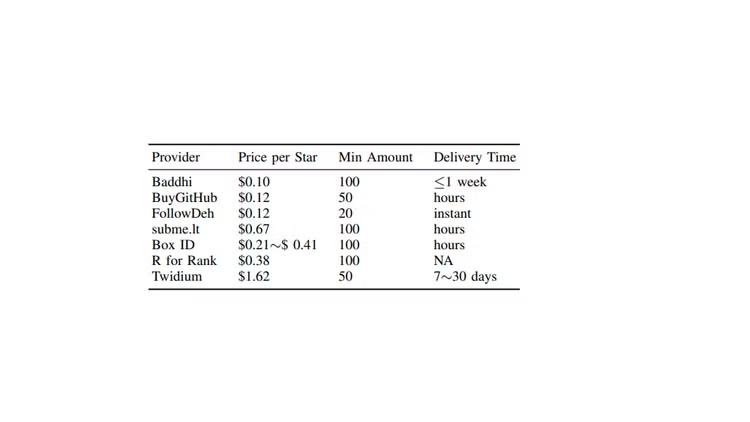
It's noteworthy that the GitHub star trading market now operates as a full-fledged service industry, with many websites openly selling stars for as little as $0.03 per star, while "premium" packages using long-standing accounts with genuine activity history are sold for nearly $1 per star to avoid detection and deletion by GitHub.
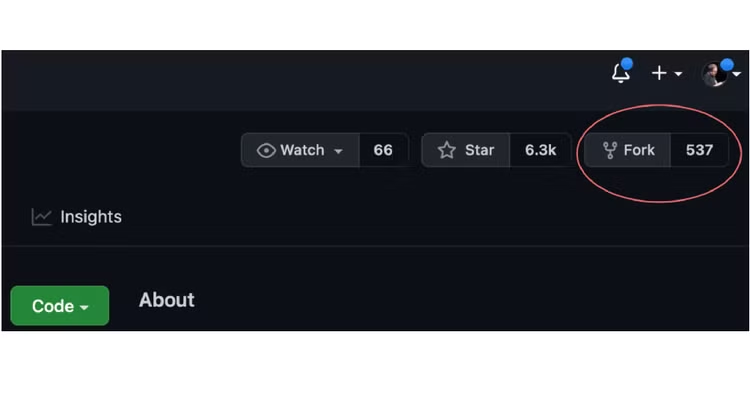
According to venture capital funds in Silicon Valley, the number of GitHub stars has now become a key growth indicator for evaluating AI startups, leading many companies to be willing to spend a few hundred dollars buying fake stars to create the illusion that their project is attracting strong interest from the programming community before approaching multi-million dollar funding rounds. The study also points out that a number of well-known AI startups such as Lovable, Browser-use, and LangChain experienced extremely rapid growth in GitHub star ratings before successfully raising large investments, with one startup reaching a valuation of up to $1.8 billion shortly after entering the AI generation market. Experts say that signs of repositories using fake stars often include an unusually low fork rate, a large number of accounts with no followers, no dedicated repository, or almost no activity history, indicating that many "stars" are actually fake interactions aimed at manipulating GitHub's recommendation algorithm.
Although GitHub has begun deleting numerous accounts and repositories related to fraudulent activity, and the US FTC has tightened regulations on the buying and selling of fake influencers on the internet, there have been almost no criminal prosecutions directly related to the practice of buying GitHub stars for fundraising, leaving the underground economy behind the AI craze still thriving.




 Báo Khoa học và Đời sống•13/05/2026













![[GALLERY] The super-cheap Claude AI API turns out to be selling user data.](https://vphoto.vietnam.vn/thumb/402x226/vietnam/resource/IMAGE/2026/05/25/1779691077049_cl-6-png.webp)

























































































Comment (0)