


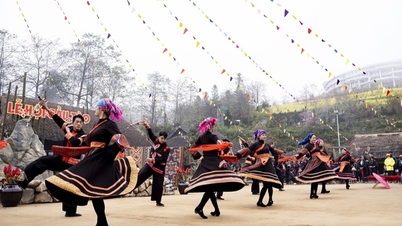
Welcoming us in the courtyard of the longhouse were J'rai men in traditional attire, wearing loincloths but revealing their strong legs. The rhythmic beat of gongs echoed loudly…
It must be said that when the J'rai people hold a festival, it's a celebration of the arrival of spring. And this was the first time we were welcomed in the atmosphere of a real festival, so everyone felt emotional and excited.
After the rituals were completed, the village chief briefly announced, "Now, please join the group for a meal with the villagers." Following this simple but heartfelt announcement, the feast was immediately served.
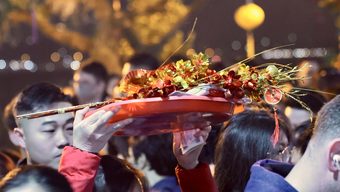
The "feast table" was divided into two areas with a huge jug of rice wine placed in the middle. The women of the village cooked the feast at their homes and then helped each other carry out the "trays." These were large bamboo trays, about one and a half times the size of a regular aluminum tray, and in each tray were about 10 neatly wrapped and tightly sealed packages of leaves.
 |
| Join us for a J'rai feast with traditional dishes. |
Y Chua, the leader of the gong ensemble in Treng village, a man of few words, respectfully invited the guests and villagers to sit down and join the meal. His gesture was sincere and simple, as the host had no intention of arranging seating for the guests.
Both guests and hosts sat down after choosing a suitable seat for themselves. Of course, the men preferred to sit together. The women did the same, sitting side-by-side as if they were holding hands and dancing together.
Each bundle of leaves was opened, revealing food inside; each bundle contained a different dish, the green of the leaves creating a feast that felt close to nature and plants. I leaned closer to artisan H'Uyên and whispered, "How is life for your people?" The beautiful J'rai girl, radiant like the moon, smiled and said, "Our people mainly work in the fields, and we still cultivate rice paddies. Families also raise buffaloes, cows, pigs, and chickens. Buffaloes, in particular, are considered valuable in the exchange of precious items like gongs and jars."
After finishing the glass of wine she had offered me (a fragrant and delicious wine distilled by the locals), I asked, "How do you all eat and live your daily lives?" H'Uyên smiled and replied, "We mainly eat rice, with corn as a side dish. Our food includes various vegetables like bitter eggplant, gourd flowers, sweet potato leaves, bitter wild herbs, bamboo shoots, chili salt… Whatever grows in the garden or on the fields, we eat. As for meat, we have chicken, pork, and fish. There's a wide variety of everything."
The festivities were warm and convivial. The J'rai men ate and drank quite slowly, pouring distilled liquor into cups and offering it to each other, but only with encouraging glances. Occasionally, a couple would stand up and walk to where the rice wine jug was placed. A small bamboo stick placed horizontally across the jug served as a ruler; it would "honestly" indicate who was sucking on the end of the jug without drinking, because if they weren't sucking, the bamboo stick would tilt to one side.
I and artisan Y Chua drank rice wine together. I asked, "How do you know if the bamboo stick will be balanced?" Artisan Y Chua replied, "Coming together to drink rice wine is a matter of mutual understanding and honesty. Drinking together is what makes it fun and strengthens unity." Indeed, the J'rai people don't hide anything from each other, they don't lie to one another. If it's fun, it's just fun.
 |
| Gongs are played to welcome guests to the village. |
Although the J'rai community here is still poor, they live with great kindness and hospitality. They welcome honored guests with their special dishes, some with spicy and some with bitter flavors, such as cassava leaves, bitter eggplant, male papaya flowers, green chili peppers, and wild bamboo shoots.
I suddenly remembered what Mr. Nguyen Huy Dung, a former cultural officer of Ea H'leo district, once said: "The leaves of cultivated or wild plants are used by the people as everyday dishes; they are the soul of the culinary culture, present in communal meals or family dinners regardless of wealth or poverty. This dish, for those unfamiliar with it, is very difficult to eat because it is both spicy, bitter, and has a pungent taste."
I picked up a handful of cassava leaves and put them in my mouth. I chewed slowly and swallowed. A wave of nostalgia washed over me. When we were stationed on the border, having boiled cassava leaves to eat was a great joy. On days when we were feeling particularly well-off, we would boil the cassava leaves, let them cool slightly, then squeeze out the excess water, chop them finely, and make a cassava leaf salad that tasted as delicious as water spinach salad.
Occasionally, we would ask the villagers for a lot of cassava leaves and pickle them. Pickled cassava leaves have a sour and slightly chewy taste that our soldiers absolutely loved. Now, being able to "eat" that cassava leaf dish again, I feel a pang of nostalgia.
This time, H'Uyên didn't offer me a glass of wine; instead, she pointed to other dishes. There was stir-fried male papaya flowers, which had a slightly bitter taste at first, but a sweet aftertaste. Then H'Uyên introduced a dish with a fragrant roasted rice powder flavor. The J'rai girl said, "Roasted rice powder is almost an indispensable spice for the J'rai people. It's made from white rice, roasted until golden brown, then ground and stored in bamboo tubes for later use. The dish you just ate was mixed with roasted rice powder."
Then she added, "I heard that in the old days, when salt was scarce, people made their own kind of salt from mung beans by burning the mung bean husks, then filtering the liquid and using it as a substitute for salt."
The festivities seemed endless. The alcohol had taken effect, reddening the young women's faces and energizing the men's conversations. I had the pleasure of enjoying many strange and interesting dishes. For example, the dish called "lap," which consists of lightly boiled and minced pork, along with cleaned and separately boiled and chopped pork offal, mixed together with roasted rice powder, raw blood, chili peppers, salt, lemongrass, scallions, coriander, and finally, lime juice.
The J'rai people's sticky rice cooked in bamboo tubes is both chewy and fragrant. It is known that to make this dish, the locals meticulously select small bamboo stalks, meaning those that are just the right age – not too young and not too old. The "nham pung" soup, a dish often served at festivals, is prepared more elaborately. The soup contains taro, jackfruit, papaya, green squash, rattan shoots, banana blossoms, along with beef bones, pork bones, and rice.
The rice is soaked for about 30 minutes, drained, pounded into flour, and then mixed with other spices such as salt, chili, onion, and garlic. H'Uyên explained: "Nham pung is a dish that everyone, young and old, male and female, can eat. J'rai women put almost all their heart into this dish during important family, clan, and village festivals."
Night had fallen over the village of Treng. The longhouse seemed to stretch even wider in the pervasive atmosphere. The artisan Y Chua came to me again, inviting me to share a cup of rice wine. After an encouraging wink from the renowned gong-playing artisan, I put the straw to my lips and took a long sip. The wine, or the essence of the mountains and forests, seemed to permeate me…
Nguyen Trong Van
Source: https://baodaklak.vn/van-hoa-xa-hoi/van-hoa/202602/an-co-voi-nguoi-jrai-d01341f/





























































Comment (0)