

A team of Chinese researchers has developed a cloaking material that combines characteristics of geckos, glass frogs, and bearded dragons.
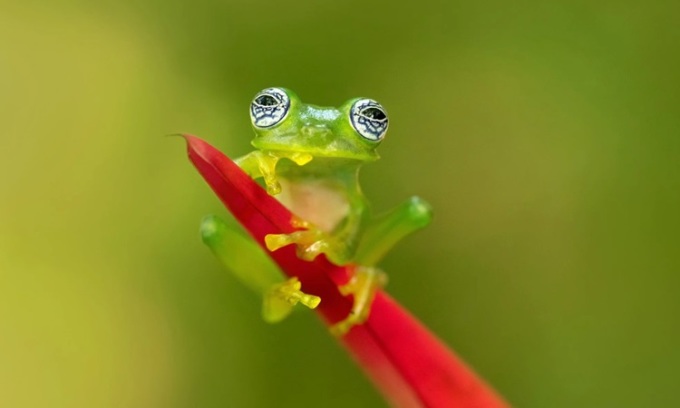
Glass frogs are one of three species that inspired the research. Photo : iStock
Inspired by the chimera monster of Greek mythology, Chinese researchers have combined characteristics of three cold-blooded animals—geckos, glass frogs, and bearded dragons—to create a hybrid material that could make invisibility cloaks a reality, the Times of India reported on January 30. The research team, from Jilin and Tsinghua Universities, said they designed a prototype based on the unique natural survival tactics of each animal species, making it undetectable by microwaves, visible light, and infrared spectrum.
In a study published on January 30 in the journal Proceedings of the National Academy of Sciences , researchers shared that they used a bioengineering-based approach to the current camouflage problem: a lack of flexibility across diverse terrains. "Our work transforms camouflage technology from a situational, limited environment to a changing terrain, representing a major step toward next-generation electromagnetism," the team stated.
The research is based on recent rapid advances in metamaterials and composite fibers with unique electromagnetic wave manipulation capabilities, increasingly applied to stealth technology. Through precise control of surface structure, metamaterials can reflect electromagnetic waves in a specialized way, making objects invisible to radar. However, their intended function only provides camouflage in certain environments.
Chinese scientists are aiming for a metamaterial that can adapt to diverse spectral conditions and terrain while maintaining evasiveness against visible and infrared light. They call this metamaterial Chimera, named after the creature composed of three different animals, because it integrates the color-changing characteristics of a chameleon, the transparency of a glass frog, and the temperature regulation of a bearded dragon.
Lead researcher Xu Zhaohua from Jilin University revealed that their initial inspiration came from geckos, lizards known for their ability to change color and skin tone. The Chimera metamaterial mimics geckos by adjusting its microwave reflectivity to blend into different landscapes, from water surfaces to grasslands. The Chimera's design was also influenced by the glass frogs that live in the rainforests of Central and South America, which hide most of their blood in their livers while sleeping, making their bodies transparent. The researchers embedded Chimera's electrical circuitry between layers of PET plastic and quartz glass to achieve a similar level of optical transparency to the glass frog's natural camouflage properties.
The research team faced the challenge of how to hide the heat generated by the electrical circuits on the surface of the metamaterial, which could be detected by infrared detectors. To solve this problem, the scientists relied on bearded dragons in Australia. This reptile regulates its body temperature by changing the color of its back, from pale yellow when it needs to cool down to dark brown to stay warm.
Using a mechanically controlled design, the research team minimized Chimera's temperature difference to 3.1 degrees Celsius, a level undetectable by thermal imaging technology in various terrains. By mimicking how bearded dragons react to their natural environment, the Chimera metamaterial can reduce the likelihood of it being detected by remote thermal detectors.
According to the research paper, a prototype version of the Chimera metamaterial was developed using a five-step process, starting with a pattern on plastic, followed by creating a metal mesh, and ending with manual assembly to achieve multispectral invisibility. The research team stated that the potential applications of the new technology are broad, ranging from military use to wildlife conservation. In the military , Chimera could provide a significant advantage, allowing soldiers or objects to blend into diverse environments while avoiding detection by cameras, infrared detectors, and optical devices. The technology could also facilitate non-invasive observation of animals in their natural habitats. By minimizing human impact on wildlife, Chimera could contribute to conservation efforts.
An Khang (According to Times of India )
Source link

![[Photo] Prime Minister Pham Minh Chinh receives the Chinese Ambassador to Vietnam](https://vphoto.vietnam.vn/thumb/1200x675/vietnam/resource/IMAGE/2026/04/05/1775397481797_ndo_br_dsc-5512-jpg.webp)








































































































Comment (0)