

After hitting a low of nearly $64 per ounce on February 6th, silver prices rebounded strongly, at one point soaring to $96 on March 2nd. However, this recovery is showing signs of weakening as several key market indicators begin to turn unfavorable.
From a technical perspective, the upward movement of silver from the beginning of February to the present has mainly been within an ascending channel formed inside a larger downtrend that began after the metal reached its all-time high of nearly $121/ounce at the end of January. In technical analysis, ascending channels appearing within a downtrend are often considered continuation patterns, reflecting temporary rallies before the price returns to its original downtrend.
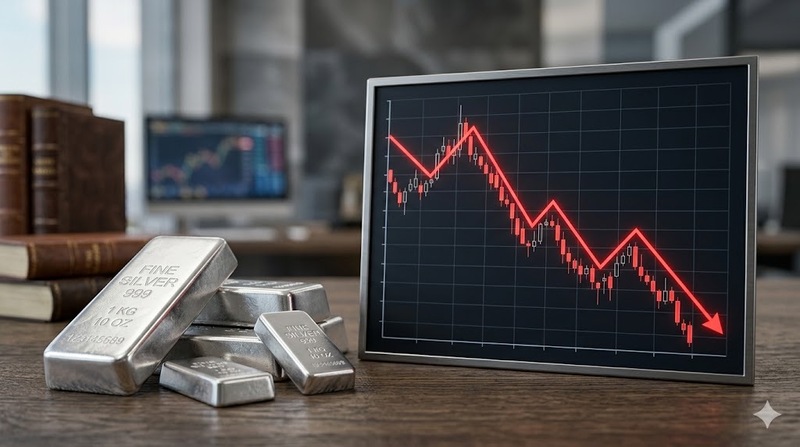
From technical fluctuations and the gold-silver ratio to pressure from oil prices and the US dollar, the price of silver has declined.
In fact, less than a week after peaking at $96, world silver prices plummeted by nearly 17%, falling to around $79 before recovering. Although the $79 level, the lower boundary of the uptrend channel, was successfully tested, this sharp and rapid decline shows that selling pressure is still fiercely defending the upper resistance area.
Currently, silver is trading around $85 per ounce, near the middle of the price channel. However, several macroeconomic factors are gradually putting pressure on this technical structure, increasing the risk of the upward channel being broken in a downward direction.
The gold-silver ratio has reversed, signaling a shift of capital away from silver.
One notable indicator comes from the gold/silver price ratio, an index reflecting the number of ounces of silver needed to buy one ounce of gold. Recently, this ratio has been forming an "inverse head and shoulders" pattern on the daily chart, a technical pattern that often signals an uptrend.
If the gold/silver ratio surpasses the trigger level around 62, the index could advance to the 65 and even 73 regions according to extended Fibonacci levels. This means gold is likely to outperform silver in the near future, reflecting a trend of capital shifting towards safer-haven assets.
This development typically occurs when the market is concerned about the economic growth outlook, because silver is closely linked to industrial production while gold is primarily considered a safe-haven asset.
Rising oil prices are putting double pressure on the silver market.
Besides technical factors and capital flows, the silver market has also been significantly impacted by the sharp rise in energy prices. Brent crude oil prices have increased by approximately 31% in just one month, approaching the $100/barrel mark, thereby creating numerous ripple effects on financial markets.
First, high energy prices increase global inflation expectations, thereby supporting the strength of the US dollar. A stronger dollar typically puts downward pressure on the prices of commodities priced in USD, including silver.
Secondly, inflationary pressures make the likelihood of the Federal Reserve (FED) cutting interest rates anytime soon less certain. The weakening expectations of monetary easing also diminish a key driver that had supported the recent rally in precious metals.
Furthermore, rising energy costs are raising concerns about the outlook for global industrial production. This is particularly important for silver, as approximately 60% of the world's silver demand currently comes from industrial applications.
Large amounts of money have not yet returned to the silver market.
Derivative market data also shows that large capital flows have yet to return to silver. According to the Commitment of Traders report published by the US Commodity Futures Trading Commission, the total number of open contracts on the COMEX silver market decreased by more than 12,000 contracts, to approximately 113,000 contracts as of early March.
Notably, this decline occurred precisely when silver was trading near the $96 mark, suggesting that the price increase at that time was largely driven by the closing of previous short positions, rather than new buying from large investors.
Hedge funds and non-commercial traders currently hold only about 23,000 net long contracts, significantly lower than the nearly 45,000 contracts recorded by mid-2025. According to StoneX data, the group's total long position is currently at its lowest level in 13 years.
The performance of ETFs also reflects a similar cautious sentiment. The world's largest physical silver ETF, iShares Silver Trust (SLV), has seen net outflows of approximately $1.18 billion over the past month, even though silver prices have risen slightly during the same period.
The combination of three factors—decreasing open interest, the absence of a backwardation in the market, and capital outflows from ETFs—suggests that the recent silver rally still lacks the support of institutional money.
Against this backdrop, the US dollar is emerging as a key variable that could determine the next direction of silver prices. The USD Index (DXY) is currently fluctuating around 98.65 and remains within a downtrend channel after a sharp surge in early March.
The key technical resistance levels for this index are located at 99.07, 99.61, and 100 points, respectively. If the DXY breaks above 99.61, pressure on silver prices could increase significantly.
Technically, the $91 level is currently considered the nearest resistance for silver, while $96 is the level to overcome for a clearer uptrend confirmation. Conversely, the $82 level acts as the first support. If this level is breached, silver prices could retreat to $74 before testing the $67 level, which many analysts consider the "critical boundary" of the long-term trend.
In a more negative scenario, if the price breaks below $60, the market could even see silver fall further to the $51 area.
Overall, most market signals still lean towards an unfavorable scenario for silver. With the gold-silver ratio trending upwards, institutional capital not yet returning, and pressure from oil prices and the US dollar still present, the recovery of this metal faces many challenges in the coming period.
Source: https://congthuong.vn/ba-tin-hieu-khien-gia-bac-lao-doc-446936.html
![[Photo] The courage of new recruits of Brigade 144 on the training ground.](https://vphoto.vietnam.vn/thumb/1200x675/vietnam/resource/IMAGE/2026/05/27/1779881651341_anh-man-hinh-2026-05-27-luc-18-32-52.png)
![[Photo] The heat at the fireworks display site on the opening night of the Da Nang International Fireworks Festival 2026](https://vphoto.vietnam.vn/thumb/1200x675/vietnam/resource/IMAGE/2026/05/27/1779889741485_ndo_br_z7872039145157-fecaba5112f39e8352544099d7ef4738-5140-jpg.webp)































































![[Photo] The courage of new recruits of Brigade 144 on the training ground.](https://vphoto.vietnam.vn/thumb/402x226/vietnam/resource/IMAGE/2026/05/27/1779881651341_anh-man-hinh-2026-05-27-luc-18-32-52.png)






























Comment (0)