

Indeed, for people in the East, including Vietnam, with our traditional village culture, setting a good example plays an extremely important role. This is especially true for those in leadership positions. The higher the position and the greater the power, the wider the influence and guidance their actions and ethics have on the community.
Understanding this, in his introductory lecture to revolutionary cadres in Guangzhou in 1927, it was no coincidence that Nguyen Ai Quoc (Ho Chi Minh) demanded that future leaders possess strong character, including the ability to effectively manage three relationships: self-care, relationships with others, and relationships with their work. That is, regarding oneself, one must avoid arrogance, self-importance, and complacency; one must be patient, hardworking, and self-sacrificing. Regarding others, one must always maintain a sincere, honest, approachable, humble, united, tolerant, and magnanimous attitude. Regarding work, one must carefully consider the circumstances, be dedicated and enthusiastic, decisive, courageous, and obedient to the organization. By doing these three things well, the cadre truly becomes a good role model for the masses to follow.
Uncle Ho taught us, "Actions speak louder than words," and looking back at his 79 years of life, we see that his entire life set an example of lifelong struggle and sacrifice, maintaining a pure and upright character, and remaining loyal to the country and devoted to the people. In his childhood, he was a good son and an excellent student. During his years of wandering abroad in search of a way to save the country, he immersed himself in the lives of international working people, without distinction of skin color or ethnicity, enthusiastically studying, working, intelligently and creatively, and living sincerely with his friends... earning the respect of everyone.
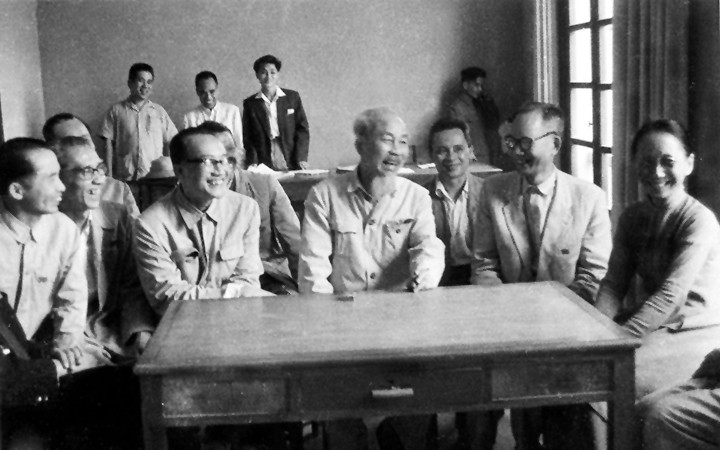 |
| President Ho Chi Minh speaking with intellectual delegates of the 3rd National Assembly. |
Upon discovering communism, he creatively absorbed its best aspects and intelligently found a suitable path to spread it back to Vietnam: combining patriotism with the workers' movement and communism. Then, when history demanded it, he used his personal prestige to convene a meeting to unify the three communist organizations, establishing the Communist Party of Vietnam .
In 1930, at the Party's founding conference, when he proposed the strategy of winning over the small and medium-sized propertied class during the national liberation struggle (a strategy that was only deemed correct at the 8th Central Committee Conference in May 1941), he was deemed a right-wing error by his superiors, the Communist International, and some comrades within the Party. Faced with this situation, despite being right but misunderstood, he patiently endured, strictly adhering to the principle of democratic centralism, and refraining from propagating or speaking against the resolution.
From the day of the nation's declaration of independence until his passing, in his capacity as Chairman of the Party and President of the country , at the pinnacle of power, he always maintained his moral character and kept himself exceptionally pure.
According to those who assisted him, whether in the Viet Bac War Zone or at the Presidential Palace (Hanoi), he maintained a regular and scientific lifestyle and work routine: waking up early in the morning and not going to bed too late at night. He regularly exercised in a way that suited his health. His secretary, at his request, still scheduled a packed daily schedule of work, meetings, and guest receptions. Even many meals, seemingly private, turned into intimate and memorable gatherings.
The inscription written on the rafters by Deputy Scholar Nguyen Sinh Sac reads, "Do not adopt the style of an official's family as your own," meaning not to adopt the style of an official's family, intended to admonish his children not to learn the arrogance and authoritarianism of officials, but to maintain the simple and modest lifestyle of their family. His three children strictly followed this advice. Our President Ho Chi Minh was always humble, learned, lived harmoniously with his colleagues, and was always ready to help others. He is a prime example of lifelong learning. His purpose in learning was exactly as he wrote in the golden notebook of the Nguyen Ai Quoc Central School in 1949: "Learn to work, to be a good person, to be a good cadre. Learn to serve the Party, to serve the class and the people, to serve the Fatherland and humanity."
As a high-ranking official, Uncle Ho set an even greater example of adhering to laws, regulations, and rules. In the early days of the revolution, when the entire population was starving, he called for people to fast for one meal every ten days, donating the resulting rice to the famine relief fund. On one occasion, while his office was fasting, he was invited to a meal hosted by General Xiao Wen of Chiang Kai-shek's army. He resolutely decided to make up for it by fasting himself the following day. His bodyguards recounted an incident where, while he was driving in a crowded street, a security guard tried to approach and ask the traffic controller to prioritize his car. Uncle Ho stopped him, saying, "Let him manage things according to his duty."
President Ho Chi Minh always taught cadres and the people to combat individualism. Throughout his life, he strictly avoided self-aggrandizement and adoration. In 1969, the Politburo met and passed a resolution on organizing four major holidays in 1970: the founding of the Party, National Day, Lenin's birthday, and President Ho Chi Minh's birthday. He only agreed to three-quarters of the resolution. He did not agree to include May 19th as a major anniversary in the following year...
President Ho Chi Minh's exemplary conduct encompassed everything from major matters such as adhering to the Party's guidelines, policies, regulations, and the State's laws, as well as collective rules and regulations, to ordinary daily activities like eating, living, dressing, and using transportation... all of which occurred naturally, regularly, without exaggeration, and simply, reflecting his inherent life. Given the immense significance of exemplary conduct in building a clean and strong Party, and fulfilling its tasks, the Party has always emphasized the role of exemplary conduct among cadres and Party members, especially leaders at all levels. This is a correct solution and also an urgent requirement in the current situation. We believe that every cadre and Party member will learn from and follow the thoughts, ethics, and style of Uncle Ho. They will consciously learn, self-reflect, self-correct, fulfill their responsibilities as Party members, and set a shining example for their families and the people to emulate.
Source: https://www.qdnd.vn/chinh-polit/cac-van-de/bac-ho-voi-van-de-neu-guong-1040197





























































Comment (0)