

Ensure adequate infrastructure and human resources.
To facilitate the implementation of administrative procedures in the digital environment, the Department of Science and Technology has configured electronic processes for 2,044 procedures; of which 896 procedures provide fully online public services, while the rest are partially online. All are integrated into the National Public Service Portal. The Department also organized training courses on the implementation of electronic administrative procedures for 99 communes and wards, ensuring that 100% of commune-level authorities are familiar with the process of receiving, resolving, and digitizing documents.
 |
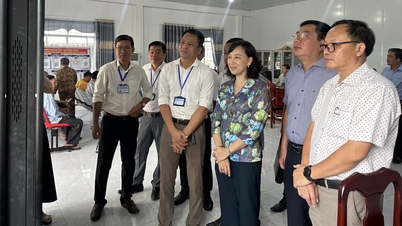
Officials from Tan Tien ward assist residents in filling out application forms. |
The Provincial Public Administrative Service Center serves as both the central point for receiving administrative procedure applications from departments and agencies, and directly guides communes and wards in implementing the one-stop and integrated electronic one-stop service mechanisms. Immediately after establishing its structure, the Center organized training for all 99 communes and wards on the process of resolving administrative procedures according to the two-tiered local government model; simultaneously, it coordinated the management, operation, and upgrading of the province's administrative procedure information system. The Center also closely collaborated with relevant departments and agencies to implement the "5 steps in an electronic environment" and "5 on-site" administrative procedure resolution models, maximizing convenience for citizens and businesses. From July 1st to the present, the unit has received over 30,000 applications, with the online application rate reaching 99.6%. This result was achieved thanks to the synchronized efforts from the provincial level to the grassroots level. At the Department of Agriculture and Environment, in July 2025 alone, the rate of online applications reached 99% out of a total of over 12,500 applications received. The Department of Internal Affairs also processed 100% of over 3,100 applications online during the month.
At the commune level, public administrative service centers have staff and youth union members on duty to guide and assist citizens and businesses with online procedures. Mr. Giap Van Quy, Vice Chairman of the Tan Tien Ward People's Committee, said: “The ward has mobilized the entire political system and community digital technology groups. At the same time, we are improving the quality of our professional staff, providing hands-on guidance. For example, the ward is currently implementing a campaign to receive applications for special social assistance benefits for over 2,700 people. To ensure timely processing, assigned staff are assisting with online application submission. As a result, many people have changed their perceptions and habits. Mr. Dao Van Tuan, from Xuan Dong residential group, was initially unfamiliar with the online process when registering his child's birth, but after just a few minutes of guidance from staff on logging in and filling out the form, his application was successfully accepted. Mr. Tuan said: “Seeing how quick and convenient it is, I will proactively learn how to do other administrative procedures online in the future.”

Diverse forms of support
Besides the positive results, authorities at all levels also face many difficulties in moving towards receiving and processing all administrative procedures electronically. These include network congestion when many transactions are simultaneously conducted on the National Public Service Portal; the transmission system in some communes and wards does not meet the requirements; digital capacity and the habit of using online public services are still limited; some dossiers require many documents, and in many cases, information is repeated while the verification steps are not standardized... With a determination to comprehensively transform digitally, on August 7th, the Chairman of the Provincial People's Committee issued a document launching a movement to support people in carrying out administrative procedures online at their place of residence. Agencies, units, and localities are required to clearly define the objectives, target groups for support, work content, implementation time, and appropriate personnel deployment plans. In particular, flexible forms such as support in residential areas, public places, working outside of office hours or on Saturdays and Sundays are encouraged; Priority should be given to the elderly, vulnerable groups, and those who do not have access to information technology.
| Regarding the percentage of administrative procedures processed online throughout the entire process, Bac Ninh province aims to reach over 70% by the end of 2025 and over 100% by the end of 2030. |
It is expected that by 2025, 100% of commune and ward People's Committees will have at least one support point for citizens outside of regular working hours. Support methods will also be expanded, not limited to fixed points, such as: volunteer officials and civil servants can directly guide neighbors and acquaintances in the community or provide remote support via phone, Zalo, and social media. The police force will coordinate to support level 2 electronic identification.
Responding to this movement, the Youth Union of Bac Giang ward launched the "Youth Digital Technology Team" model with over 100 members, following the motto "going to every alley, knocking on every door, guiding each person." Over the past two weekends, the ward's Youth Union coordinated a peak period of support for residents in completing procedures to receive special social assistance benefits from the province at community cultural centers. The core members of the "Youth Digital Technology Team" are responsible for guiding residents in filling out and submitting online applications. Nguyen Duy Dat, a member of the team, shared: "I've learned more digital skills while contributing to helping people access online public services." In Tu Son ward, Phuc Hoa commune, and Canh Thuy ward, the authorities also arranged for overtime work to support residents in resolving administrative procedures.
According to the head of the Department of Science and Technology, in the coming time, specialized agencies of the province and the People's Committees at the commune level need to continue to promote the dissemination and guidance on using online public services, both fully and partially. They should strengthen support for people using electronic identification accounts (VNeID) when carrying out administrative procedures; maintain consultation channels via Zalo, fanpage, and digital platforms; and promptly address feedback and questions. The goal is to gradually change people's habits, shifting from submitting applications in person to online.

Regarding long-term solutions, provincial specialized agencies and commune-level People's Committees should promptly establish dedicated IT positions when restructuring civil servants after reorganization and mergers. Attention should be paid to investing in and upgrading infrastructure and network connections for wards and communes; strengthening training, guidance, and support activities. Maintaining the effective operation of the Technology and Professional Response Team is crucial to promoting interconnected, synchronized, rapid, and efficient digital transformation to meet the requirements of reorganizing the political system's apparatus.
Source: https://baobacninhtv.vn/bac-ninh-dua-dich-vu-cong-truc-tuyen-ve-tan-khu-dan-cu-postid424030.bbg





























































![[Video] Sunset at Lap An Lagoon – Where the sun sets over the fishing nets](https://vphoto.vietnam.vn/thumb/1200x675/vietnam/resource/IMAGE/2026/05/31/1780192137701_beach-landscape-sea-water-nature-grass-745871-pxhere-com.jpeg)

































Comment (0)