

Resident doctors study and work at the hospital.
In Vietnam, the residency program has existed since 1974 ( Hanoi Medical University was the first training institution), standardized by Regulation 19/2006/QD-BYT, currently implemented in many medical schools, and is not a mandatory requirement for obtaining a medical license.
A residency program is a three-year postgraduate program involving study and work in tertiary hospitals, aiming to train specialists with high practical skills. Universities currently charge fees for residency training; there are no regulations regarding salaries for resident physicians. Tuition fees are determined by each institution; in public institutions, they typically range from tens of millions of dong to around 80 million dong per year; some specialized programs or private institutions may charge higher fees.
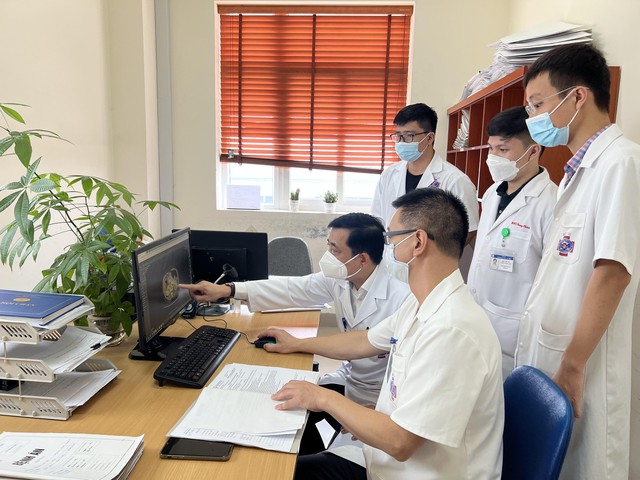
Resident doctors who study while also participating in medical examinations and treatment should be paid a salary (illustrative image).
PHOTO: TL
In other countries, residency programs are considered a specialized type of training or professional practice, rather than a purely academic program.
In the US, the average salary for a resident physician is approximately $60,000 - $70,000 per year (depending on the city and academic year).
In Europe, Japan, and other countries, the salaries of resident doctors are usually equal to or slightly higher than the basic salary of other trainees, but generally significantly lower than the average salary of specialist doctors.
Regarding the funding for resident physicians' salaries, in most developed countries it is legalized, and policies vary depending on the healthcare model of each country (whether public or private are the dominant factors in resident physician training).
In the United States, the primary source of funding for resident physicians' salaries is Medicare—the federal health insurance program.
Since 1965, Medicare has funded what is called the Medical Training Fund for hospitals that provide residency training. This fund consists of two components: direct payments for resident physicians' salaries and benefits, and training costs. In addition to Medicare, other sources of funding include Medicaid (state insurance), hospital-funded funding, or research/ educational funds.
In Europe, resident physicians are generally considered employees of public hospitals, with their salaries paid by the state budget or the public healthcare system.
In Japan, since the 2004 reforms, resident physicians have been considered full-time employees, receiving salaries from hospitals (mostly public hospitals), with funding provided by the government to the healthcare system.
Resident doctors need to be paid a salary, not tuition fees.
Resident doctors can be considered a valuable workforce for hospitals, assigned to participate in most inpatient treatment activities as well as some outpatient consultations and other hospital activities. They also participate in training medical students.
Therefore, resident doctors are both trainees and directly involved in medical care and treatment. In many countries, they do not have to pay tuition fees and also receive a salary and basic benefits, although the salary is usually a basic level, much lower than that of doctors who have practiced independently.
Vietnam needs to refer to advanced training models around the world regarding competency-based training, clinical supervision, patient safety assurance, and welfare for resident physicians, while flexibly adapting them to suit the practical conditions in the country.
Resident doctors should receive a minimum living wage, be guaranteed basic rights, and not have to pay tuition fees, in line with the work-study nature and the role of healthcare workers in hospitals.
Funding needs to be sustainably structured from the state budget, health insurance funds, and the participation of training institutions.
The participating training institutions also receive policy guarantees for revenue and support in this training activity.
Source: https://thanhnien.vn/bac-si-noi-tru-co-duoc-tra-luong-185251222213110376.htm
![[Photo] Prime Minister Pham Minh Chinh receives the Ministers of Foreign Affairs, Defense, and Public Security of China.](https://vphoto.vietnam.vn/thumb/1200x675/vietnam/resource/IMAGE/2026/03/16/1773659638054_ndo_br_dsc-4386-6157-jpg.webp)
![[Photo] Secretary of the National Assembly Party Committee, Chairman of the National Assembly presides over the fourth meeting of the National Assembly Party Committee Executive Board.](https://vphoto.vietnam.vn/thumb/1200x675/vietnam/resource/IMAGE/2026/03/16/1773656046264_ndo_br_bnd-0533-jpg.webp)
![[Photo] Prime Minister Pham Minh Chinh holds a phone call with Angolan President João Manuel Gonçalves Lourenço](https://vphoto.vietnam.vn/thumb/1200x675/vietnam/resource/IMAGE/2026/03/16/1773674632171_ndo_br_dsc-4772-jpg.webp)
![[Photo] Prime Minister Pham Minh Chinh presides over meetings of the Government Standing Committee to discuss several important issues.](https://vphoto.vietnam.vn/thumb/1200x675/vietnam/resource/IMAGE/2026/03/16/1773674631996_ndo_br_img-5789-jpg.webp)
![[Photo] General Secretary To Lam receives the Chinese Ministers of Foreign Affairs, National Defense, and Public Security attending the Conference on the “3+3” Strategic Dialogue Mechanism](https://vphoto.vietnam.vn/thumb/1200x675/vietnam/resource/IMAGE/2026/03/16/1773659640884_a1-bnd-0963-2144-jpg.webp)











































































Comment (0)