I was born and raised in the countryside, so I witnessed and know firsthand how long and arduous the process was, from the glutinous rice grain to the traditional Tet rice cake. The rice paddies with their thick, sturdy stalks and greener leaves were the "objects" of our children's attention during Tet. And that waiting seemed endless due to our hunger and lack of fun. Because of that hunger, when we passed by rice paddies with developing panicles, we would secretly pull out the panicles near the edge to eat. We also ate the panicles of regular rice, but the panicles of glutinous rice were noticeably tastier.
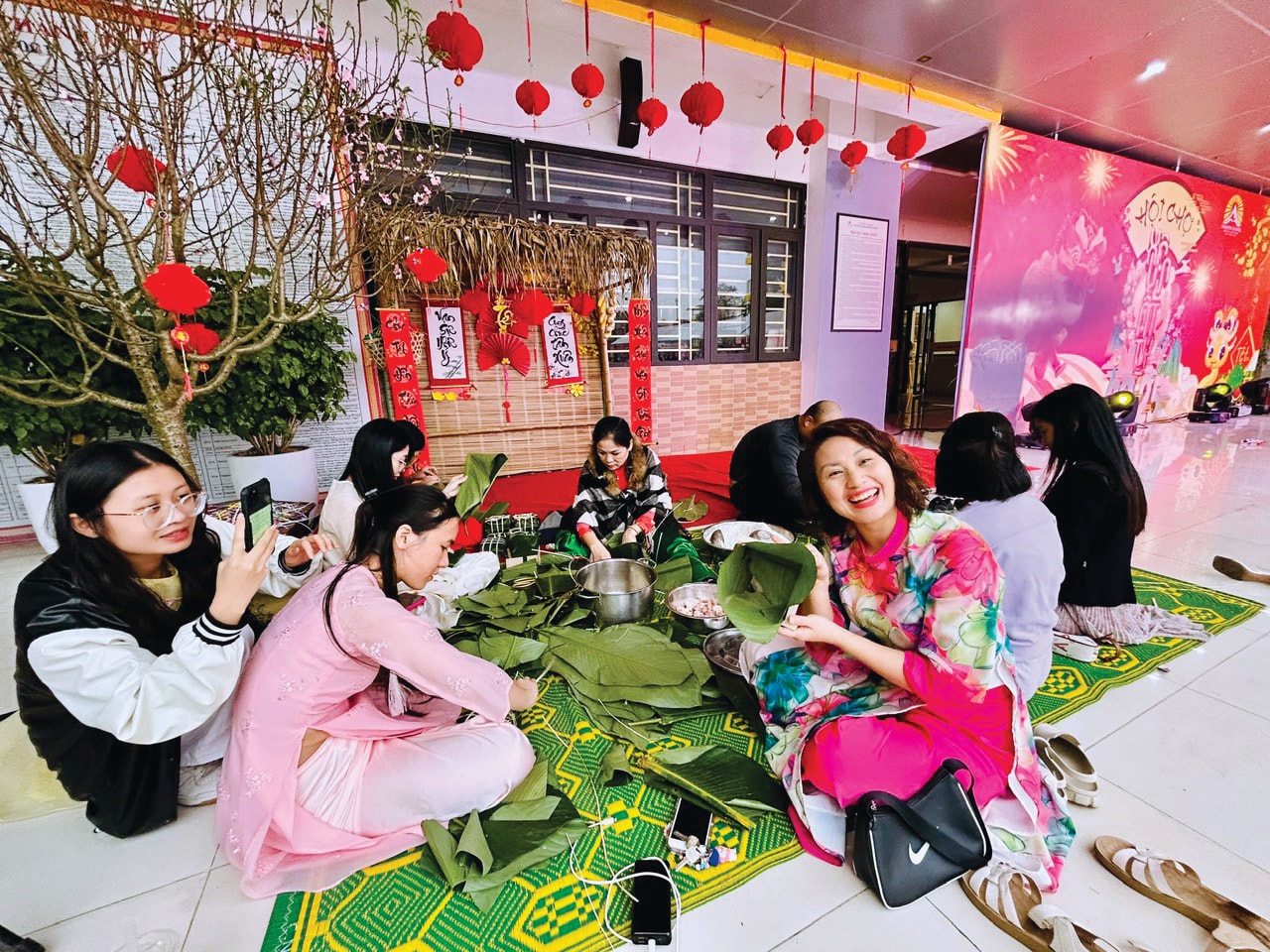
Glutinous rice takes considerably longer to grow than regular rice. It's said that this is why ancient Vietnamese people, and even ethnic minorities in mountainous regions, whose main food was glutinous rice or sticky rice, switched to regular rice because regular rice takes fewer days to grow and has significantly higher yields. Population pressure has changed dietary habits.
Glutinous rice, once ripe, is carefully stored and only milled when needed, and only used during Tet (Lunar New Year) and ancestral commemoration days. In those days, glutinous rice was associated with worship and rituals; it was considered "sacred." Only when our economy developed and hunger was no longer a haunting threat did glutinous rice, sticky rice, and banh chung (traditional Vietnamese rice cakes) become "de-sacred," as Professor Tran Quoc Vuong explains in his article "The Philosophy of Banh Chung and Banh Giay" (traditional Vietnamese rice cakes) in his book "In the Realm."
To make banh chung (Vietnamese sticky rice cake), besides growing sticky rice, people had to raise pigs, grow mung beans, and onions (in the past, families usually grew their own in a self-sufficient economy). They also had to worry about firewood. A large pot of banh chung had to be cooked continuously for dozens of hours, creating a huge problem with firewood. In the old rural areas, the saying "firewood is scarce" was absolutely true, given the cooking methods that relied on straw. Straw was basically useless for cooking banh chung because there was too little of it; how much could possibly be enough? Besides, no household had the strength to constantly add straw to the stove and remove the ash for dozens of hours like that. I don't know about other places, but in my hometown, a region between the plains and the midlands of Thanh Hoa, before the advent of coal for cooking, this problem had to be solved using bamboo stalks.
Months before Tet (Lunar New Year), people start digging up bamboo stumps. The bamboo stalks have been cut down, leaving mostly the stumps underground. They have to dig up the soil and cut off these dead stumps. It's not a simple task; you wouldn't know it unless you did it. The bamboo stumps are intertwined, tightly packed, and very hard. Therefore, only strong young men can do this arduous work. Hoes and shovels are only useful as they are not very helpful; those digging up bamboo stumps need shovels, crowbars, and hammers. They use shovels and crowbars to dig up the soil to expose the bamboo stumps, and then use hammers—specifically sledgehammers—to cut them apart. The work is so heavy that even farmers with calloused hands get blisters, sometimes even tearing skin and bleeding.
Once enough bamboo roots have been harvested, they must be stacked in a pile in the garden or yard so that the roots can air dry easily, making them suitable for burning and ensuring a good fire.
The making of banh chung (traditional Vietnamese rice cakes) takes place on a joyous day in the countryside, usually the 29th or 30th of Tet (Lunar New Year). It's the day of the pig slaughter. From dawn, the villages resound with the agonizing screams of pigs being butchered. Then comes the noisy chatter of scraping hair, butchering, making sausages, boiling offal, and dividing the meat among the families sharing one pig. Finally, the courtyards of each house are filled with the sounds of slicing, chopping, mincing, and pounding… And the last task is wrapping the banh chung.
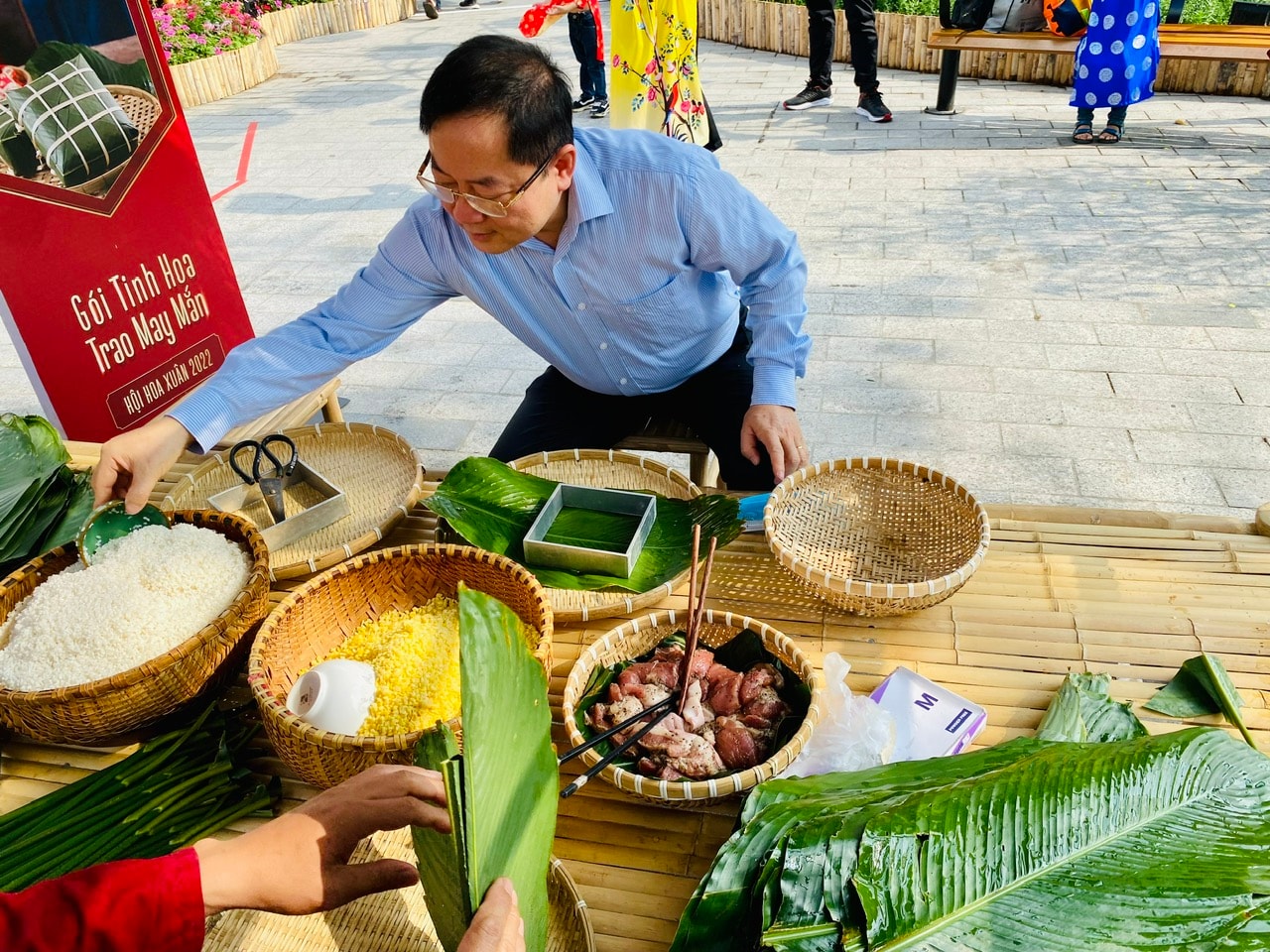
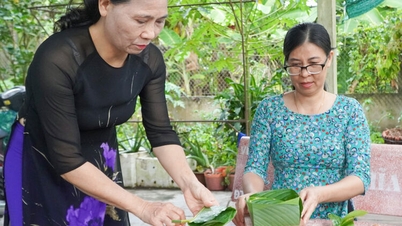
The rice is soaked and drained, the mung beans are washed and packed into handfuls, the banana leaves are washed, wiped, and dried, and the freshly received meat is selected, with both lean and fat, and cut into large pieces. The bamboo strips are either split young bamboo or, for a more luxurious option, peeled rattan. Skilled and experienced hands begin wrapping, while the children watch intently with wide eyes. First, the leaves are arranged, with the innermost leaves facing the green side (so that the outer layer of the rice cake will be green after cooking). A large bowl or cup (a large serving bowl) is used to measure the rice, which is then spread evenly. A handful of washed, golden-yellow mung beans is placed in the center, followed by one or two pieces of meat. More rice is added on top, and the leaves are folded in layers, carefully arranged to form a square, then tied with string, and arranged in rows on a mat. In many places, square molds are used to make the rice cakes look nicer. The glutinous rice can also be dyed with water from crushed rattan leaves or galangal leaves to give the cake a uniform green color from inside to out and a warm, fragrant aroma.
One of the reasons we kids used to gather around groups making banh chung (Vietnamese rice cakes) was that, in the end, the adults would often set aside some rice, beans, and meat to make a small cake for each of us. When boiled, these cakes cooked much faster, and we got to enjoy this sacred treat even before our grandparents and great-grandparents.
The finished glutinous rice cakes were placed in a very large copper pot, the largest size called the "thirty-pot" (size 30, the largest in the old copper pot system, starting from the clay pot to the second, third, and fourth pots...), then water was added and boiled. For adults, tending the pot of glutinous rice cakes could be tiring because they had to stay up all night (most glutinous rice cakes were cooked at night) to add bamboo sticks to the stove and add water when the pot ran low, but for us children, it was fun and very exciting. Excited because we knew that one day, our little glutinous rice cake would be taken out first. Usually, we couldn't wait for that glorious moment and would fall asleep; the adults would wake us up when the cakes were ready.
By morning, the huge pot of sticky rice cakes was fully cooked. The cakes were taken out, arranged flat on a large wooden board, then another board was placed on top, and two heavy stone mortars were placed on top of that. This was done to press the cakes, removing excess water and making them firm. Afterward, each cake was carefully shaped into a neat square. Some cakes, intended for offerings and worship, were wrapped in a layer of fresh dong leaves to keep them vibrant green. More elaborately, they were tied together with red-dyed string. The remaining cakes were strung together with string and hung from the kitchen rafters to allow for ventilation and prevent spoilage, so they could be eaten not only during Tet but for months afterward.
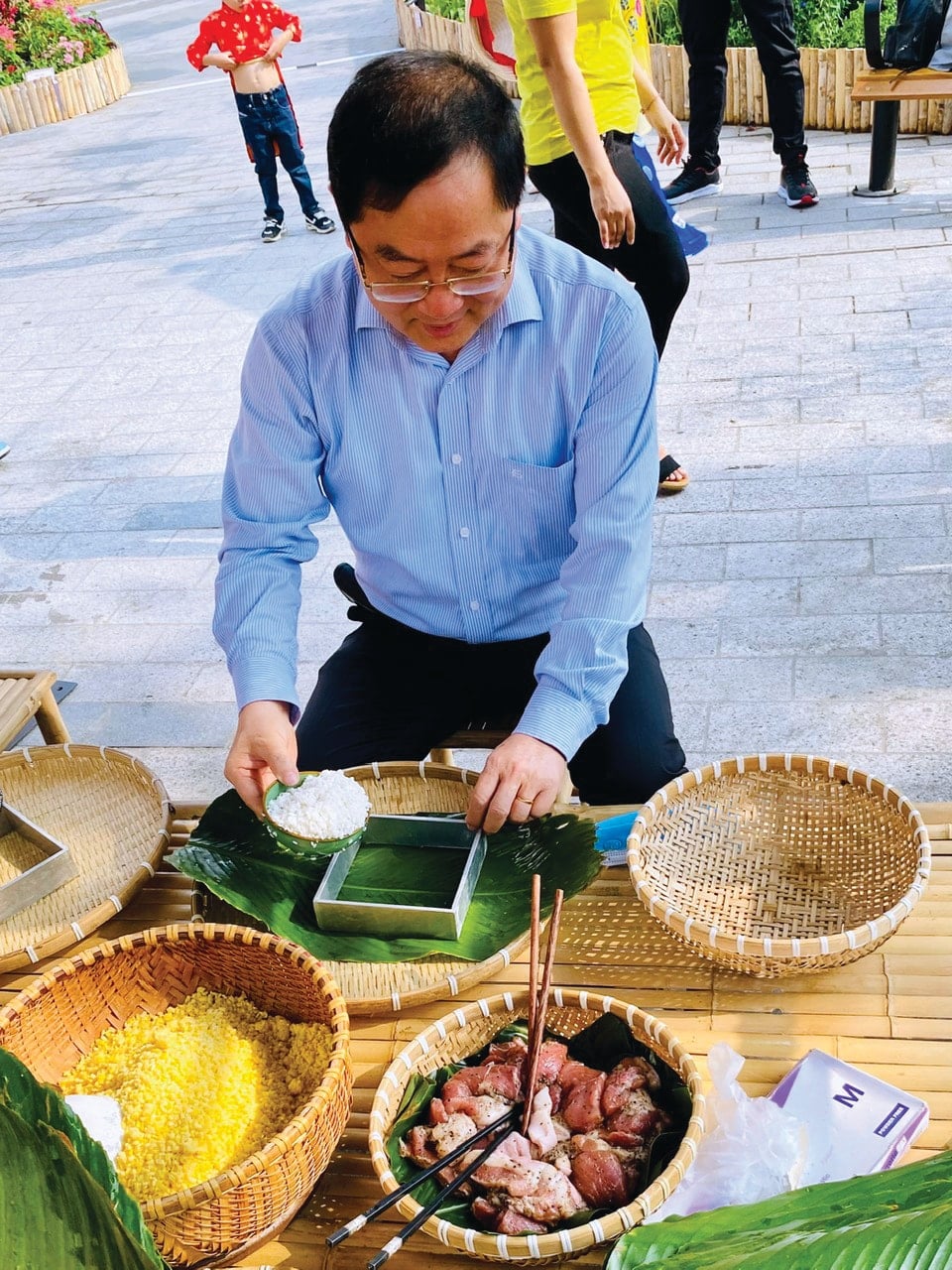
Author Le Xuan Son is wrapping banh chung (Vietnamese rice cakes).
It's said that sticky rice cakes last for a whole month, or even longer, for well-off families who might make dozens, seventy, or even a hundred cakes. Those less affluent might only make about ten, and usually don't cook them themselves, but instead share them with others or send them to someone else's pot to be boiled. Sticky rice cakes spoil very slowly. If the spring weather is favorable, not too hot, they can last for a month. The corners of the cake where the banana leaves are folded might tear, allowing air to enter, causing the cake to become slightly sour and mushy. But if you peel off the leaves, skim off the torn parts, and fry them, they're still delicious. If left for too long, the rice grains will become hard, tasting like raw rice – a phenomenon called "re-hardening." Simply boiling or frying them again will make them soft and delicious.
When I returned to my hometown for Tet, I noticed that few families still made and cooked banh chung (traditional Vietnamese rice cakes) themselves. There are now specialized workshops and businesses that make and cook them, providing as many as you want for a fee. It's very convenient and easy, but a rich and traditional Tet custom passed down through generations has truly faded away.

*
It's said vaguely that the tradition of making banh chung (Vietnamese sticky rice cake) has existed for countless generations, and many would scoff, saying it dates back to the time of King Hung. The book "Linh Nam Chich Quai" clearly states in the story "Banh Chung" that after defeating the Yin invaders, King Hung wanted to pass the throne to his son, so he held a competition among the princes. Prince Lang Lieu created banh chung, symbolizing the square earth, and banh giay (or "dai?"), symbolizing the round sky. This creation was innovative, meaningful, and delicious, earning him the king's approval. Thus, banh chung originated in Vietnam in ancient times, approximately three thousand years ago (around the same time as the Yin dynasty in China). And naturally, banh chung is a purely Vietnamese dish, and moreover, it carries a profound philosophy.
However, I happened to read about a debate that wasn't widely publicized. In the article "The Philosophy of Banh Chung and Banh Giay" that I mentioned earlier, Professor Tran Quoc Vuong presented several noteworthy points. Firstly, originally, banh chung wasn't wrapped in a square shape but in a cylindrical shape like a sausage, just like banh tet in the South, and also similar to the long, round banh chung that is still wrapped in some areas of the Northern Delta, the Northern Midlands, and the Northern mountainous regions (in Lang Son , I once ate a black banh chung that looked exactly like banh tet). Some places in Southern China, specifically Sichuan, also have similar banh tet. And the traditional Japanese method of making mochi is very similar to the method of making banh giay. From that, Professor Tran Quoc Vuong concluded: "Banh chung and banh giay are unique products of a vast rice-based civilization in East Asia and Southeast Asia. Of course, Professor and Academician Dao The Tuan tells us that glutinous rice has the most diverse and typical varieties in the Red River basin. Therefore, this area is rich in offerings and dishes made from glutinous rice."
According to Professor Vuong, the long, cylindrical shape of the banh chung (rice cake) and the round, sticky rice cake represent the Nõ-Nường culture. The original long, cylindrical banh chung symbolized Nõ (male genitalia), while the round sticky rice cake represented Nường (female genitalia). The round sky and square earth represent a foreign worldview , later adopted by the Vietnamese people.
The above viewpoint is agreed upon by many, but also refuted by many who find it unconvincing and lacking evidence. The most vehement rebuttal comes from author Phan Lan Hoa in her article "A Discussion on the Origin and Meaning of Banh Chung and Banh Day" (note, "Banh Day" is Phan Lan Hoa's spelling) published in Van Hoa Nghe An on September 19, 2014. In this article, the author refutes Professor Tran Quoc Vuong and others who share the same viewpoint, arguing that according to the timelines in legends about the origin of Banh Chung and Banh Day in Vietnam (around the Yin Dynasty, approximately three thousand years ago) and Zongzi, a Chinese sticky rice and bean cake wrapped in leaves, was originally made to commemorate the death anniversary of the poet Qu Yuan.
According to legend, sticky rice cakes (bánh chưng) predate mochi by nearly 750 years (dating back to May 5, 278 BC). Similarly, based on legend, sticky rice cakes (bánh dày) predate mochi by more than 1,700 years.
In this respect, it is immediately apparent that author Phan Lan Hoa's use of legends (the earliest recorded Vietnamese legends about banh chung and banh giay dating back to the Tran Dynasty in the book Linh Nam Chich Quai) for addition, subtraction, and comparison as authentic historical evidence is unconvincing.
Author Phan Lan Hoa also rejected Professor Vuong's opinion on the symbolic meaning of the "Nõ - Nường" symbolism in the banh chung and banh giay (traditional Vietnamese rice cakes), writing: "Mr. Tran Quoc Vuong comparing banh tet (another type of rice cake) to the 'Nõ Nường' culture is, in my opinion, an arbitrary cultural fabrication. Vietnamese legends clearly record 'The Legend of Banh Chung and Banh Giay,' not 'The Legend of Banh Tet and Banh Giay.' Furthermore, the 'Nõ Nường' culture isn't necessarily the same as the Lac Viet culture. There are no depictions of the 'Nõ Nường' culture on bronze drums, and in reality, the 'Nõ Nường' phenomenon only exists in the Phu Tho region; the other two ancient Vietnamese cultural centers, the Ma River basin and the Lam River basin, haven't been found to possess this type of culture..."
In short, it's a rather perplexing issue, and further serious research is needed to determine what's right and wrong. In my opinion, this doesn't affect the deliciousness of banh chung and banh giay, nor the beautiful folk memories associated with them. And every spring, we cherish the green banh chung, carefully placing them on the altar as a respectful offering to heaven, earth, gods, and ancestors, as has been the case for generations.
Source: https://congluan.vn/banh-chung-lan-man-chuyen-10329500.html




![[Image] A brilliant symphony and explosive power in the skies of Da Nang.](https://vphoto.vietnam.vn/thumb/1200x675/vietnam/resource/IMAGE/2026/05/31/1780196945787_anh-man-hinh-2026-05-31-luc-10-08-51.png)









![[Video] Sunset at Lap An Lagoon – Where the sun sets over the fishing nets](https://vphoto.vietnam.vn/thumb/340x192/vietnam/resource/IMAGE/2026/05/31/1780192137701_beach-landscape-sea-water-nature-grass-745871-pxhere-com.jpeg)





















































Comment (0)