

With the rise of cashless payments and digital transactions, using public Wi-Fi to browse the web, log into social media, or make transfers is becoming increasingly common. However, according to a recent warning from the Quang Ninh Provincial Police, behind this convenience lie numerous information security risks, potentially leading to users having all their money stolen from their bank accounts after just a few careless login attempts. In reality, cybercriminals are exploiting users' complacency when accessing free internet at cafes, airports, hotels, or shopping malls to implement increasingly sophisticated scams.
Free Wi-Fi has become a "gateway" for hackers to steal data.
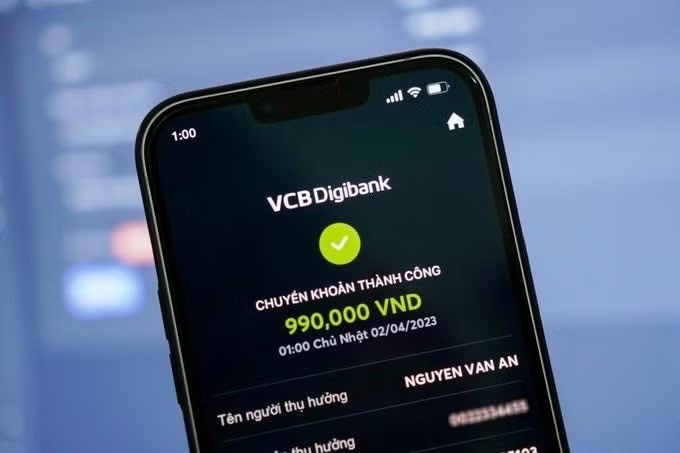
Illustrative image.
According to the police, one of the common tactics currently is setting up fake Wi-Fi hotspots with names similar to the official network in public places. For example, instead of the cafe's Wi-Fi name being "Coffee House Free," criminals might create a network named "Coffee_House_Free" or add characters that make it difficult for users to distinguish visually. When victims unknowingly connect to this fake network, all data transmitted from their phones or computers to the internet can be monitored.
According to information from the Quang Ninh Provincial Police, malicious actors often exploit public Wi-Fi networks to steal users' personal information, accounts, and passwords. In some cases, hackers even redirect users to fake websites to steal bank login data or electronic payment information.
Even more concerning, many people now have the habit of saving their bank account information, e-wallet details, or logging in automatically on their phones. If the device accesses a fake website that mimics the real bank's interface, users can easily enter their login information without realizing they are falling into a scam.
Mr. Nguyen Van H. (32 years old, Hanoi ) is one of the victims who experienced a similar incident while using free Wi-Fi at the airport. According to his account, while waiting for his flight, he connected to a Wi-Fi network with a name similar to the airport's official system to check emails and conduct banking transactions. About 20 minutes later, he continuously received OTP messages and discovered that over 48 million VND had been transferred from his account. “At the time, I thought it was just normal free Wi-Fi and didn't take any precautions. Only when I lost the money did I realize I had connected to a fake network,” Mr. H. said.
Besides stealing account information, fake Wi-Fi networks can also be exploited to spread malware. According to a warning from the Quang Ninh Provincial Police, some applications offering free Wi-Fi operate on a "community sharing" mechanism. Once installed, these applications request access to the device, thereby collecting information about Wi-Fi networks the user has previously connected to, including network names and passwords stored on the device.
This data is then sent to the application's management server and shared with other users. This means that the user's home or office Wi-Fi network is also at risk of unauthorized access if using applications from unknown sources.
Another victim is Ms. Tran Thu M. (27 years old, Ho Chi Minh City), who installed a free Wi-Fi sharing application advertised on social media. After a few days of use, her social media accounts were unexpectedly compromised, and her personal email continuously received unusual login notifications from unknown devices. Upon checking, she discovered that the application had requested too many access permissions on her phone, which she hadn't noticed during installation.
According to authorities, the danger lies in the fact that many people tend to be complacent when accessing free Wi-Fi in public places. Meanwhile, scammers take advantage of this convenience to access personal data, bank accounts, or install malware on victims' devices.
Experts warn against transferring money via public Wi-Fi.
Given this situation, the Quang Ninh Provincial Police advise people to absolutely refrain from conducting financial transactions such as money transfers, logging into digital banks or e-wallets while using public Wi-Fi. In cases where urgent transactions are needed, users should prioritize using 4G or 5G mobile data connections for greater security.
Cybersecurity expert Vu Ngoc Son said that users risk having their information stolen or malware installed when using untrusted Wi-Fi networks. According to Mr. Son, a common attack method involves hackers creating fake Wi-Fi networks with names similar to public Wi-Fi hotspots, making it difficult for users to distinguish them. This tricks users into connecting to the fake Wi-Fi system in order to control their data.
The expert also stated that after users connect to a fake Wi-Fi network, hackers can control the device's internet connections, steal information, or redirect users to fake websites. Additionally, they can exploit the web browsing process to trick users into installing fake software or malware.
According to recommendations from the police, people should regularly update their operating systems and security software on their devices to patch security vulnerabilities. They should also disable automatic Wi-Fi connection features to prevent their phones from automatically accessing previously saved networks.
Furthermore, users should absolutely avoid using "cracked" or unknown Wi-Fi sharing applications circulating on social media. These applications often pose a risk of collecting personal data or stealing user information.
Mr. Vu Ngoc Son also advised that when connecting to unreliable Wi-Fi networks, users should only access websites with the secure "https" protocol. For public Wi-Fi networks, users should only use them to read information and limit login, transaction, or money transfer activities.
"In case transactions are necessary, it's best to use a 3G or 4G connection on your phone. Additionally, users should carefully double-check all information before making a transfer," Mr. Son noted.
Besides warnings from authorities, many experts believe that the most important factor remains user awareness. In the digital age, cyberattacks are no longer limited to large businesses or organizations but are increasingly targeting individuals, as they are the most vulnerable link to exploitation.
Simple actions like connecting to the wrong Wi-Fi network, clicking on a fake website, or downloading an app from an unknown source can lead to data and financial losses. Therefore, vigilance, the habit of verifying information, and personal data protection skills are becoming crucial "shields" to help users protect themselves from increasingly sophisticated traps in cyberspace.
Source: https://khoahocdoisong.vn/bay-wi-fi-cong-cong-danh-cap-tai-khoan-ngan-hang-post2149099907.html

![[Image] Hanoi's urban life under the challenge of a "scorching hot" environment](https://vphoto.vietnam.vn/thumb/1200x675/vietnam/resource/IMAGE/2026/05/25/1779706979265_nang-nong-t5-2026-minh-duy-7-4636-jpg.webp)


![[Image] Close-up view of the interchange connecting the two expressways and Long Thanh Airport.](https://vphoto.vietnam.vn/thumb/1200x675/vietnam/resource/IMAGE/2026/05/25/1779703378210_ndo_br_z7863716673926-224453a31600126cce10622af6290afd-4549-jpg.webp)
















![[GALLERY] A completely different iPhone for the 20th anniversary edition](https://vphoto.vietnam.vn/thumb/402x226/vietnam/resource/IMAGE/2026/05/25/1779686871893_212-jpg.webp)










































































Comment (0)