

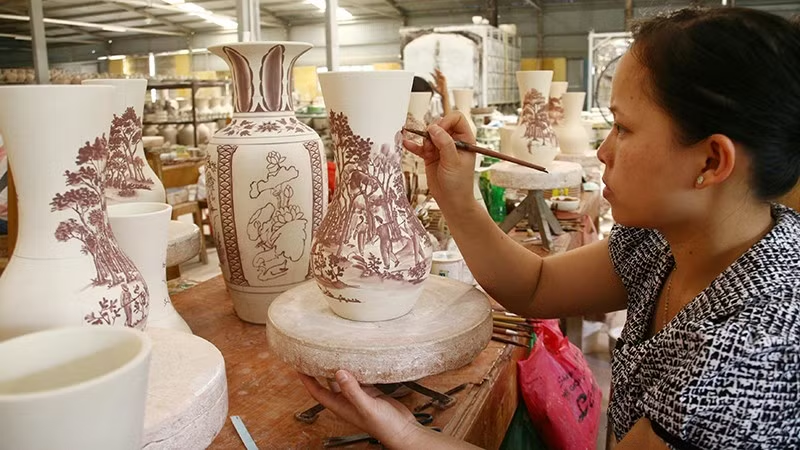
However, according to experts, "doing things the right way" is not only an irreversible trend, but also a gateway to systematic, transparent, and sustainable development in an economy that increasingly demands high levels of professionalism.
Building a transparent, fair, and professional business environment is a consistent goal throughout the process of perfecting the socialist-oriented market economy. However, as many management policies – especially Government Decree 70/2025 requiring business households to use electronic invoices and point-of-sale systems connected to the tax authorities from June 1st – begin to be implemented, hundreds of thousands of small and micro-enterprises are facing significant challenges ranging from compliance costs and operational capacity to concerns about being "tightened."
Anxiety and apprehension
In reality, while large businesses are accustomed to complying with standards, financial reporting, taxes, and electronic invoicing, small businesses face numerous concerns such as a lack of understanding, insufficient technical capabilities, fear of back taxes, anxiety about inspections, and pressure from compliance costs. These are real concerns that have been and continue to cause many individual business owners to hesitate in deciding whether to "upgrade to a formal business" or continue operating in the old way.
According to Mr. Phan Duc Hieu, a full-time member of the National Assembly's Economic and Financial Committee, complying with the law is not simple for small businesses. Many regulations that seem normal for large enterprises can become a burden for micro-enterprises. The costs of electronic invoices, accounting software, accountants, and full tax payment can consume a large portion of already limited revenue or profit.
Another barrier is the limited understanding and operational capacity of household businesses. Many small businesses, even those engaged in small-scale trading or home-based crafts, have never considered tax declaration or financial reporting. Mandatory invoicing and bookkeeping seem unthinkable without specific support. Some even fear being held accountable for past tax obligations, meaning they would have to prove the legality of their business operations in previous years. This lack of knowledge, management skills, and apprehension about policies prevents many household businesses from officially formalizing their operations.
According to Mr. Dau Anh Tuan, Deputy Secretary General and Head of the Legal Department of the Vietnam Chamber of Commerce and Industry (VCCI), current policies are becoming increasingly stringent, especially in areas such as taxation, food safety, and fire prevention and control. This is an inevitable trend aimed at protecting consumer rights and raising business standards.
However, for small businesses, especially sole proprietorships, complying with these regulations places significant pressure in terms of cost, time, and capacity. To implement electronic invoices, many businesses have to invest in computers, learn how to use software, and completely change their sales habits. Tax payments are also higher due to increased transparency. The general sentiment is one of concern, even resistance.
An irreversible trend
While concerns are understandable, formalizing business operations is an irreversible trend. This is not just a matter of government management, but also benefits the businesses themselves. Ms. Nguyen Thi Minh, owner of a dried goods stall at Tan Dinh Market (Ho Chi Minh City), shared that after more than 10 years of operating as a sole proprietorship, she officially converted to a small business in March 2025. Initially, she was apprehensive because she was unfamiliar with tax declarations, electronic invoicing software, and accounting fees. However, thanks to the dedicated support from the local Small and Medium-sized Enterprise Support Center, she gradually adapted and confidently operated the new model after only two months. “I was surprised that restaurants and supermarkets started contacting me to place more orders. They requested invoices and contracts, which I was able to provide. After a year of transitioning, revenue increased by 40%, we opened another warehouse, and we are building our own brand,” Ms. Minh shared.
It's not just Ms. Minh; many business households are beginning to see opportunities in this "new game." According to data from the Ministry of Finance, the number of business households converting to enterprises in June this year reached 118% higher than the same period last year, an increase of over 60% compared to the previous month, and 2.4 times higher than the average of the last 2-3 years, showing that the mindset of "becoming an enterprise" is gradually forming.
According to Dr. Nguyen Quoc Viet, a public policy expert at the University of Economics (Vietnam National University, Hanoi), transitioning from a household business to a company helps legalize operations, open up opportunities for borrowing capital, expand scale, and increase trust with partners. Many small businesses, after formalization, have clearly seen the advantages such as greater customer trust, easier expansion of sales channels, and access to policies. Previously, many household businesses avoided obligations, from taxes to declarations, leading to unfair competition. Now, with everyone having to be transparent and comply with the law, those operating in a structured manner will no longer be at a disadvantage compared to informal, non-transparent household businesses.
Moreover, compliance with the law helps businesses avoid the risk of penalties, creating a solid foundation for participating in formal supply chains and gradually expanding into international markets. This is a fundamental element for sustainable, long-term development. Regulatory agencies also need a transparent business system to develop targeted policies, prevent tax evasion, and limit "backroom" business practices. From both an internal and external perspective, formalizing small businesses remains the right path.
Appropriate policies are needed for effective implementation.
Turning anxieties into opportunities – this can only become a reality if policies are designed flexibly, the roadmap is reasonable, and the support system is strong enough. According to Mr. Phan Duc Hieu, one of the core issues today is that the legal framework is being built on a "one size fits all" mentality, inadvertently creating immense pressure on small and micro-enterprises. Therefore, it is necessary to design policies and laws that are categorized and appropriate to the size of businesses, in which small and micro-enterprises should benefit from mechanisms that reduce the requirements for documentation, conditions, or administrative procedures to match their capacity. Besides reviewing the current regulatory system, special attention should be paid to the "ease of compliance" factor – meaning that small businesses not only need laws that are appropriate but also laws that are easy to understand, easy to implement, and easy to apply.
From a law enforcement perspective, Mr. Dau Anh Tuan believes that if new policies are issued and required to be implemented immediately, small businesses will be caught off guard, fearful, and may even temporarily cease operations because they cannot keep up. Therefore, policy implementation needs to combine both "push" (compulsory action) and "pull" (support to encourage action), such as providing free accounting software and electronic invoices; offering short-term training courses; and providing timely advice from relevant authorities. The government needs to proactively approach, explain, and support businesses, instead of just waiting for them to figure things out on their own. When they feel supported, small businesses will have more motivation and confidence to enter the official market.
Besides technical support, Dr. Nguyen Quoc Viet believes that the State needs to go further in transparentizing the business environment, eliminating "favor-seeking" elements, reducing hidden costs, and most importantly, ensuring consistency between regulations on paper and their actual implementation. If compliance costs are too high compared to the scale of operations, many small businesses will not be able to survive, let alone develop. Therefore, reviewing and minimizing legal compliance costs is a strategic priority so that all support policies can be effective. When businesses feel that the law is easy to understand, the environment is transparent, and there are no "hidden" barriers, they will be willing to invest, expand, and develop in a formal manner.
Clearly, "following the law" is not only a management requirement but also the key to small businesses gradually professionalizing, expanding their markets, and enhancing their competitiveness. However, this path cannot be taken alone. Even the most sound legal policies need to be implemented through a reasonable roadmap, specific support tools, and genuine collaboration from the government.
Source: https://nhandan.vn/bien-noi-lo-thanh-co-hoi-post895792.html





![[Photo] General Secretary and President To Lam presides over a working session with the Central Policy and Strategy Committee on the development of the materials industry.](https://vphoto.vietnam.vn/thumb/1200x675/vietnam/resource/IMAGE/2026/05/21/1779359935432_a3-bnd-3129-1412-jpg.webp)









![[Video] Hanoi plans to select two communes with 700,000 inhabitants to pilot the socialist model.](https://vphoto.vietnam.vn/thumb/402x226/vietnam/resource/IMAGE/2026/05/21/1779373741887_z7851174239346-8a83e741648b3fa19f4e711ad18c6234-jpg.webp)
![[Video] National Assembly Chairman Tran Thanh Man: The Committee on Law and Justice must be proactive in creating institutions for development.](https://vphoto.vietnam.vn/thumb/402x226/vietnam/resource/IMAGE/2026/05/21/1779373141088_ctqh-jpg.webp)
![[Video] General Secretary and President To Lam: Developing the materials industry towards green, sustainable, and self-reliant development.](https://vphoto.vietnam.vn/thumb/402x226/vietnam/resource/IMAGE/2026/05/21/1779373152758_z7850964883596-4496ed727d99797c00c22dbb8c265740-jpg.webp)




































































Comment (0)