

 |
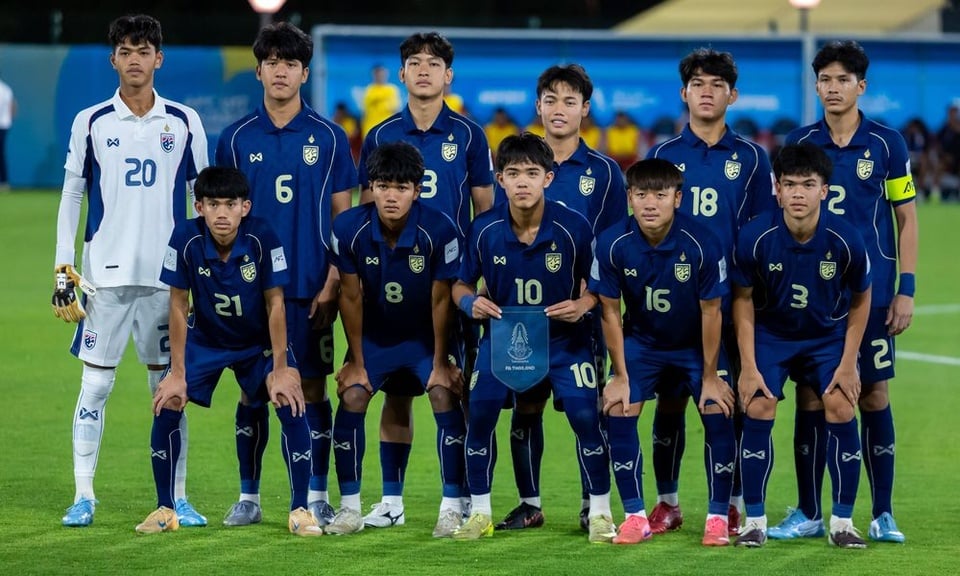
Thailand U17 eliminated despite fielding a strong team - Photo: AFC . |
From U17, U20 to U23, the Thai youth teams have consistently disappointed in major tournaments. These failures are no longer temporary phenomena but reflect a systemic crisis in Thai youth football.
Thailand U17 and the shattered dream of the World Cup.
Despite the disappointing performance of the Thailand U17 team at the Southeast Asian Championship last month with unbelievable defeats against Myanmar and Laos, many Thai football fans remained optimistic. On regional forums, many opinions suggested that the team participating in the tournament was merely a "B team," while the strongest squad was quietly preparing for the U17 Asian Championship finals, where the ultimate goal is to qualify for the World Cup.
But the reality on the continental stage was even harsher. Thailand's "top team" not only failed but also displayed a disappointing performance. They started with a 0-2 loss to Tajikistan, followed by a similar defeat against Australia. In their final match against Myanmar, a supposedly weaker opponent, Thailand continued to disappoint by falling behind by two goals.
Only through a second-half effort did the U17 Thailand team manage to salvage a 2-2 draw with a late equalizer in the 75th minute. However, that single point only helped them avoid the bottom of the table, not prevent the young team from being eliminated early.
The dream of making its first appearance at the U17 World Cup in the 21st century remains unfulfilled. The last time Thai football appeared at the U17 World Cup was in 1999, a distant memory for a nation that once considered itself the best in Southeast Asia.
Looking at the bigger picture, Thailand's U17 team's participation in this year's Asian Championship finals was partly due to luck. In the qualifying rounds, despite playing at home, they only overcame Turkmenistan and Kuwait thanks to their head-to-head record. Signs of instability had already appeared beforehand, but many people were unwilling to confront them directly.
It can be confidently stated that the defeats of the Thai U17 team are no longer accidents. A team that lost to Tajikistan, failed to beat Myanmar, and even lost to Laos can hardly be considered a contender at the continental level.
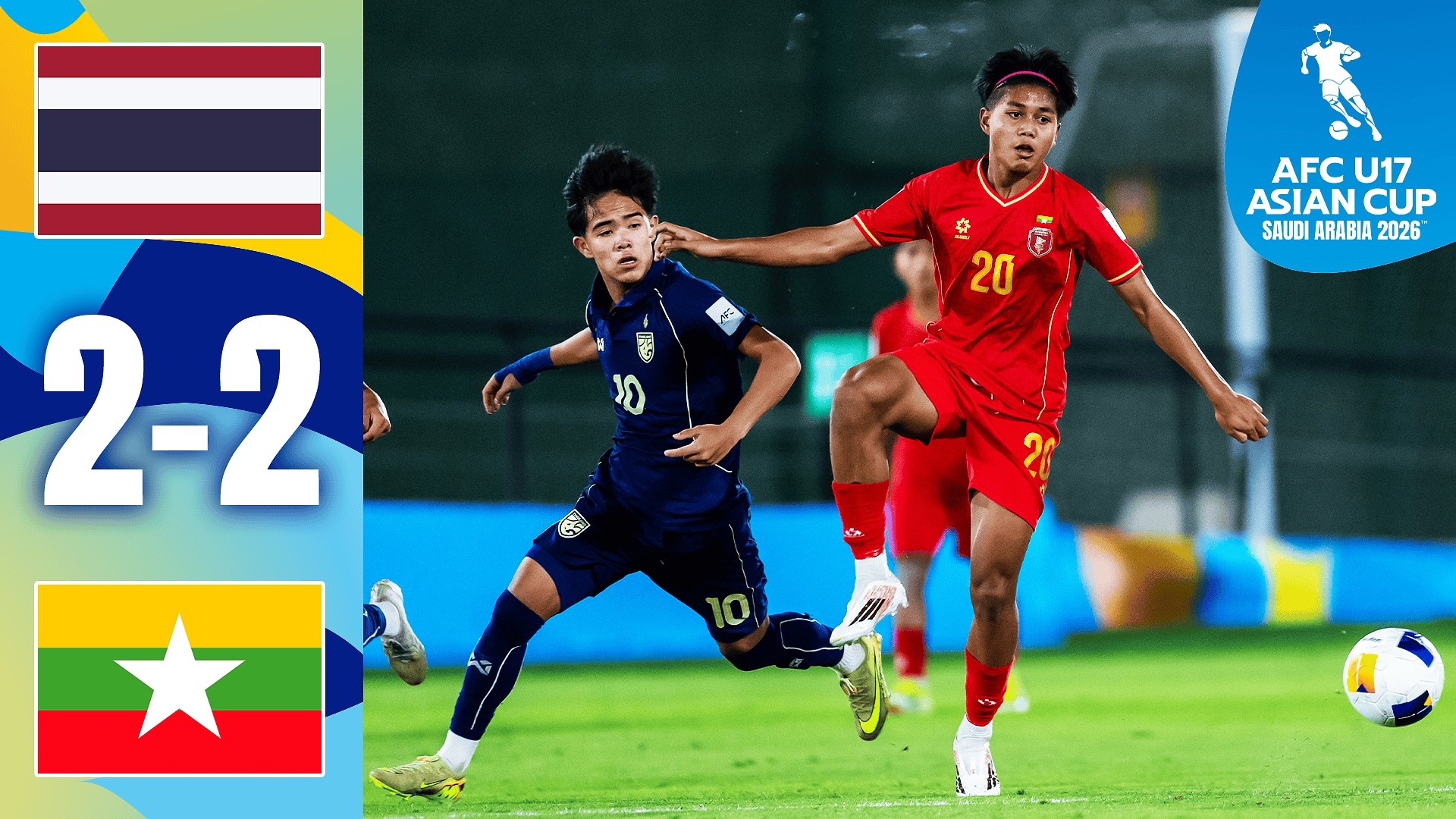 |
Thailand drew with Myanmar. Photo: AFC |
From U20 to U23: The continuing failures of Thai football.
The crisis in Thai youth football is not limited to the U17 level. A year ago, the Thai U20 team also entered the Asian arena with high expectations but left the tournament in disappointment. They suffered a heavy 0-3 defeat against Japan, followed by a 1-4 loss to South Korea, and were almost unable to compete in their group.
In their final match against Syria, the U20 Thailand team once again repeated the familiar scenario: falling behind by two goals before struggling to equalize 2-2. But like the current U17 team, that one point didn't lift them out of last place in the group. It's worth noting that, to this day, the U20 Thailand team has never participated in a Youth World Cup, something the U20 Vietnam team achieved in 2017 under coach Hoang Anh Tuan.
At the U23 level, which is considered a direct transition to the national team, the situation is no brighter. Late last year, the Thai U23 team lost to the Vietnamese U23 team in the SEA Games gold medal match, despite leading by two goals at home.
Furthermore, at the subsequent U23 Asian Championship finals, the Thai team continued to disappoint, failing to win a single match in the group stage and finishing last in Group D. Meanwhile, the Vietnamese U23 team won all three group stage matches and finished the tournament with a convincing bronze medal.
When failure occurs at one level, it might just be a temporary slump. But when teams from U17, U20 to U23 all face the same problems—weak mentality, being outmatched by stronger opponents, and a lack of competitiveness—it's a sign of a systemic crisis.
What's more worrying is that the consequences are now beginning to spread to the Thai national team. A football system without a strong enough next generation of players will find it very difficult to maintain success at the highest level. The failure at the ASEAN Cup in early 2025, or the near miss out on qualifying for the 2027 Asian Cup against a supposedly weaker opponent like Turkmenistan, partly reflects this problem.
For many years, Thai fans were accustomed to believing that their football was superior to the rest of Southeast Asia. But the current reality shows that this gap no longer exists, and there is even a risk of being overtaken by Vietnam or Indonesia in the FIFA rankings.
If the problem isn't addressed correctly instead of seeking excuses, Thai youth football may continue to sink deeper into a spiral of disappointment. And the 2027 Asian Cup could just be another difficult hurdle awaiting the Thai national team.
Source: https://znews.vn/bong-da-tre-thai-lan-khung-hoang-toan-dien-cac-cap-do-post1651071.html





























































































Comment (0)