

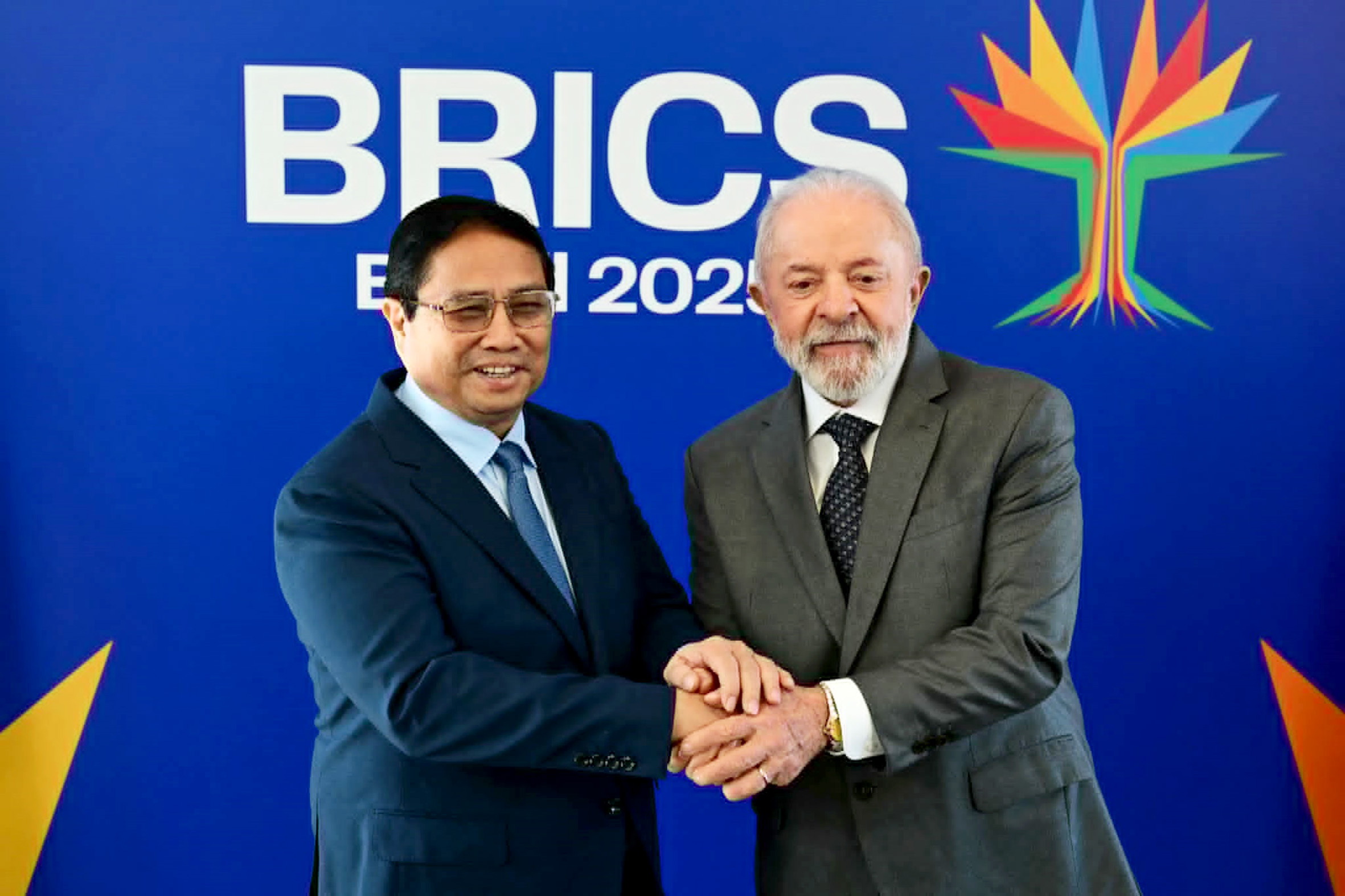
Prime Minister Pham Minh Chinh shakes hands with Brazilian President Luiz Inacio Lula da Silva before their bilateral talks on the sidelines of the BRICS summit on July 5 - Photo: AFP
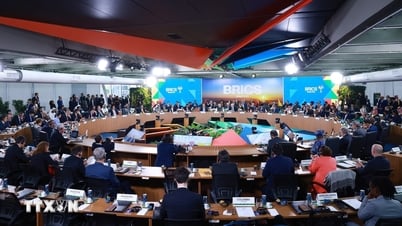
In his opening address at the conference in Rio de Janeiro on July 6-7 (early morning of July 7 in Vietnam time), Brazilian President Luiz Inacio Lula da Silva compared BRICS to the Non-Aligned Movement – a group of developing countries that opposed joining any side in international relations. "BRICS is the successor to the Non-Aligned Movement," Lula da Silva emphasized.
Strengthening multilateralism
The Brazilian leader is confident in asserting this. The recent expansion of BRICS has added diplomatic weight to this conference, with 10 member countries, 10 partner countries, and the presence of leaders from the United Nations and other international organizations.
"If current international governance does not reflect the new multipolar reality of the 21st century, then BRICS must help bring it back into reality," Lula emphasized.
In his opening address, UN Secretary-General António Guterres also emphasized that at a time when multilateralism is eroding, "new cooperation is humanity's greatest innovation."
Since its inception 16 years ago, BRICS has often been interpreted in Western media as a group of countries seeking to create a "de-Westernized" political system.
In the current global context, with the rise of unilateralism and trade protectionism, Brazil, the BRICS 2025 chair, has proposed concrete paths towards a fairer multilateralism.
Speaking to Tuoi Tre newspaper , journalist Daniel Henrique Diniz (Brazil) pointed out that during Brazil's five-year term, BRICS countries have strived to promote reform goals desired by many developing countries, such as artificial intelligence governance, UN reform, increased quotas at the International Monetary Fund, and increased capital holdings at the World Bank.
The importance and focus on emerging and developing countries were demonstrated in the joint statement of BRICS member countries on June 6-7.
"We recognize that multipolarity can enhance opportunities for developing countries and emerging markets (DCS) to develop their constructive potential and benefit from globalization and mutually beneficial, inclusive, and equitable economic cooperation."
"We underscore the importance of Global South as a driver of positive change, particularly in the face of significant international challenges, including rising geopolitical tensions, economic slowdown and accelerated technological transformation, protectionism and migration challenges," the joint statement said.
"By linking its actions to the Sustainable Development Goals (SDGs), Brazil wants to demonstrate that BRICS not only protects the Global South countries but also offers global solutions based on equity, cooperation, and shared responsibility," journalist Daniel Henrique Diniz commented.
Vietnam's message
Attending the BRICS Expanded Summit for the first time as a partner country, Prime Minister Pham Minh Chinh delivered an important speech at the BRICS Expanded High-Level Discussion on "Strengthening Multilateralism, Economic and Financial Issues, and Artificial Intelligence".
Prime Minister Pham Minh Chinh emphasized the role and contributions of the Global South countries in global governance.
In the context of a world undergoing many changes, he argued that countries need to continue to uphold solidarity, strengthen cooperation and dialogue to address challenges with a global, people-to-people, comprehensive, and inclusive approach.
In that spirit, the Prime Minister put forward three important and practical proposals. Firstly, BRICS and the countries of the South need to take the lead in revitalizing multilateralism, persistently engaging in dialogue and cooperation based on the fundamental principles of the United Nations Charter and international law.
According to the Prime Minister, BRICS needs to actively participate in promoting reforms of global institutions such as the United Nations, IMF, WB, and WTO in a way that meets the realities and needs of developing countries, strengthen South-South cooperation; and promote connectivity, build trust, and foster cooperation between developed and developing countries.
Secondly, BRICS needs to take the lead in promoting trade liberalization and respecting the legitimate rights and interests of all countries.
To enhance strategic autonomy, BRICS and the Southern countries need to strengthen market openness, promote supply chain linkages, mobilize and share resources, support technology transfer and human resource training for projects in health, education, digital infrastructure, green transformation, and climate change adaptation.
Thirdly, we must be pioneers in leveraging the power of artificial intelligence (AI) to serve humanity, not to replace humans.
According to the Prime Minister, BRICS needs to work with multilateral mechanisms to promote the development of a fair, secure, safe, and accessible global AI governance system. This includes building an AI ecosystem that adheres to ethical values and balances innovation with social benefits.
On the sidelines of the BRICS Expanded Summit, on June 6-7, Prime Minister Pham Minh Chinh held meetings with leaders from Cuba, Malaysia, South Africa, India, Uganda, and Nigeria; he also received the First Vice President of the Senate of Uzbekistan, the Russian Foreign Minister, and leaders from the World Trade Organization, the World Health Organization, and the Asian Infrastructure Investment Bank.
Tuoitre.vn
Source: https://tuoitre.vn/brics-ke-thua-phong-trao-khong-lien-ket-20250708074211311.htm
![[Photo] General Secretary and President To Lam meets with National Assembly delegates from ethnic minorities.](https://vphoto.vietnam.vn/thumb/1200x675/vietnam/resource/IMAGE/2026/04/20/1776696701056_a1-bnd-8331-3342-jpg.webp)




![[Image] National Assembly discusses the implementation of the socio-economic development plan.](https://vphoto.vietnam.vn/thumb/1200x675/vietnam/resource/IMAGE/2026/04/20/1776696707422_ndo_br_img-20260420-185419-jpg.webp)



































































Comment (0)