"The Nation's Complete Joy" is one of the musical symbols of the Great Victory Day, but few know that it was born in very special circumstances, written from the "aspiration in the soul" of the talented musician Hoang Ha, even before the scene of victory flags and flowers actually materialized.
In the final days of April 1975, Hanoi was buzzing with activity. People across the country, especially in the capital, followed the war situation in the South hour by hour, minute by minute. Composer Hoang Ha was no exception.
Working at the Voice of Vietnam (VOV), he had access to news quickly and comprehensively. Many days, he didn't go home but stayed at the office, sharing an atmosphere of "burning determination and unwavering belief in victory" with his colleagues.
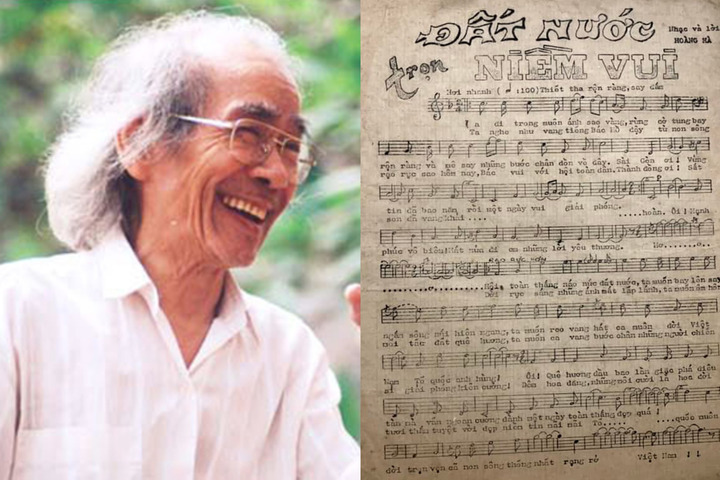
Composer Hoang Ha wrote the song "The Country is Filled with Joy" on April 26, 1975.
News of our troops' swift advance toward Saigon poured in. The moment of hearing the overwhelming news of victory, signaling the imminent arrival of a momentous national celebration, created a powerful surge of emotion. Boundless joy and happiness welled up in the musician's heart.
On the night of April 26, 1975, at his home in Hanoi, composer Hoang Ha put pen to paper and wrote the song "The Nation's Complete Joy." The song was his most heartfelt expression, fully conveying his happiness at the impending complete liberation of the country and the reunification of the nation.
The melody is lively and bright, the lyrics joyful and spirited, just like its name suggests: "The triumphant celebration fills the country with excitement / We want to fly up and gaze in awe at the majestic mountains and rivers / We want to shout and sing the eternal song of Vietnam / Our heroic homeland."
Speaking about the song's "origin," composer Hoang Ha said during his lifetime: " It wasn't until April 26, 1975, that I learned the campaign to attack Saigon was named the Ho Chi Minh Campaign. I was deeply moved, thinking that once a campaign was named after Uncle Ho, victory was inevitable. That very night, I wrote 'The Nation's Complete Joy' with lines reflecting on Uncle Ho: 'We hear the resounding voice of Uncle Ho rising from the mountains and rivers. How exhilarating it is today that Uncle Ho rejoices with the entire nation...'"
On the morning of April 27, 1975, composer Hoang Ha brought the manuscript of the song "The Country's Complete Joy" to the Voice of Vietnam Radio. The song was immediately well-received. Composer Nguyen An, then head of the music editorial team, read, approved, and immediately handed it over to composer Trieu Dang for urgent arrangement and orchestration in time for broadcast. Artist Trung Kien (later People's Artist Trung Kien) was the first singer to perform this song.
One remarkable aspect of the songwriting process is that at the time he began writing the song, composer Hoang Ha had not yet witnessed firsthand the scene of "a forest of victory flags or the sight of countless golden stars and red flags fluttering" in the streets of Saigon.
The joy in the song is the joy in his soul, his dream, his intense aspiration for the reunification of the country. He believed that this joy of victory would not only be felt by him but also by millions of Vietnamese people as news of the victory of the Ho Chi Minh Campaign spread throughout the country.
According to composer Hoang Ha, the song was created in just one day, but it was the culmination of a whole process, a lifetime. He was in Hanoi when he wrote it, and it wasn't until 1977 that he first saw Saigon.
The first recording of the song "The Country Filled with Joy" was performed by People's Artist Trung Kien.
The first recording of "The Country Full of Joy" was quickly broadcast on the Voice of Vietnam radio station, bringing an atmosphere of jubilation to all parts of the country. Later, the song was also broadcast for the first time on Liberation Radio on the morning of May 1, 1975, along with the song " As If Uncle Ho Were Present on the Day of Great Victory " by composer Pham Tuyen, spreading the joy of reunification throughout the newly liberated South.
If " If Uncle Ho were present on the day of the great victory " by composer Pham Tuyen is an outstanding song in the genre of popular songs, then " The Country is Filled with Joy" by composer Hoang Ha also achieves that standard in the genre of art songs.
The melody of the song is like "a joy that has been suppressed for a long time," now bursting forth in this joyous historical moment. The lyrics "dance and sing," "spreading joy" to listeners and singers alike, with "joy sparkling in every lyric." This is what makes the song easily resonate with people and endure through the years.
Composer Hoàng Hà, whose real name was Hoàng Phi Hồng (1929-2013), was originally from Yên Phụ, Tây Hồ, Hanoi. At the age of 16, he worked at the provincial office of the Viet Minh in Phúc Yên. Hoàng Hà was closely involved in cultural work in Vĩnh Phúc province. In 1962, he studied at the Vietnam School of Music (now the Vietnam National Academy of Music) and later worked at the Voice of Vietnam Radio – where he contributed and created many valuable musical works.
Before "The Country's Complete Joy," composer Hoang Ha was famous for many songs such as: " The Bright Lights on Viet Tri Bridge," "Marching Together in Spring," "Meeting on the Truong Son Peak," etc. However, "The Country's Complete Joy" further affirmed his talent and won the hearts of audiences nationwide, becoming one of the songs that have accompanied the years and live on in the hearts of the public.
The song "The Nation's Complete Joy" is not only a musical work but also a historical witness, an auditory symbol of the day the country was reunified. The song's title was later chosen as the name of a music anthology published in 1975 and reissued in 1985 on the theme of April 30, 1975, demonstrating the immense historical significance and importance of the work.
Le Chi - Vtcnews.vn
Source: https://vtcnews.vn/chuyen-it-biet-ve-tac-gia-ca-khuc-dat-nuoc-tron-niem-vui-ar940401.html




![[Image] Hanoi's urban life under the challenge of a "scorching hot" environment](https://vphoto.vietnam.vn/thumb/1200x675/vietnam/resource/IMAGE/2026/05/25/1779706979265_nang-nong-t5-2026-minh-duy-7-4636-jpg.webp)



































































Comment (0)