 |
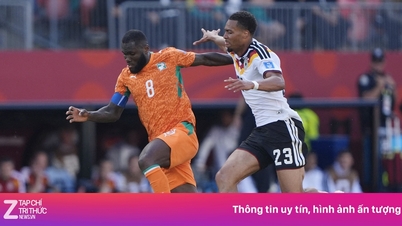
The extreme heat in North America caused the players to tire quickly, constantly having to douse themselves with water and use cold towels to cool down right on the court. Photo: Reuters. |
Scorching, stifling, and oppressive – that's what experts predict for the weather at this World Cup. Analysis suggests that most matches will be played in temperatures exceeding 32 degrees Celsius.
World football history is about to witness what could be the hottest World Cup since the summer of 1994, when the tournament was also held in the United States. That year, the fact that over 80% of the matches were scheduled to be played before 5 pm under the scorching sun became a terrifying nightmare, exemplified by the match between Mexico and Ireland in Orlando, where the temperature measured on the pitch reached a record high of nearly 47 degrees Celsius, according to The Athletic .
The stadium turned into a "baking oven".
Last summer, FIFA used the Club World Cup in the US as a test. Weather data from Visual Crossing indicated that the tournament was even hotter than the last four World Cups combined.
To get a more comprehensive picture, The Athletic analyzed hourly weather data over the past 10 years at match venues, taking into account the kick-off time (including the hour before and after the match) around match day. The results revealed the league's top "cauldrons":
AT&T Stadium (Dallas, USA): Topping the list with an estimated average temperature of 32 degrees Celsius. The peak was on July 14th, when the stadium hosted the semi-final match at 2 PM (local time), with temperatures expected to reach 34 degrees Celsius.
Estadio BBVA (Monterrey, Mexico): Closely ranked in terms of difficulty.
The good news for the players is that Dallas, along with Atlanta and Houston, are three of the rare venues with stadiums featuring enclosed dome roofs and comprehensive air conditioning systems, helping to reduce stress on the players.
Conversely, stadiums without roofs will present an extreme challenge. In the past decade, temperatures at least once in 6 out of the 16 stadiums selected to host the 2026 World Cup have exceeded 37.7 degrees Celsius during match hours.
Aaron Mentkowski, head of meteorology at WKBW-TV Buffalo and the league's climate expert, explained: "On days with little wind and intense sunshine, the pitch turns into a baking oven. The covered stands provide shade, but the grass absorbs all the solar radiation and radiates that heat back into the air. The enclosed architecture of the stadium inadvertently blocks the wind, trapping the hot air and causing it to accumulate right on the pitch."
This extreme heat will undoubtedly stifle tactical intentions, making high-intensity pressing impossible.
German football legend Jurgen Klinsmann once recalled his 1994 experience: "Getting into the rhythm of the game under such harsh weather conditions was truly an unbearable challenge."
Given this situation, teams from colder climates are having to find ways to acclimate their bodies to this heat.



Recently, Norwegian national team players were spotted lying exhausted in the sun during a training session in North Carolina under the 32°C heat, a stark contrast to the cool Nordic climate.
Statistics show that Norway is one of the teams that experienced the largest temperature difference between the group stage competition environment and the climate in their home country of Norway.
  |
The Norwegian player lies stretched out on the grass basking in the sun during a training session. Photo: X. |
However, Mentkowski noted: "Essentially, a person in good physical condition from a cool climate will adapt after a week or two in hot weather conditions."
Moreover, most of the Norwegian national team's stars are actually playing for top clubs in Europe or around the world, where they are already accustomed to traveling and playing in various weather conditions throughout the year.
Risks of impact from natural disasters
While the heat affects the quality of play, the summer thunderstorms in the US pose a significant logistical challenge for organizers.
According to strict U.S. disaster response regulations, a game must be immediately suspended if lightning or electrical discharge is detected within an 8-mile (approximately 13 km) radius of the stadium.
This is accompanied by the "Harsh 30-Minute Rule": Every time a new lightning strike occurs, the 30-minute safety countdown timer is reset to the beginning.
Last summer, the FIFA Club World Cup match between Chelsea and Benfica was extended to a record-breaking 4 hours and 38 minutes due to repeated delays caused by lightning strikes.
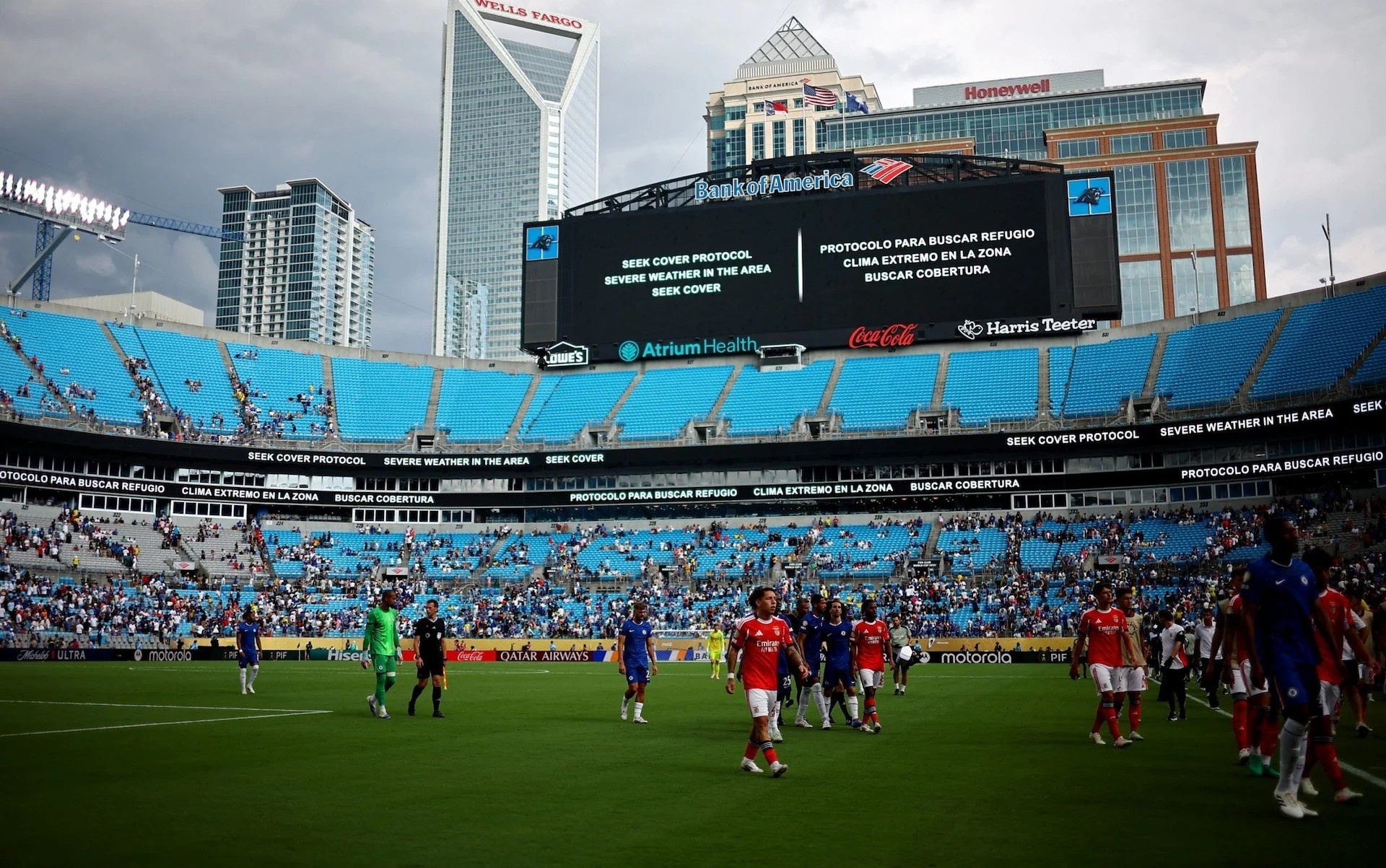 |
The electronic scoreboard at Bank of America Stadium displayed a message urging players and spectators to seek emergency shelter due to lightning strikes during the match between Chelsea and Benfica. Photo: Reuters . |
Based on climate data, Mentkowski identified the cities that are in the "red alert zone" for thunderstorms at this World Cup:
Miami & Mexico City (USA): Frequent thunderstorms with heavy lightning occur in the afternoons.
Kansas City (USA): Located in the peak of the dangerous weather season, the risk of major storms is very high.



Boston, Philadelphia & New York (USA): Hot weather combined with a sudden increase in humidity can easily cause sudden thunderstorms.
These unannounced breaks can be a "weapon" to disrupt the players' momentum.
Not knowing exactly when the game will resume will affect morale, concentration, and completely disrupt the meticulously planned nutrition and hydration schedules of the teams.
Clearly, at this World Cup, the ability to adapt to the environment is now just as important and decisive as tactics or the class of the star players.
Source: https://znews.vn/cai-kho-cua-world-cup-2026-post1658566.html
![[Photo] General Secretary and President To Lam receives Palestinian Ambassador Saadi Salama](https://vphoto.vietnam.vn/thumb/1200x675/vietnam/resource/IMAGE/2026/06/25/1782365384740_a1-bnd-9423-8322-jpg.webp)
![[Image] Schools organize meetings and introduce teaching models to students admitted to grade 10.](https://vphoto.vietnam.vn/thumb/1200x675/vietnam/resource/IMAGE/2026/06/25/1782368077271_ndo_br_z7970052192242-1ec8daeb77a6eed1a4e9f58c564ddd3e-jpg.webp)
![[Image] Ho Chi Minh City: Ma Lang area, Chicken-Rice Market about to change its appearance](https://vphoto.vietnam.vn/thumb/1200x675/vietnam/resource/IMAGE/2026/06/25/1782377698627_ndo_br_m1-jpg.webp)