

 |
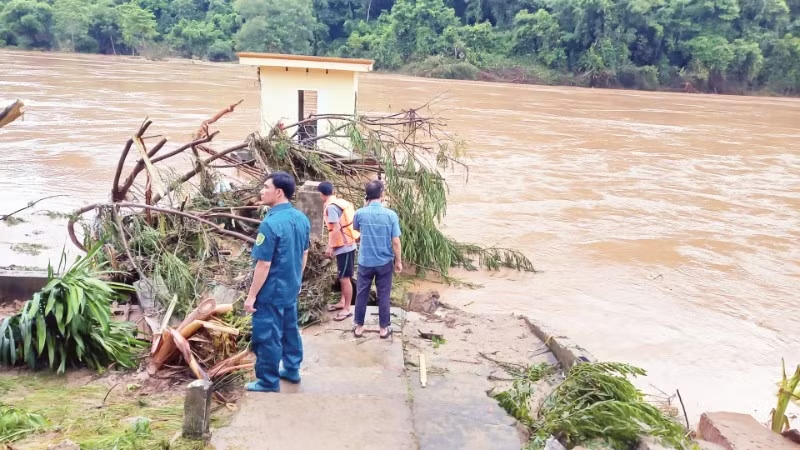
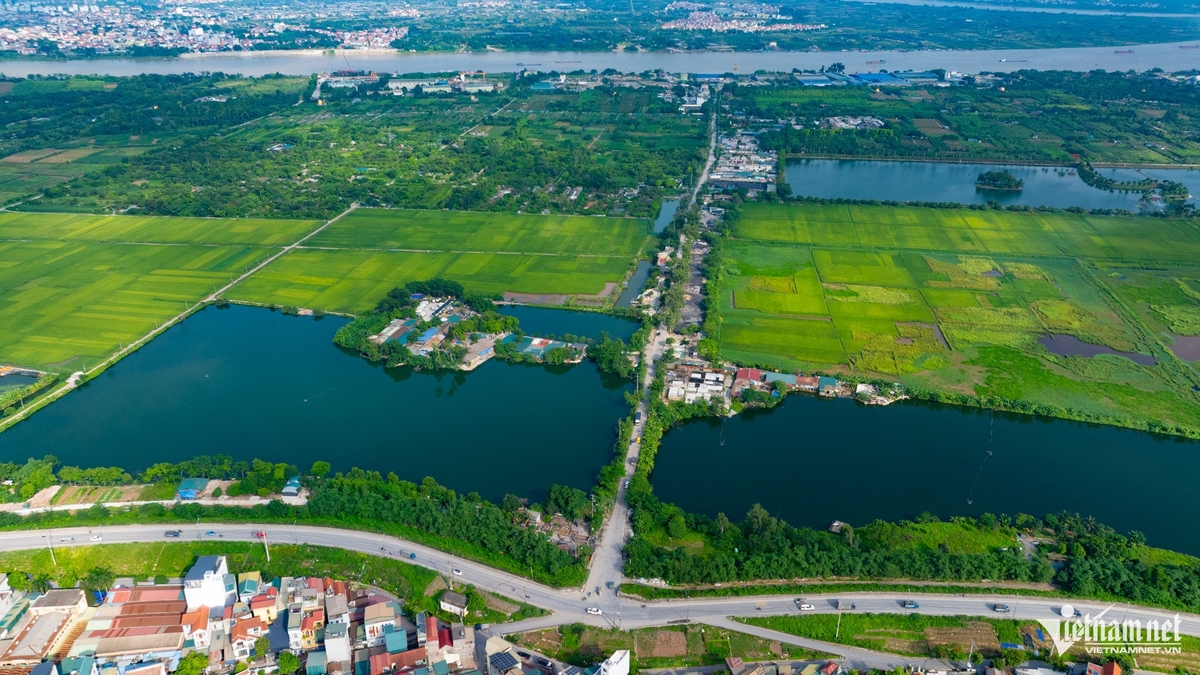
| The historic flood on the Lam River in Tuong Duong, Nghe An in 2025. |
Scientists are researching hybrid models that integrate multiple data sources and artificial intelligence (AI) to improve forecasting quality and support more effective disaster prevention and response decision-making.
The integrated hybrid solution for early warning of natural disasters, researched and introduced by the Institute of Water Resources Science (Center for Water Resources Planning and Investigation, Ministry of Agriculture and Environment ), is considered a breakthrough in natural disaster forecasting in Vietnam.
Dr. Bui Du Duong, Deputy Director of the Institute of Water Resources Science, stated: "The Hybrid solution is a forecasting solution that integrates multiple data sources and models, leveraging the strengths of each method. Compared to traditional models, this solution is more flexible, stable, and provides more accurate predictions. However, it is a supplementary solution and does not replace traditional forecasting models."
In principle, a hybrid solution combines multiple data sources and models, leveraging the strengths of each method to transform disparate data into useful information. This can improve input data, reduce errors, increase early warning value, and support decision-making.
This solution uses traditional mathematical and physical models as its scientific basis; employs remote sensing technology for wide-area observation; and uses real-world measured data for calibration and verification. In addition, it utilizes algorithms combined with artificial intelligence (AI) methods to calculate and draw conclusions. Typically, these conclusions are accurate, helping the forecasting industry reduce the error rate of the underlying data, providing accurate and timely early forecasts and warnings. Four models are applied using the Hybrid solution: rainfall and runoff forecasting; landslide warning; watershed erosion and reservoir sedimentation risk; and flood forecasting.
These solutions not only leverage traditional meteorological and hydrological data but also integrate satellite data, global meteorological models, and machine learning algorithms, thereby assisting forecasters in processing large volumes of information and providing earlier, more accurate warnings.
To implement those four models, the Institute of Water Resources Science proposed several solutions, a group of hybrid solutions in disaster forecasting and warning. These include the GM-ForcePast solution, which updates daily and can provide synchronized, high-resolution rainfall information, reducing uncertainty due to limited or uneven observation, and supporting daily reservoir operation and short-term planning.
The next solution, forecasting from 16 days to 6 months in advance, also updated daily, can predict combined rainfall from global models (GFS, ECMWF, Google). For hybrid modeling solutions, this forecasts inflow into the reservoir 16 days in advance, updated daily, combining mathematical-physical models (HYPE) and machine learning models (RF, XGBoost), enhanced by data from satellites and global meteorological models.
Besides the Hybrid model for monitoring and forecasting flow, along with solutions addressing the impact of the interconnected reservoir system on flow and sediment, early warning of landslide risk is considered a solution based on research into natural disaster patterns. This allows for predictions of landslide risk based on field data and potential rainfall. The final solution is predicting the extent, depth, and duration of flooding. In trials in the lower Mekong region, the Hybrid system was able to calculate the extent and depth of daily flooding in just about 30 seconds, with a forecast time of up to 18 days.
According to research and testing results, the Hybrid solution can increase forecast accuracy by more than 40%. Furthermore, forecasters can update and synthesize a much larger amount of information while reducing time and effort. The combination of the aforementioned solutions and groups of solutions complements and overcomes the limitations of traditional methods, contributing to the modernization of Vietnam's disaster forecasting in a faster, more accurate, and smarter direction, while also leveraging new scientific and technological achievements.
According to Nhan Dan newspaper
Source: https://baotuyenquang.com.vn/xa-hoi/202605/cai-thien-chat-luong-du-bao-thien-tai-4ae4321/






















































































Comment (0)