

Hanoi currently has over 1,300 craft villages and villages with traditional crafts, employing nearly 1 million workers. This is an important resource for promoting economic development, creating jobs, and preserving a rich cultural heritage through traditional production and business activities.
However, in this new stage of development, craft villages in Hanoi face a mix of opportunities and challenges. In particular, the majority of craft villages still operate on a small-scale, fragmented, and manual production model, hesitant to adopt new technologies in the context of digital transformation, which is seen as a driving force for increasing labor productivity. Therefore, improving digital skills for craft village workers is a mandatory requirement on the path to integration.
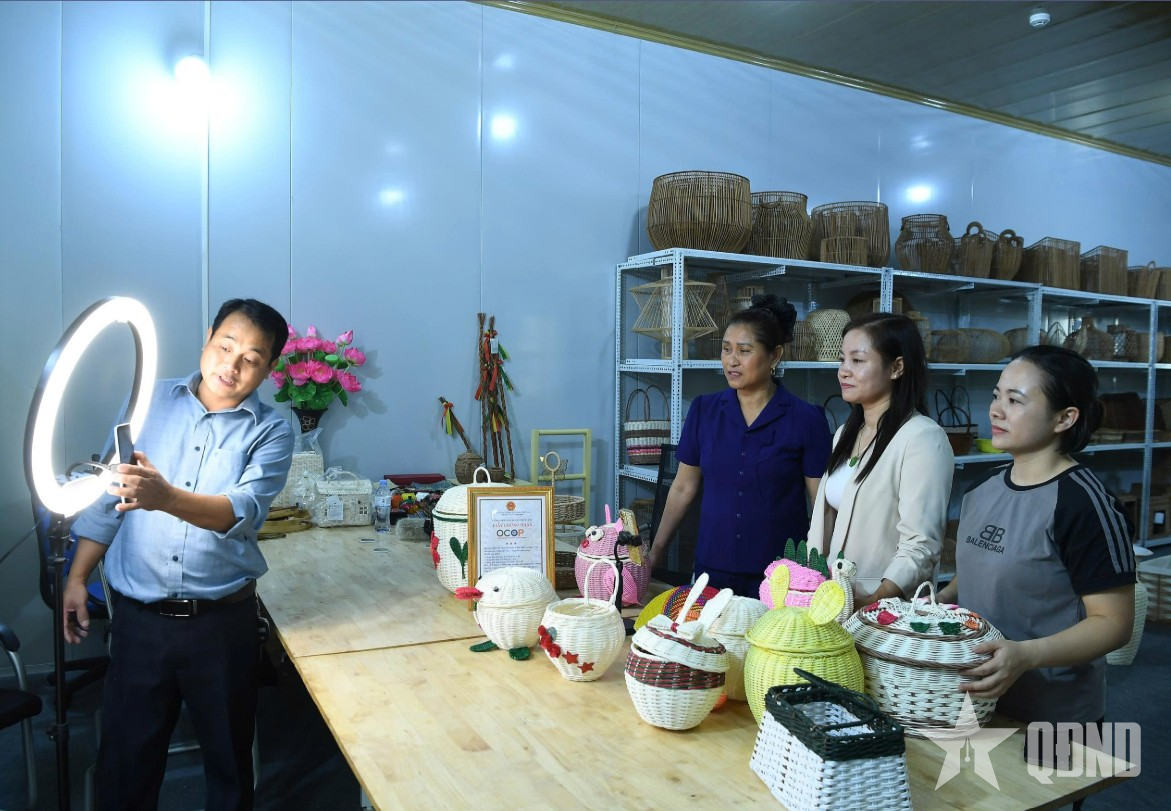 |
Officials from Phuong Duc commune (Hanoi) instruct residents on how to livestream selling goods. Photo: Phu Son. |
Currently, Hanoi has implemented a comprehensive plan for the development of craft villages in the city for the period 2025-2030, with a vision to 2050. In this plan, from now until 2030, the city aims to ensure that at least 80% of workers in craft villages and traditional craft villages receive basic training in information technology.
Speaking on a news program titled "Hanoi's Traditional Craft Villages in the Digital Age," Mr. Le Duc Thinh, Director of the Department of Cooperative Economics and Rural Development ( Ministry of Agriculture and Environment ), stated that the goal of training 80% of craft village workers in digital transformation is ambitious but entirely feasible if the right approach is taken. Specifically, it needs to be implemented in three steps. First, train key technology personnel within each craft village. Second, from that core workforce, disseminate digital knowledge to the majority of the labor force. Third, elevate the process to a higher level by forming a team of "digital artisans," individuals who both preserve the essence of traditional crafts and master modern technology.
This approach is clearly effective, based on the practical experience of Phuong Duc commune—one of Hanoi's pioneering localities in digitally transforming traditional production and business models, achieving e-commerce revenue of nearly 450 billion VND in 2025.
According to Mr. Nguyen Trong Vinh, Chairman of the People's Committee of Phuong Duc commune, the commune has built a startup and innovation design center with 3 community livestreaming rooms, providing free services to help people, businesses, and cooperatives have a professional space to promote their products, improve image quality, and effectively reach customers. In particular, to support and assist people in the digital transformation of their business models, Phuong Duc commune has organized many training courses on online sales skills, and invited celebrities and experienced e-commerce professionals to participate in hands-on training, meticulously guiding people on how to sell on social media platforms such as Facebook, TikTok, YouTube, and Zalo; teaching how to film, edit video clips, and write promotional scripts using artificial intelligence.
Comrade Nguyen Trong Vinh stated that the training process will be divided into several levels, from mass training to core groups. These core groups will then spread the spirit of innovation and guide other households in implementing digital transformation. The goal is for all residents in the commune, from young to old, to participate in the digital transformation, contributing to the fulfillment of the commune's political objectives.
Source: https://www.qdnd.vn/kinh-te/cac-van-de/chuyen-doi-so-lao-dong-lang-nghe-1041076


![[Image] Hanoi's urban life under the challenge of a "scorching hot" environment](https://vphoto.vietnam.vn/thumb/1200x675/vietnam/resource/IMAGE/2026/05/25/1779706979265_nang-nong-t5-2026-minh-duy-7-4636-jpg.webp)
![[Image] Close-up view of the interchange connecting the two expressways and Long Thanh Airport.](https://vphoto.vietnam.vn/thumb/1200x675/vietnam/resource/IMAGE/2026/05/25/1779703378210_ndo_br_z7863716673926-224453a31600126cce10622af6290afd-4549-jpg.webp)


































































































Comment (0)