

To attract talented individuals to study majors relevant to the high-speed rail project, the government needs to invest 2,000 billion VND in improving the quality of training, including scholarships for students.
Today, February 11th, the National Assembly's Committee on Science, Technology and Environment held a working session with the University of Transport and Communications to discuss several issues related to the review of the revised Railway Law project.
The highlight of the meeting was the discussion of human resource training for the railway industry, especially for preparing personnel for major national railway projects such as the North-South high-speed railway project and the Hai Phong - Lao Cai railway...
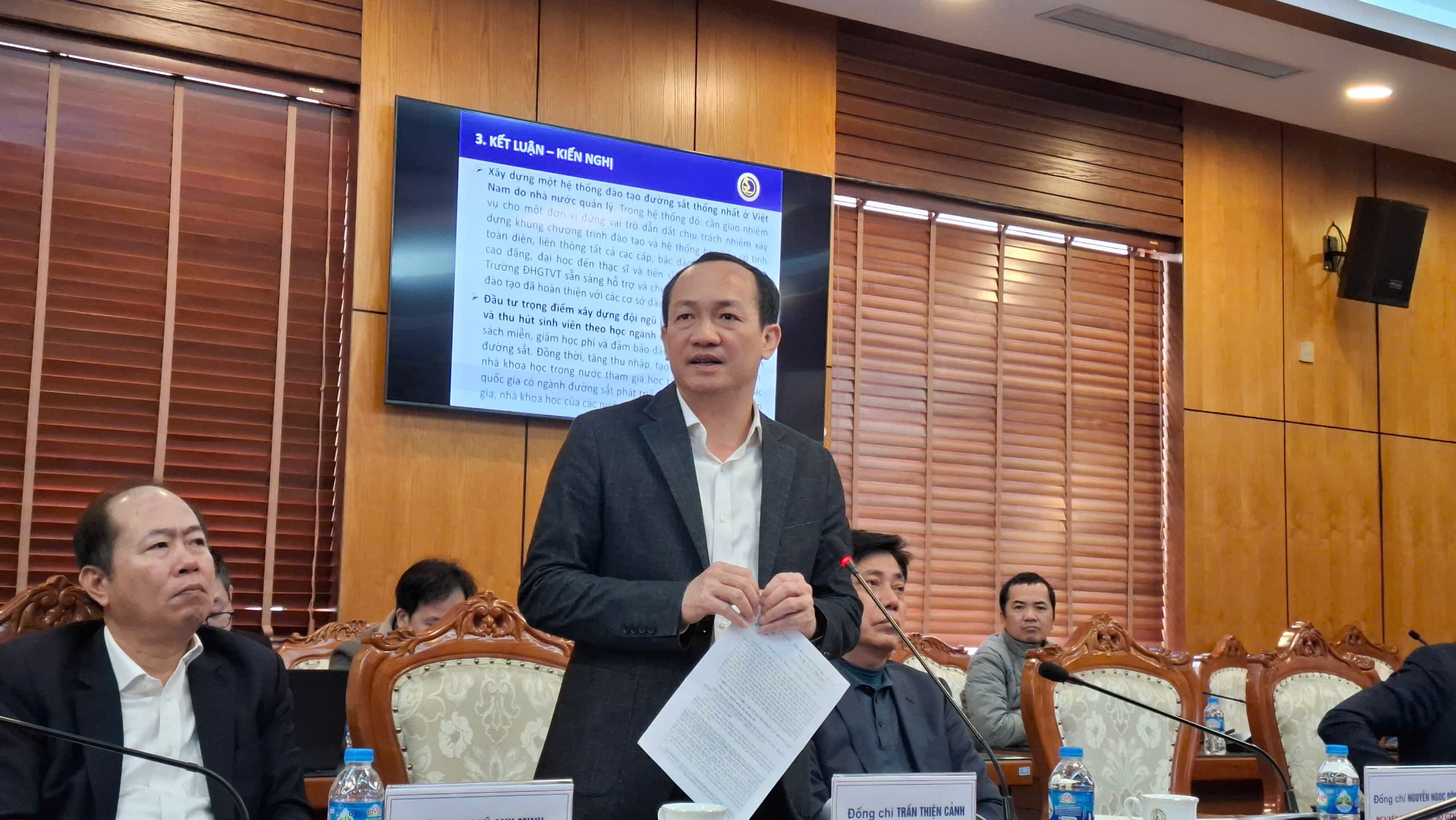
According to Mr. Tran Thien Canh, Director of the Vietnam Railway Department, the State needs to allocate 2,000 billion VND to improve the quality of railway training.
Which schools train personnel for the railway industry?
According to the University of Transport, railway human resource training in Vietnam is currently conducted at two main levels. Training of technical workers (train drivers, vehicle maintenance and repair, bridge and track infrastructure, information and signaling) is primarily undertaken by the Railway College under the Vietnam Railway Corporation .
Regarding training at the university level and above, there are three main institutions participating: the University of Transport, the Ho Chi Minh City University of Transport, and the University of Transport Technology. In addition, the University of Construction, the University of Technology - Da Nang University, and the University of Water Resources are also researching the possibility of opening several majors related to railways.
However, this is an unattractive field of study that receives little investment, resulting in a severe shortage of high-quality personnel. Even at the University of Transport and Communications, out of 90 PhDs in civil engineering for transportation infrastructure, only 5 specialize in railway engineering.
Many key positions in the fields of engineering, operational management, and railway safety lack sufficient personnel, especially in areas related to high-speed rail and urban rail. The number of students choosing to pursue postgraduate or doctoral studies is very limited.
"Although the demand for human resources and mastery of core technologies in the modern railway sector is currently very high, compared to other engineering and economic fields, the attractiveness of this sector to society is still limited. The majority of students studying railway engineering at railway training institutions choose dual degree programs, part-time programs, or short-term training courses," shared Associate Professor Nguyen Van Hung, Rector of the University of Transport.
We need 4,000 scholarships for outstanding students.
Mr. Tran Thien Canh, Director of the Vietnam Railway Department, also noted that Vietnam's current railway workforce only meets the basic needs of the existing railway system. Given the future development needs of the railway industry, the State needs appropriate policies to expand the scale and improve the quality of human resource training in various areas: management, construction, operation, etc.
According to the pre-feasibility study report for the North-South high-speed railway project, the workforce for operation and maintenance (train operation and system maintenance, from 2035-2036) alone will need approximately 13,880 workers, of which about 20% will have a university degree or higher, and the remainder will be workers with intermediate or college-level qualifications.
Over the next few years, the project management workforce will need approximately 500 people, while the consulting sector will require 1,200-1,300 people.
The construction sector has the largest demand for manpower, reaching 220,000-240,000 people. At its peak, this sector needed 18,000-20,000 engineers, with 20-30% of them being engineers specializing in railway construction (infrastructure, railway vehicles).
According to Mr. Canh, all personnel involved in the construction and operation of new railway lines, especially the North-South high-speed railway, must undergo basic training, meaning 20,000-25,000 personnel with a university degree or higher. Currently, the capacity of domestic universities meets the human resource requirements for the project. However, the issue lies in the quality of training.
"To attract high-quality students to enroll in majors related to high-speed rail, the state budget needs to allocate approximately 2,000 billion VND (equivalent to 80 million USD) to make this field of study more attractive."
"This money will be used for: training teaching staff, especially in the specialized field of high-speed rail (expected to send 100 master's degree holders and 10 doctoral degree holders abroad); providing 4,000 scholarships to attract talented individuals; and equipping laboratories and practical simulation equipment," Mr. Canh said.
Source: https://thanhnien.vn/can-2000-ti-dong-de-dao-tao-nhan-luc-chat-luong-cho-duong-sat-toc-do-cao-185250211172920033.htm


![[Photo] Prime Minister Pham Minh Chinh presides over a meeting on private sector economic development.](/_next/image?url=https%3A%2F%2Fvphoto.vietnam.vn%2Fthumb%2F1200x675%2Fvietnam%2Fresource%2FIMAGE%2F2025%2F12%2F20%2F1766237501876_thiet-ke-chua-co-ten-40-png.webp&w=3840&q=75)




















































































Comment (0)