


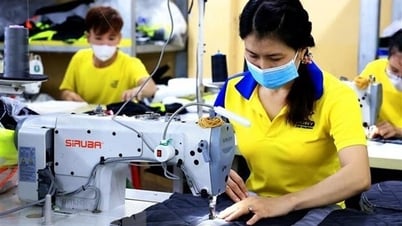
Many textile and garment businesses are facing difficulties in sourcing raw materials and accessories - Photo: CONG TRIEU
Many businesses are hesitant to sign new contracts due to concerns about risk. Authorities are working to ensure growth, but strong government support mechanisms are also needed.
Businesses adopt a "defensive" approach, seeking new paths.
Speaking to Tuoi Tre newspaper, Mr. Pham Quang Anh, Director of Dony Garment Co., Ltd., said that the biggest problem currently is not the high price of raw materials, but the constant and unpredictable fluctuations.
He cited an example of a large order to Africa: Although the client requested a price quote to finalize the order within the next month, the company hesitated to accept it due to the risk. A high price might lead to losing the client, and they would likely not accept it; a low price, only to have raw material costs increase the next day, would result in significant losses for the business. Therefore, he had to find a way to get the client to wait a few more weeks for the market trend to become clearer.
For orders signed before Tet (Lunar New Year), businesses are forced to negotiate risk-sharing with partners. For example, in a case where an order to the US saw a cost increase of $0.30 per product, Dony agreed that each party would bear half of the cost ($0.15), even though this significantly reduced the company's profits.
Amidst the volatile raw material market, Mr. Anh stated that Dony's long-term plan prioritizes outsourcing. Instead of being self-sufficient in raw materials, the company will focus on the labor aspect (customers will supply the raw materials).
This approach helps businesses avoid being affected by fluctuations in the prices of fabrics, plastics, etc., while ensuring production for the factory and preventing order shortfalls when customers temporarily stop placing orders while waiting for better prices.
Some other businesses say that the biggest challenge facing the garment industry today is no longer in sales but in the procurement of raw materials and accessories.
Many suppliers now no longer sell goods based on "promises" or deferred payment contracts, but require 100% cash payment before delivery.
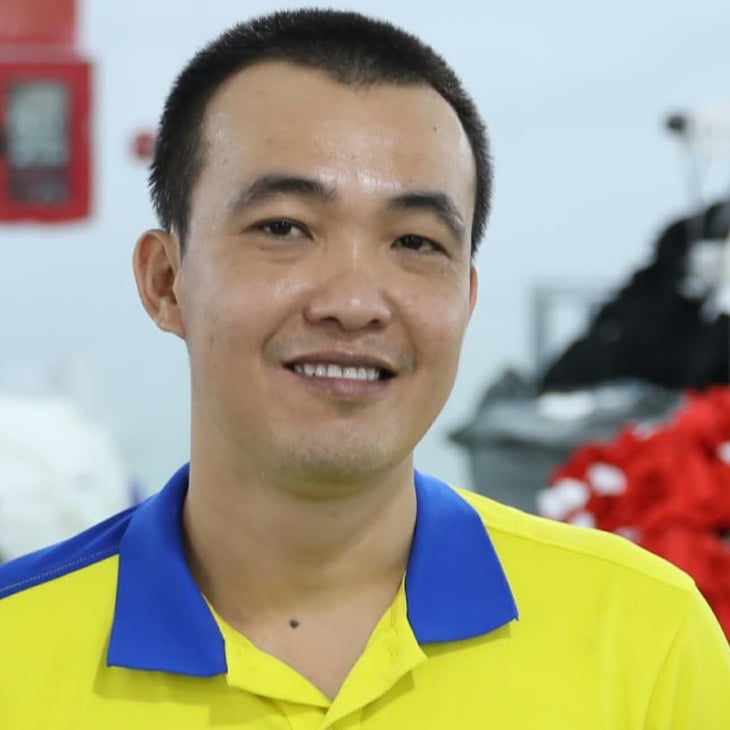 Mr. Pham Quang Anh
The government needs to focus on three driving forces.
Tensions in the Middle East, particularly concerning Iran, have caused significant volatility in energy markets. In stock markets, geopolitical shifts often lead to more cautious international capital flows, especially in emerging markets.
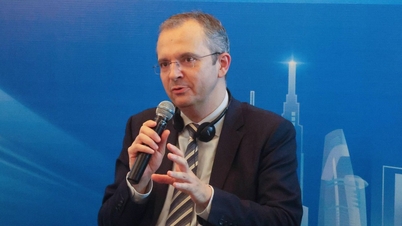
Michael Kokalari, Director of Macroeconomic Analysis and Market Research at VinaCapital, believes that Vietnam's economy faces high expectations in 2026. After growing by approximately 8% in 2025, GDP this year could reach around 10%.
According to him, the outlook for 2026 is supported by three main drivers: infrastructure investment, exports, and institutional reforms linked to the private sector.
With public debt remaining low compared to many economies in the region, Vietnam has fiscal space to boost infrastructure spending. However, rising oil prices could increase transportation, logistics, and production costs, leading to the risk of cost-push inflation. This complicates the management challenge of maintaining growth while keeping prices stable.
Emphasizing expectations for institutional reform, experts from VinaCapital believe that reforms within the framework of "Innovation 2.0" could contribute approximately 2 percentage points to GDP growth in the long term. New sectors such as data centers, TOD (Transit-Oriented Development), energy, and finance are opening up new growth opportunities but simultaneously require a flexible and predictable institutional framework.
From a business perspective, Mr. Vo Phi Nhat Huy, Chairman of the Board of Directors of Big Group Holdings Investment Joint Stock Company, believes that the biggest bottleneck currently lies not in policy but in the quality of institutional implementation and governance capacity. Without improving consistency in implementation and reducing compliance costs, many investment decisions may continue to be delayed. In particular, this also affects the ability to protect those who dare to think outside the box.
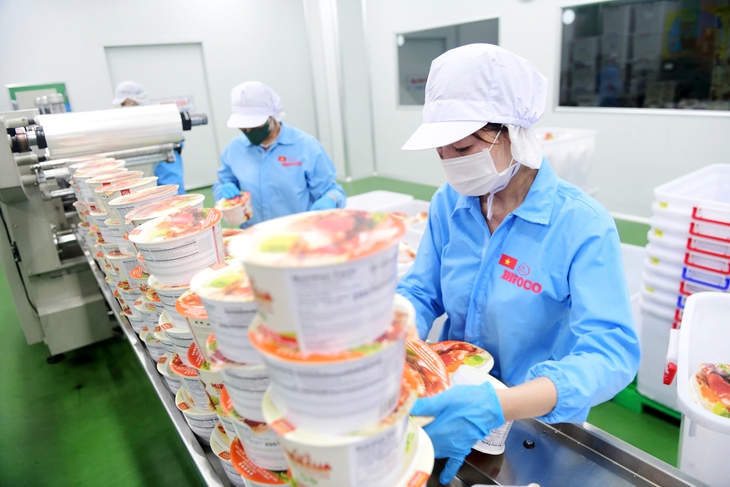
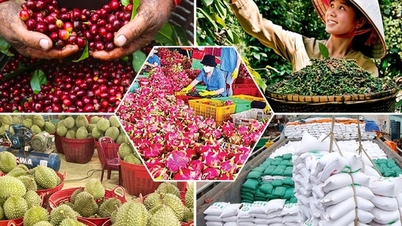
Packaging products for export in Tan Thuan Export Processing Zone (Ho Chi Minh City) - Photo: QUANG DINH
A comprehensive and far-reaching approach is needed.
Many experts and businesspeople have proposed solutions that Vietnam previously implemented in its economic support packages during difficult times.
To help businesses overcome difficulties, Mr. Pham Quang Anh believes that, in addition to the State ensuring the supply of basic goods such as gasoline and oil, the crucial factor at this time is maintaining cash flow for businesses.
The government can provide support through tax exemptions, extensions of tax payment deadlines, or subsidized bank interest rates. Having readily available cash allows businesses more flexibility in purchasing raw materials when suppliers require immediate payment, and provides resources to handle unexpected fluctuations.
Furthermore, the business community also desires improvements in administrative procedures and the activation of special mechanisms to quickly address obstacles in the current period of rapid market volatility.
Mr. Pham Binh An, Deputy Director of the Ho Chi Minh City Development Research Institute, believes that in order to achieve high growth targets amidst a volatile global economy, Ho Chi Minh City needs to implement a comprehensive set of solutions right from the beginning of the year.
Ho Chi Minh City needs to focus its resources on key national and local infrastructure projects, especially transportation, logistics, and high-tech zones in interconnected economic regions such as the merged Binh Duong and Ba Ria - Vung Tau areas.
Simultaneously, it is necessary to expedite the removal of obstacles related to procedures, land, and site clearance; and apply special mechanisms according to Resolution 98 and related adjustments to shorten project approval times.
Ho Chi Minh City needs to support businesses in boosting production in the first quarter to take advantage of the temporary period when the 15% US tariff is still in effect, before it may change after about 150 days. In addition, it needs to diversify export markets and strengthen the exploitation of trade agreements to expand into the EU, Japan, and South Korea.
The city should also organize trade promotion programs early, support small and medium-sized enterprises in ensuring transparent supply chains, and improve certificates of origin (C/O) to avoid the risk of being investigated for tax evasion. At the same time, it should implement large-scale consumer stimulus programs linked to shopping events and festivals in Ho Chi Minh City...
Mr. An suggested that the city needs to effectively control price levels to both stabilize the economy and support domestic consumption. At the same time, it must ensure a stable energy supply, coordinating between major enterprises such as Petrolimex and Petrovietnam in guaranteeing the supply of gasoline, diesel, and natural gas.
Solutions such as activating strategic energy reserves, finding alternative sources of supply when necessary, monitoring prices, and encouraging energy conservation should also be considered.
Risks to monitor
According to Dr. Chu Thanh Tuan, Deputy Head of the Bachelor of Business program at RMIT University, recent developments in the energy market demonstrate the sensitivity of the Vietnamese economy to external shocks. Therefore, Vietnam needs to maintain fiscal discipline and close supervision to ensure the safety of the banking system.
VinaCapital's 2026 strategic report reveals that Vietnam's growth picture is not entirely uniform. Domestic consumption, which accounts for over 60% of GDP, remains slow to recover as the upward trend in household savings persists after the pandemic.
Another risk lies in the liquidity of the banking system. In 2025, credit growth is projected to reach approximately 19% while deposits are expected to increase by only about 15%, creating a significant gap (around $40 billion). This imbalance has led to higher deposit interest rates and may continue to rise in 2026.
Source: https://tuoitre.vn/can-goi-giai-phap-ho-tro-nen-kinh-te-20260316081814518.htm

![[Photo] The heat at the fireworks display site on the opening night of the Da Nang International Fireworks Festival 2026](https://vphoto.vietnam.vn/thumb/1200x675/vietnam/resource/IMAGE/2026/05/27/1779889741485_ndo_br_z7872039145157-fecaba5112f39e8352544099d7ef4738-5140-jpg.webp)
![[Photo] The courage of new recruits of Brigade 144 on the training ground.](https://vphoto.vietnam.vn/thumb/1200x675/vietnam/resource/IMAGE/2026/05/27/1779881651341_anh-man-hinh-2026-05-27-luc-18-32-52.png)














































![[Photo] The courage of new recruits of Brigade 144 on the training ground.](https://vphoto.vietnam.vn/thumb/402x226/vietnam/resource/IMAGE/2026/05/27/1779881651341_anh-man-hinh-2026-05-27-luc-18-32-52.png)

























Comment (0)