

Over the past 10 years, the teaching and learning of foreign languages in Vietnam has developed rapidly, especially in regions with favorable socio -economic conditions and major cities. Along with the growth in scale, the quality of teaching and learning has also increased, reflected in the diversity and richness of approaches taken by both learners and teachers.
Experts believe that gradually making English the second language in schools will not be easy in the beginning. However, it is not impossible, as the legal framework, practical effectiveness, and investment in expertise and infrastructure provide a good foundation for implementing this significant initiative.
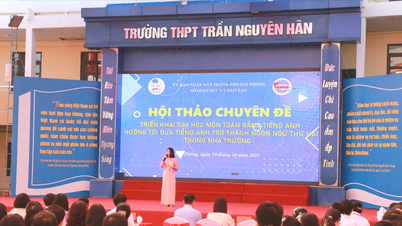
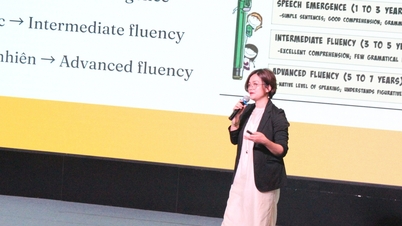
At the seminar, Associate Professor, Dr. Ha Le Kim Anh, Vice Rector of the University of Foreign Languages (Vietnam National University, Hanoi), stated that over the past 10 years, English language teaching in Vietnam has seen many positive changes. Several legal frameworks related to foreign languages in general and English in particular have been issued. Along with the active implementation of the Foreign Language Project 2020, with the attention of the Party, Government, and the Ministry of Education and Training , English language teaching and the development of English teachers at the secondary and university levels have received attention and yielded certain results.
At the Ministry of Education and Training's 2023 Annual Report Conference, survey results showed that the majority of students are interested in learning English. This is a favorable condition for promoting English teaching in secondary schools, gradually making English a second language.
According to Vo Hong Hanh, Director of Marketing and Communications at the British University Vietnam (BUV), students who are proficient in English will have many educational opportunities. For example, good English opens doors to English-speaking countries. Leading countries in education worldwide, such as the UK, the US, Australia, and Canada, all use English. Having good English skills naturally makes it a tool to find suitable opportunities, including scholarships. Even if studying abroad isn't possible, English still opens up similar opportunities within Vietnam.
From the perspective of a local education management agency, Dr. Le Duc Thuan, Head of the Education and Training Department of Ba Dinh District (Hanoi), stated that the general difficulties in teaching foreign languages in general and English in particular mainly stem from two issues. Firstly, there is a shortage of teachers in both quantity and quality. The reasons for this have been analyzed extensively by the delegates, ranging from salary issues to the student recruitment sources of universities.
Secondly, while the objectives of the 2018 general education program were established, implementation has led to a situation where teachers teach solely for exam purposes, students study to pass exams, and parents enroll their children for grades… consequently, the objectives of foreign language teaching have been distorted. While students may be confident in reading and writing, their communication skills remain limited.
To achieve the goal of making English the second language in schools, Deputy Chair of the National Assembly's Committee on Culture and Education, Nguyen Thi Mai Hoa, believes that the first step is to further improve the legal framework. In addition, policies and strategies must be developed, concretized into specific projects, and these projects must prioritize training for teachers. Following that are projects related to infrastructure.
Affirming that English is considered a global communication tool, Deputy Editor-in-Chief of the People's Representatives Newspaper Le Thanh Kim emphasized that it is the "key" to accessing the vast amount of knowledge and information of world civilization.
Understanding and using English proficiently helps improve the quality of education and training, making a significant contribution to promoting the country's development and international integration.
Many countries consider English a second language, such as India, Singapore, Malaysia, Nigeria, and the Philippines. The fundamental difference between English as a foreign language and English as a second language lies in the level of usage and its importance in social life and administrative activities. In places where English is only a foreign language, it is not widely used outside of academic settings. However, the transition from a foreign language to a second language is entirely possible if there are changes in policy and societal needs, as is the case in Singapore and India.
On August 12, 2024, the Politburo issued Conclusion 91-KL/TW on continuing to implement Resolution 29-NQ/TW dated November 4, 2013, of the 11th Central Committee of the Communist Party of Vietnam, "On fundamentally and comprehensively reforming education and training to meet the requirements of industrialization and modernization in the context of a socialist-oriented market economy and international integration." An important point mentioned in Conclusion 91-KL/TW is: "Focus on improving the foreign language proficiency of students, gradually making English the second language in schools."
Source: https://nhandan.vn/dua-tieng-anh-tro-thanh-ngon-ngu-thu-2-trong-truong-hoc-can-lo-trinh-trien-khai-tung-buoc-post833348.html

![[Photo] Prime Minister Pham Minh Chinh presides over a meeting on private sector economic development.](/_next/image?url=https%3A%2F%2Fvphoto.vietnam.vn%2Fthumb%2F1200x675%2Fvietnam%2Fresource%2FIMAGE%2F2025%2F12%2F20%2F1766237501876_thiet-ke-chua-co-ten-40-png.webp&w=3840&q=75)


















































































Comment (0)