

The story shared by Ms. Vu Thi Thu Hang, founder and developer of the M-English program for learning English through storytelling and creative music , in the workshop "Building schools using English as a second language: Practice and solutions" that took place today, December 6, in Ho Chi Minh City, made school owners, teachers, and guests all nod in agreement because it was so true. It reflects a story that has been happening for a long time, in many schools and kindergartens.
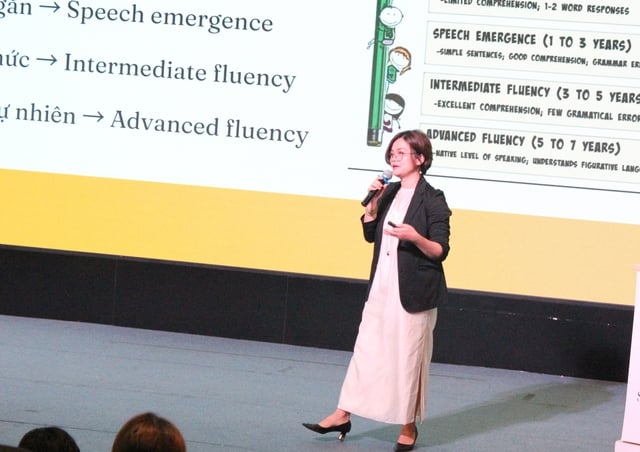
Master Vu Thi Thu Hang shared at the workshop on December 6.
PHOTO: THUY HANG
Parents need to see many pictures of their children in English classes to feel secure. It has become familiar for teachers to let children sit in a row below, and the rest of the children step forward one by one, the teacher holding flashcards (learning cards) with pre-printed colors, fruits, animals, the children read the English words and the teacher records the video and sends it to the parents. But the question is, is this way of doing things effective in creating an English environment in kindergarten? Or are we just trying to please parents, using parents as the center for enrollment and not focusing on children - the real goal of education today?
Two thought-provoking stories about speaking English
Master Vu Thi Thu Hang told a story, once a foreigner told her, among many Asian people, to check whether a person is Vietnamese or not, he just needs to ask the question "How are you?". If the answer is "I'm fine, thank you, and you?", then almost 100% this person is Vietnamese.
Or many parents think that preschool children also learn English by memorizing vocabulary, knowing how to write, how to read, for example, when they come home they ask their child "What is apple in English?", but they don't see that the child knows how to read "apple", so they go to school and complain to the preschool teacher "my child learns English but doesn't know anything".
"Many Vietnamese people are using English not as a language but as a subject. And this is also the mindset of many parents, English is not as a language in life but as a subject, so parents are primarily concerned about their children's scores. Therefore, we often see, the familiar question of many parents when coming to find out about schools for their children is "How many English lessons do your children study a week?", said Master Hang.
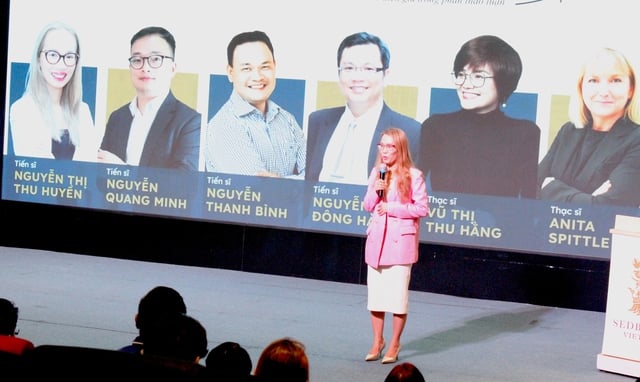
Doctor of Education Nguyen Thi Thu Huyen, head of the organizing committee, introduces the speakers participating in the conference.
PHOTO: THUY HANG
Teaching English to preschool children requires skills in preschool pedagogy.
Master Vu Thi Thu Hang also pointed out the current reality that many English teachers in preschools do not have knowledge and skills in preschool pedagogy, therefore they do not grasp the psychological characteristics of preschool children, do not understand how children absorb knowledge from their daily environment. Preschool children learn through emotions, through their hearts, from people they trust and love, not learning the way high school students do. Therefore, there are English teachers who are good at pronouncing English, but are extremely confused when entering a class of 1-year-old children who do not even know how to speak, just crawling around the classroom.
Master Hang emphasized that it would be great if we could educate children bilingually from preschool. The golden window for language development, the reason why we should start bilingualism from preschool is because there are many advantages in developing cognitive and language abilities.
According to Master Hang, the principle of implementing the construction of kindergartens where children use English as a second language is to choose methods appropriate to the context, avoid language overload, and ensure priority is given to developing the mother tongue. At the same time, the role of parents is to create a supportive environment at home, coordinate with the school to reinforce natural language, not to consider English for preschool children as a subject.
According to Master Hang, the approach models for preschool children using English as a second language are full immersion, partial immersion, bilingual teacher - English teaching assistant model, simple CLIL model (CLIL - abbreviation of "Content and Language Integrated Learning", meaning integrated learning of content and language).
Ms. Hang also emphasized that repetition is the foundation of language learning. However, in order for preschool children to maintain motivation and absorb deeply, teachers need to apply repetition without getting bored. For example, learning about colors does not mean showing children flashcards and reading them over and over again. Teachers can teach children to sing, tell creative stories, and help them develop natural language.
"Pay attention to connecting children's emotions and pay attention to the principle that children need to feel safe first, have positive emotions first, and learn language later. Children learn language best from people they feel attached to. Be careful not to correct mistakes immediately, encourage children to make efforts rather than demanding perfection. Remember, emotions and experiences are the most sustainable languages," said Ms. Hang. This is also the reason Ms. Hang told the story of a teacher who had to take more than 100 photos in 30 minutes of children learning English to send to parents. So can the emotional and experiential factors of the teacher and the children be guaranteed?
Become a global citizen but do not forget Vietnamese identity
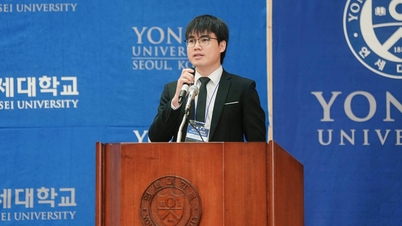
The workshop "Building schools using English as a second language: Practice and solutions" was organized by Dr. Nguyen Thi Thu Huyen, a doctor of education.
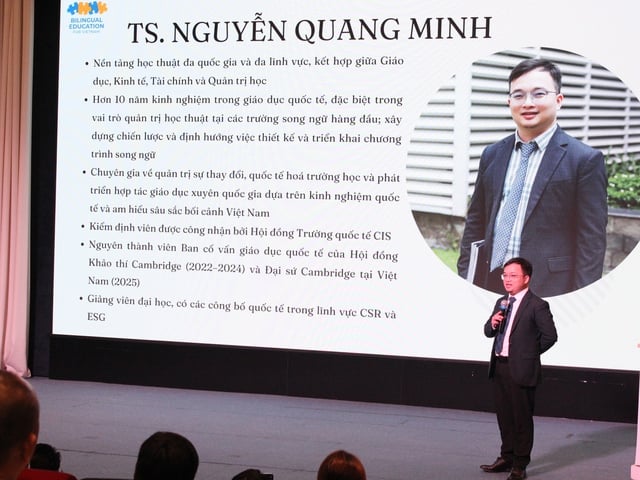
Dr. Nguyen Quang Minh presented at the conference
PHOTO: THUY HANG
Besides Dr. Nguyen Thi Thu Huyen and Master Vu Thi Thu Hang, the workshop also had the participation of Dr. Nguyen Quang Minh; Dr. Nguyen Thanh Binh, Head of English Department and Deputy Head of the Management Board of the National Foreign Language Project, Ho Chi Minh City University of Education; Dr. Nguyen Dong Hai.
The message throughout the conference was "Bilingualism is not only language ability but also integration ability, opening up global citizenship opportunities for Vietnamese students".
According to the speakers, the decisive factor for the success of schools using English as a second language is the role of policy, teacher capacity, curriculum and learning resources. And the global trend is shifting from bilingual "language learning" to bilingual "learning through language" (CLIL). Regarding the vision for the next 10 years, the speakers proposed the direction of bilingual education development in the context of integration - how to help students become global citizens while still preserving Vietnamese identity.
Source: https://thanhnien.vn/gio-tieng-anh-30-phut-giao-vien-mam-non-phai-chup-104-buc-hinh-185251206125131022.htm
![[Photo] 60th Anniversary of the Founding of the Vietnam Association of Photographic Artists](/_next/image?url=https%3A%2F%2Fvphoto.vietnam.vn%2Fthumb%2F1200x675%2Fvietnam%2Fresource%2FIMAGE%2F2025%2F12%2F05%2F1764935864512_a1-bnd-0841-9740-jpg.webp&w=3840&q=75)



![[Photo] National Assembly Chairman Tran Thanh Man attends the VinFuture 2025 Award Ceremony](/_next/image?url=https%3A%2F%2Fvphoto.vietnam.vn%2Fthumb%2F1200x675%2Fvietnam%2Fresource%2FIMAGE%2F2025%2F12%2F05%2F1764951162416_2628509768338816493-6995-jpg.webp&w=3840&q=75)


































































Comment (0)