

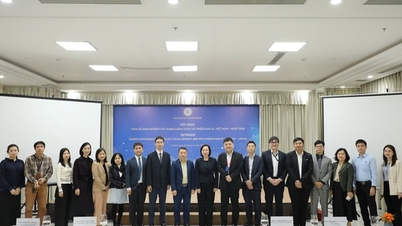
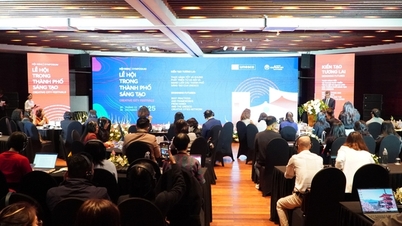
On December 5, the Vietnam Institute of Educational Sciences hosted the 2025 educational science conference with the theme "Education in the era of national development". One of the issues discussed was the implementation of the Project to make English the second language in schools.
At the conference, Mr. Nguyen The Son, Deputy Director of the General Education Department (Ministry of Education and Training), said that the project will be applied in preschool, general education, university, vocational and continuing education facilities nationwide; It is estimated that it will impact about 50,000 educational facilities with nearly 30 million children, students and about 1 million managers and teachers.
The project implementation period is 20 years (from 2025 - 2045). Phase 1 (2025 - 2030) will build the foundation and standardize; Phase 2 (2030 - 2035) will expand and enhance the use of English; Phase 3 (2035 - 2045) will complete and improve, English is used naturally, developing the English ecosystem in the educational environment, communication and school administration.

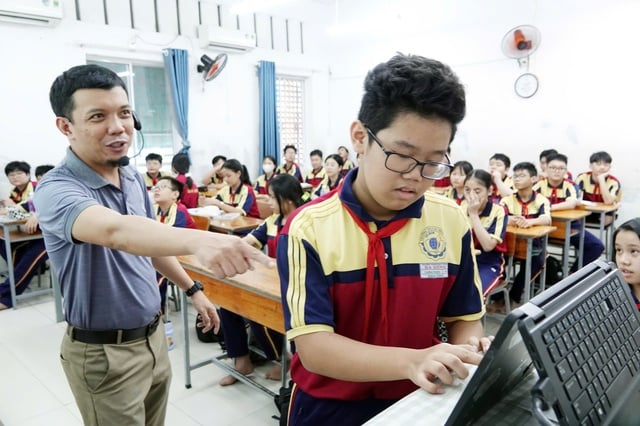
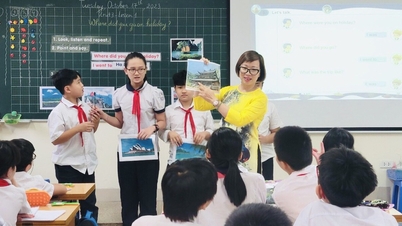
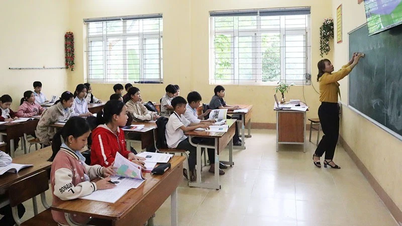
An English lesson for students in Mu Cang Chai ( Lao Cai ). Lack of teachers is a big challenge when implementing the project of making English the second language in schools.
PHOTO: TUE NGUYEN
Regarding resource conditions, for preschool education, to successfully implement the project, there will be an additional 12,000 English teacher positions in public preschool education institutions nationwide.
For primary schools, nearly 10,000 more English teachers will be created. In addition, it is necessary to train and foster English and professional and pedagogical skills for at least 10% (200,000) of teachers teaching in English from now until 2035.
ENGLISH IS AN ELECTIVE SUBJECT. IS THERE ANY OBSTACLE IN IMPLEMENTING THE PROJECT?
Mr. Do Duc Lan, Vietnam Institute of Educational Sciences , on behalf of the research team, presented some current situations of teaching and learning English in high schools from the survey results with thousands of teachers and students across the country.
Accordingly, about 40% of students surveyed were not confident about their English ability even though their results on their profile were still good; similarly, according to teachers' assessment, about 35% of students were at the "nearly satisfactory" level in English; about 14% of students said that the English test and assessment were not appropriate. The rate of students feeling pressured and very pressured when learning English was also high; lack of practice environment, not regularly assessing listening and speaking skills, lack of conditions to ensure teaching this subject... are also challenges when making English a second language.
The rate of teachers who can teach subjects in English in all schools is very low; many managers and teachers interviewed said that it is difficult to implement teaching in English due to staffing issues.
Mr. Do Duc Lan said that it is necessary to consider the context that this year English has become an optional subject instead of a compulsory subject in the high school graduation exam as before. Regarding this issue, Mr. Lan also asked whether there are any obstacles to implementing the project of English becoming a second language when a foreign language becomes an optional subject in the high school graduation exam?
However, Mr. Nguyen The Son also emphasized that the project should be implemented first in places where conditions permit, not all places can do it simultaneously when implementing the project. In addition, it is necessary to ensure the preservation of the mother tongue and national cultural identity while teaching the language of neighboring countries in border localities.
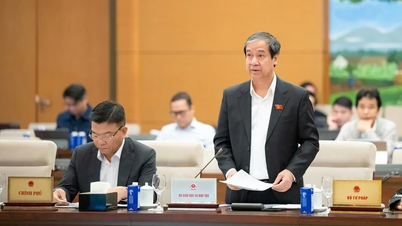
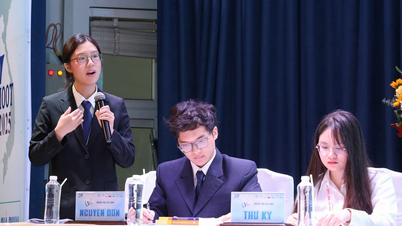
There needs to be a strong enough policy to attract English teachers.
Photo: Dao Ngoc Thach
BEFORE DECEMBER 15, ISSUING A SPECIFIC IMPLEMENTATION PLAN
Mr. Nguyen The Son said that according to the request of the Ministry of Education and Training, before December 15, a plan to implement the project with specific requirements will be issued.
Professor Le Anh Vinh, Director of the Vietnam Institute of Educational Sciences, raised the issue: the lack of teachers is a huge challenge in implementing the project, so what advice and solutions does the Ministry of Education and Training have to solve this problem?
Mr. Son said that the problem of teacher shortage is not only in English but also in other subjects. The General Education Department will coordinate with the Department of Teachers to advise on short-term and long-term solutions. Reiterating the view that this project "cannot be done all at once", Mr. Son said that localities must have calculations to have the most appropriate implementation plan, especially the issue of team building.
Mr. Son proposed solutions such as having policies to attract teachers in disadvantaged areas, having mechanisms for foreign teachers to participate in teaching, and contracting with non-staff teachers to teach in public schools...
Discussing the investment policy of the National Target Program on modernization and improvement of education and training quality in the period 2026 - 2035, National Assembly delegate Tran Khanh Thu (Hung Yen) pointed out the reality: "Many general schools have not met the standards for technological equipment for foreign language learning, many remote schools in ethnic minority areas do not have solid classrooms. The serious shortage of qualified English teachers is still a major bottleneck. So when the equipment is invested, will there be enough qualified teachers to be able to use these devices when implementing English teaching and learning?"
Therefore, Ms. Thu suggested that there should be a specific roadmap to implement these contents, especially in mountainous provinces and difficult areas. Ms. Thu suggested that there should be strong enough policies to attract quality English teachers such as increasing the attraction allowance up to 70 or even 100% of the basic salary for teachers in difficult areas, supporting housing with long-term contract commitments... In addition, there should be policies to promote the application of technology to connect online classrooms, using artificial intelligence (AI) to support to compensate for the lack of teachers...
Source: https://thanhnien.vn/thach-thuc-khi-tieng-anh-thanh-ngon-ngu-thu-hai-18525120522392865.htm

![[Photo] 60th Anniversary of the Founding of the Vietnam Association of Photographic Artists](/_next/image?url=https%3A%2F%2Fvphoto.vietnam.vn%2Fthumb%2F1200x675%2Fvietnam%2Fresource%2FIMAGE%2F2025%2F12%2F05%2F1764935864512_a1-bnd-0841-9740-jpg.webp&w=3840&q=75)
![[Photo] National Assembly Chairman Tran Thanh Man attends the VinFuture 2025 Award Ceremony](/_next/image?url=https%3A%2F%2Fvphoto.vietnam.vn%2Fthumb%2F1200x675%2Fvietnam%2Fresource%2FIMAGE%2F2025%2F12%2F05%2F1764951162416_2628509768338816493-6995-jpg.webp&w=3840&q=75)





















































































Comment (0)