

Experts say that what is important is not the name, but the quality standards and the real guarantee system.
Quality is the condition
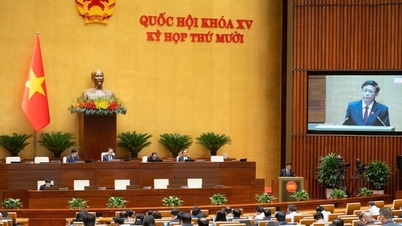
At the discussion of the 10th Session of the 15th National Assembly on the investment policy of the National Target Program on modernization and improvement of education and training quality in the period 2026 - 2035, some National Assembly delegates expressed their opinions that only medical schools should be allowed to train doctors, or that non-law schools should not be allowed to train bachelors of law but could teach law as a combined subject. The proposal immediately generated many responses from experts, as the story of "specialized - non-specialized schools" touched both the legal framework and philosophy of modern universities.
Dr. Dang Thi Thu Huyen - Dean of the Faculty of Law - Nguyen Tat Thanh University said that limiting training rights based on names is unconvincing if viewed from the perspective of university education system management.
She analyzed that in many countries with developed universities such as the United States, the United Kingdom, Canada or Australia, medical and law training programs are implemented at multidisciplinary universities, not associated with the name of Medical School or Law School. "The problem does not lie in the name of the school, but the focus must lie in the conditions for quality assurance," Dr. Thu Huyen emphasized.
According to Dr. Huyen, for a system to operate effectively, it must look at the program accreditation system, the capacity of the teaching staff, the practice-internship conditions, the academic ecosystem and output standards. If the right to train depends on the name of the school, it not only contradicts the principle of university autonomy, but also goes against the interdisciplinary development trend of world education.
Dr. Hoang Ngoc Vinh - former Director of the Department of Vocational Education ( Ministry of Education and Training ), also opposed the use of the labels "specialized medical school" and "specialized law school" to limit training rights. According to Dr. Vinh, this concept does not exist in any legal document: "Calling specialized medical school or specialized law school is mainly a way of speaking, even being elevated to traditional prestige, not legal standards. If we use a label that does not exist in the law as a basis to prohibit or permit training, we are slipping away from the principle of management by rule of law."
Mr. Vinh believes that the quality of the two specialized fields above does not depend on the sign hanging in front of the school gate but lies in the internal capacity of each program. “A specialized school with an outdated program and a lack of practice facilities will still produce weak doctors and lawyers. On the contrary, a multidisciplinary school with a properly invested Faculty of Medicine and Faculty of Law, associated with hospitals, courts, law firms, etc., can still provide good training,” Dr. Vinh said.
From a trend perspective, Dr. Vinh warned that if we tighten our belts with titles instead of standards, the result will be a monopoly in training, narrowing learning opportunities and slowing down innovation. He cited that medicine and law are both interdisciplinary fields today, doctors need to understand big data, AI, biotechnology; lawyers in the digital age must understand economics, finance, and digital technology. “If we tie medicine and law to specialized fortresses, we may cut off our ability to keep up with those interdisciplinary trends,” he analyzed.
Both experts affirmed that modern universities are multidisciplinary in nature. Therefore, what is necessary is not to classify schools to prohibit or allow training, but to standardize quality assurance criteria in an approach consistent with Resolution 71-NQ/TW on innovation in higher education.

There must be a clear set of criteria.
From a legal perspective, lawyer Hoang Van Quang (FDI International Law Firm) said that the 2018 revised Law on Higher Education grants academic autonomy to educational institutions, and does not classify the right to open majors by school group. Opening majors, according to the law, must be based on specific conditions such as teaching staff, facilities, training programs, human resource needs and quality assessment. Therefore, he commented that setting a regulation that only medical schools can train doctors and only law schools can train bachelors of law is not consistent with the spirit of university autonomy.
According to Lawyer Quang, if we want to tighten training for these specific fields, we need to establish a set of clear, quantifiable legal criteria that are applied uniformly to all facilities. First of all, there is a group of conditions on training capacity, including specific requirements on the number and qualifications of permanent lecturers in core subjects, standards on facilities from laboratories, practice rooms to hospitals or affiliated legal centers, as well as program standards and output standards.
In addition, there is a group of criteria on independent quality assurance. Accordingly, all programs must be inspected by independent organizations and the results must be made public to create objective technical barriers, minimizing the mechanism of asking and giving. Finally, there is a group of conditions on the appraisal process, which must be transparent, with evaluation criteria made public and a mechanism for explanation and complaints, thereby minimizing arbitrary intervention by management agencies.
This view was agreed by lawyer Le Ba Thuong (Director of the Institute for Law and Corporate Culture Research). Citing the Law on Higher Education and Decree 99/2019/ND-CP, Mr. Thuong said that the law only requires training institutions to meet the conditions on teaching staff, facilities, programs and output standards, and absolutely does not classify the right to open majors based on the title "specialized" or "non-specialized".
According to him, limiting schools by group potentially violates the principles of equality and fair competition, can be called administrative intervention in autonomy, creating barriers not based on training quality criteria but on subjective classification.
“The most suitable legal mechanism is management based on competency standards and independent assessment, publicizing training quality data for learners and society to monitor. At the same time, increasing autonomy associated with accountability. This mechanism both ensures human resource quality and respects the right to study, autonomy and healthy competition between educational institutions,” added Lawyer Quang.
Regarding professional training, Dr. Hoang Ngoc Vinh said that to tighten the substance, it is necessary to focus on five core criteria: A team of lecturers with professional practice; a sustainable network of hospitals/legal centers; qualified facilities; a reasonable student/lecturer ratio and independent and periodic program accreditation. Schools that do not meet the standards must stop, regardless of whether they are "specialized" or "non-specialized" schools.
“In reality, many law graduates, even those graduating from specialized training institutions, are still confused about looking up legal documents and drafting standard documents, showing the lack of uniformity and limitations in application in the curriculum.
Training is still heavy on theory, lacking in core professional skills, while the teaching staff has little practical experience, and the output assessment mechanism does not accurately reflect capacity. Given this situation, it is necessary to soon develop a set of national capacity standards and organize independent assessment exams to ensure that output has sufficient professional capacity," said lawyer Le Ba Thuong (Director of the Institute for Law and Corporate Culture Research).
Source: https://giaoducthoidai.vn/siet-mo-nganh-y-luat-khong-the-quan-ly-bang-ten-truong-post759383.html




![[Photo] 60th Anniversary of the Founding of the Vietnam Association of Photographic Artists](/_next/image?url=https%3A%2F%2Fvphoto.vietnam.vn%2Fthumb%2F1200x675%2Fvietnam%2Fresource%2FIMAGE%2F2025%2F12%2F05%2F1764935864512_a1-bnd-0841-9740-jpg.webp&w=3840&q=75)
![[Photo] National Assembly Chairman Tran Thanh Man attends the VinFuture 2025 Award Ceremony](/_next/image?url=https%3A%2F%2Fvphoto.vietnam.vn%2Fthumb%2F1200x675%2Fvietnam%2Fresource%2FIMAGE%2F2025%2F12%2F05%2F1764951162416_2628509768338816493-6995-jpg.webp&w=3840&q=75)





















































































Comment (0)