

Mixed opinions on tuition support for medical students
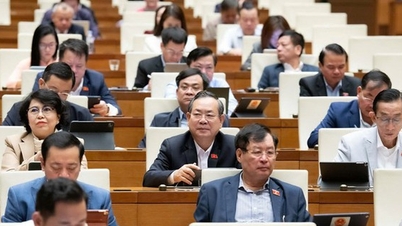
At the Parliament on December 2, the National Assembly discussed the draft Resolution on a number of breakthrough mechanisms and policies in protecting, caring for and improving people's health; and considered the investment policy for the National Target Program on health care, population and development.
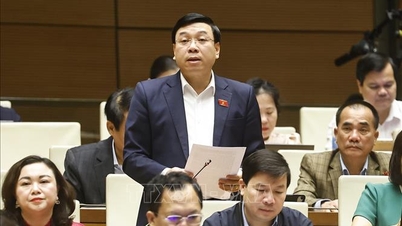
Also giving comments on the issue of training medical human resources, delegate Tran Khanh Thu (Hung Yen National Assembly Delegation) said that the new draft Resolution only mentioned postgraduate training policies in a number of majors but did not have a breakthrough solution related to creating human resources early and from a distance.
Delegate Tran Khanh Thu proposed to add medical doctor training subjects of public training institutions to the group of subjects guaranteed by the state budget, and tuition support during the training period. Along with that is the commitment to work according to the State's assignment after graduation.
Discussing this content with the reporter of the Vietnam Women's Newspaper, Mr. Pham Van Hoc, Chairman of the Board of Members, General Director of Hung Vuong Medical System expressed his disagreement with the proposal that medical students be supported with tuition fees and arranged jobs after graduation. "Training is ultimately a social service, a market. Public or private universities, foreign universities also train doctors. To train doctors, we need training costs."
According to Mr. Hoc, tuition fees should not be waived. Instead, after university graduates, the hospital will use and pay for the bachelor's degree. "If training is free for public school students, how much is free? Free food, free accommodation, or free travel? Should we let the schools be autonomous, design their own products, collect fees according to principles and regulations, and graduates will be 'priced' by the labor market, with a clear structure that is better than subsidies?"
"For poor students and those in difficult circumstances, the State has a credit loan policy during their studies, so there is no need to apply a tuition subsidy mechanism. In addition, for this group of students, they can sign a contract (sign a tuition debt) with the school. After the students graduate, the school can keep their diploma. When the hospital recruits the above students to work, it will spend money to 'buy a diploma' to use that staff. Instead of supporting the training of medical students, we should spend the budget to invest in a doctor who is both risk-free and holds them responsible," Mr. Pham Van Hoc expressed his opinion.
Explaining the risks, Mr. Pham Van Hoc gave an example of how to deal with the situation where a student drops out of the bachelor's program after 2-3 years of study. When "tuition is subsidized", learning motivation and training quality can be affected. When students take care of themselves, they will have the motivation to strive to study, practice skills... expand job opportunities, many offers from hospitals, salary/income will be higher. In the case of free tuition and a job commitment, students will both study and play as long as they graduate to have a job, affecting the quality of the medical staff," Mr. Pham Van Hoc expressed.

Currently, the number of health workers is much lower than the level in the Health Human Resources Development Plan. Illustrative photo
Separation between training and use
According to Mr. Pham Van Hoc, training and output commitment are two different things: "Training is the school's job, while employment is the job of hospitals and medical facilities. Training is a market and using labor is another thing. Training will produce excellent - fair - average graduates. When using labor, they will base on those results to pay/buy at a fair and appropriate amount, and that is the right of hospitals and medical facilities."
Subsidizing tuition fees and committing to job placement after graduation can lead to consequences for the health care labor market. Mr. Pham Van Hoc raised the question: "Who will commit to jobs? Why must there be a commitment? Let training be like a market, not just in the medical field, but in other fields as well. The important thing is that when students graduate with a bachelor's degree, whichever unit will use them will have the right to check and screen them," Mr. Pham Van Hoc emphasized.
According to the Ministry of Health 's assessment, the total number of health workers is currently about 431,700 people, much lower than the level of 632,500 people in the Health Human Resources Development Plan, period 2011-2020...
According to Mr. Pham Van Hoc, in reality, the current human resources for primary health care are not too lacking. In recent years, Vietnam has increased the target of 8-14 doctors/10,000 people. With the current training trend, in just 5-7 years, we can increase to 20 doctors/10,000 people. The important thing to pay attention to is the strategy and quality of the doctors. To have a team of high-quality doctors, we need to do two things:
The first is to create a fair competitive environment in training between schools, that is, public and private schools are the same.
The second is output verification such as measuring knowledge, skills and other qualities of learners. The State does not intervene too deeply in the design of training programs, but the State designs a set of output standards. The National Medical Council has full conditions to develop a set of output standards. All doctors, whether trained in public, private or foreign schools, who want to have a license to practice need to participate in the assessment using tools," Mr. Pham Van Hoc proposed.
Regarding the opinion that the current situation of training specialized doctors and distance learning with very low minimum scores makes it difficult to ensure output quality, Mr. Pham Van Hoc shared: "The entrance score of the medical industry is not as important as how students are trained. When we build a set of output standards, students who complete the test are qualified to work after graduation, but if they cannot complete it, they will eliminate themselves from the medical market," said Mr. Pham Van Hoc.
Source: https://phunuvietnam.vn/bao-cap-hoc-phi-cam-ket-bo-tri-viec-lam-se-gay-he-luy-cho-thi-truong-lao-dong-nganh-y-23825120311475553.htm





















![[Photo] Worshiping the Tuyet Son statue - a nearly 400-year-old treasure at Keo Pagoda](/_next/image?url=https%3A%2F%2Fvphoto.vietnam.vn%2Fthumb%2F1200x675%2Fvietnam%2Fresource%2FIMAGE%2F2025%2F12%2F02%2F1764679323086_ndo_br_tempimageomw0hi-4884-jpg.webp&w=3840&q=75)
![[Photo] Parade to celebrate the 50th anniversary of Laos' National Day](/_next/image?url=https%3A%2F%2Fvphoto.vietnam.vn%2Fthumb%2F1200x675%2Fvietnam%2Fresource%2FIMAGE%2F2025%2F12%2F02%2F1764691918289_ndo_br_0-jpg.webp&w=3840&q=75)
























































Comment (0)