

To overcome management loopholes and prevent the ongoing illegal hunting and trading of antiques, Nghe An's cultural sector is simultaneously implementing many solutions.

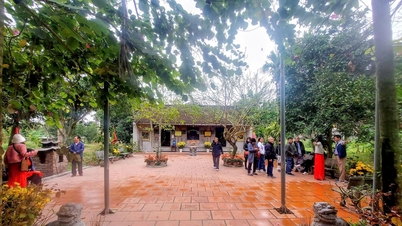
The Temple was ranked as a National Monument in 2013 and now attracts many visitors. Photo: baonghean.vn
Warning of theft of antiquities at relics
With a rich history and culture, Nghe An is home to hundreds of historical and cultural relics, from provincial to national level. However, in recent years, an alarming reality has been the fever of hunting and trading antiques, especially stone artifacts, which has caused many relics to fall into the sights of criminals. This situation not only causes property loss but also destroys the originality, sacredness and historical value of the heritage.
The incident that occurred at Than Temple, Quynh Anh Commune - an important national relic, is the clearest warning. Than Temple worships Moc Loi, the responsive angel, and three founding ancestors who have contributed to protecting the country and its people. The temple has great historical, cultural, and aesthetic value, and is an ancient architectural work with many exquisitely carved stone artifacts such as statues of tigers, war horses, war elephants, and horse keeper.
Two ancient stone horse-steward statues, which were exquisitely carved and were an inseparable part of the overall architecture, disappeared one after another between 2020 and the end of 2023. These are artifacts dating back hundreds of years, depicting horse-stewards wearing martial arts uniforms, holding swords, ready to protect warhorses, with unique historical and artistic value.
What was more worrying than the theft was the way the local authorities handled it at that time. Instead of reporting and coordinating with specialized agencies to investigate and search, local leaders hastily hired someone to cast a concrete statue to replace it. This action not only seriously violated the Law on Cultural Heritage but also concealed the truth about the loss of the antique, leading to a loss of control over records and heritage management. It was not until a working group from the Nghe An Department of Culture, Sports and Tourism inspected the case that it was exposed, revealing a long-standing management loophole.
Mr. Ho Manh Ha, Deputy Head of the Heritage Management Department - Nghe An Department of Culture, Sports and Tourism frankly commented: “Quynh Doi village is home to many historical relics and valuable antiquities, especially ancient stone statues. Meanwhile, in recent years, ancient stone objects have been very 'hot', with some statues even being priced at billions of dong. Therefore, many relics have been stolen and it is necessary to strengthen the management of these antiquities”.
Thanks to information shared on social networks, Mr. HVT, who lives in Hanoi and is a native of Quynh Anh, discovered and confirmed the two lost statues at a collector’s house in Hai Duong. Although the head of the antique was missing, the local resident used his own money to redeem it, hired an artisan to restore the head, and handed it back to the relic.
Immediately, the Quynh Anh commune authorities deployed conservation work to ensure absolute safety for the newly restored antiques. Mr. Ho Anh Dung, Head of the Department of Culture and Society of Quynh Anh commune, said: "Immediately after receiving the handover of the two stone statues after many years of theft, we hired experts to restore their original state; at the same time, we are casting concrete pedestals under the statues firmly, reinforcing the protective frame to prevent further theft."
Protecting antiquities at relic sites
The theft of artifacts at the Temple of the Gods shows that the protection of artifacts is not only an act of material restoration but also a warning bell about the responsibility and connection between people and heritage. However, if only relying on individual generosity, the conservation work will never be sustainable, requiring a synchronous and strict management system from the State level to the local community.
Mr. Ho Anh Dung - Head of the Department of Culture and Society of Quynh Anh Commune said: "Not only at the Temple of the God, but also in Quynh Doi village, there are many historical relics possessing very valuable antiquities, especially ancient stone statues. Therefore, the locality has strengthened the management of these antiquities such as installing many security cameras as well as requiring stricter protection at the relics."
Faced with this situation, the Department of Culture, Sports and Tourism has also issued many directives to strengthen management in museums and relics. Most recently, in May 2025, the Department sent a document to the People's Committees of districts, cities and towns (old) on strengthening propaganda work, preventing illegal excavation and hunting of antiquities.
The document also stated: Recently, on social networking sites, there has been some information about the illegal excavation and trading of antiquities taking place in some localities, seriously affecting cultural resources and heritage conservation. To promptly prevent and stop the above situation, the Department recommends that local authorities strengthen the management and protection of relics and archaeological sites in the area; widely propagate to the people about the meaning and value of cultural heritage, encourage people not to participate in illegal trading and digging of relics and antiquities; People's Committees of communes, wards, and relic management boards regularly inspect and review the area, promptly detect, prevent and strictly handle acts of illegal excavation, hunting, and trading of antiquities.
Ms. Tran Thi Kim Phuong, Head of the Nghe An Provincial Relic Management Board, said: Every year, the Relic Management Board regularly checks, reviews, and counts the quantity and quality of existing antiquities in the area. All antiquities are listed in a statistical table that fully and accurately records information about their names, codes, origins, ages, materials, and sizes to serve management and identification work when they are stolen.
According to Ms. Phuong, in the modern trend, preserving digital space is an essential solution, localities need to focus on digitizing artifacts to preserve and preserve them long-term. Improving the national heritage data platform helps cultural values to be preserved sustainably and spread more widely, while creating a database for comparison when losses occur, preventing counterfeiting or swapping of artifacts.
In order to "patch" the management loopholes to preserve heritage, the Department of Culture, Sports and Tourism also strictly implements the provisions of the Law on Cultural Heritage on determining Protection Zone I and Protection Zone II of relics, setting up boundary markers on the field with durable materials to create clear legal barriers. For antiquities made of easily damaged materials such as stone or wood, it is necessary to strictly follow scientific preservation processes. In the case of outdoor display, the industry and local authorities also have plans to research and handle chemicals to prevent the relics from deteriorating, protecting the relics from natural destruction. Monument conservation must be carried out promptly and properly, avoiding delays or incorrect conservation methods leading to "destruction" of the relics.
Mr. Ho Manh Ha, Deputy Head of the Heritage Management Department, affirmed: "The synchronous and drastic implementation of technical, legal and community solutions will be the key to preserving Nghe An's invaluable cultural resources. Only when responsibility is firmly attached, security is tightened and awareness is raised, can historical relics last forever, avoid the encroachment of criminals and promote their value in modern life."
Many localities also proposed to clearly define the responsibilities of each individual and organization (Management Board, Commune Government, etc.) in protecting antiquities, and to no longer "outsource" responsibility to the caretaker. Along with that, local authorities and functional agencies (Police, Customs) promptly detect and strictly handle acts of illegal hunting, trading, and digging of antiquities according to the provisions of law.
Source: https://baotintuc.vn/van-hoa/va-lo-hong-quan-ly-bao-ve-co-vat-di-san-20251203131042685.htm


![[Photo] Parade to celebrate the 50th anniversary of Laos' National Day](/_next/image?url=https%3A%2F%2Fvphoto.vietnam.vn%2Fthumb%2F1200x675%2Fvietnam%2Fresource%2FIMAGE%2F2025%2F12%2F02%2F1764691918289_ndo_br_0-jpg.webp&w=3840&q=75)



























![[Photo] Worshiping the Tuyet Son statue - a nearly 400-year-old treasure at Keo Pagoda](/_next/image?url=https%3A%2F%2Fvphoto.vietnam.vn%2Fthumb%2F1200x675%2Fvietnam%2Fresource%2FIMAGE%2F2025%2F12%2F02%2F1764679323086_ndo_br_tempimageomw0hi-4884-jpg.webp&w=3840&q=75)

























































Comment (0)