

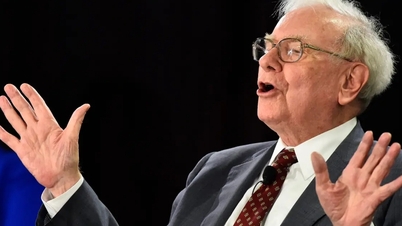
Warren Buffett, one of the greatest investors of all time, studied at the University of Nebraska for his undergraduate degree and earned his master's in economics from Columbia University under the guidance of the legendary Benjamin Graham. However, he has said that he has never cared which school an applicant attended, or even whether he attended college at all.
“I have never looked at where a candidate went to school. Never!” he asserted in a letter to shareholders in February 2025.
According to Buffett, business leadership qualities come from innate ability and practical experience, not from prestigious degrees.
Staying in Nebraska - where business thinking is formed
Buffett has a special connection to the University of Nebraska, where he graduated in 1951 and always asserted that “he owes his existence to this school.” From an early age, he showed a keen business instinct: collecting old golf balls to sell for profit, investing in farms while still in high school, or absorbing financial thinking from professor Ray Dein - who helped him understand that accounting is “the language of business.”

Not only famous for investing, Buffett is also known for his writing ability inherited from his parents - both of whom worked in journalism. That talent is most clearly shown in his letters to shareholders, which are considered "Harry Potter of the financial world" because of their special appeal. He is also the co-founder of the major charitable initiative The Giving Pledge, calling on billionaires to donate the majority of their assets to the community.
Despite being considered the greatest investor of modern times, Buffett remains humble. In his message to Nebraska students in 2020, he said he “wanted to be a young graduate more than anyone else” - an expression of his faith in the future and the next generation.
What does Buffett look for in talented people?
According to Investopedia, Buffett wrote in his 2025 shareholder letter that although many good managers come from prestigious schools, there are still countless successful entrepreneurs who do not need elite degrees, or even do not have a college degree.
“I was fortunate to have attended three good universities. I am a strong believer in lifelong learning. However, much of one’s entrepreneurial ability is inborn, far beyond any educational factor,” he wrote.

He cited three typical examples: Pete Liegl, founder of the Forest River recreational vehicle company, which had a revenue of 1.6 billion USD when it was acquired by Berkshire Hathaway in 2005. Liegl only graduated from Northern Michigan University and got an MBA at Western Michigan, but Buffett assessed that he "contributed billions of dollars to Berkshire shareholders." Bill Gates, who dropped out of Harvard to found Microsoft. However, Gates himself advised young people: "Getting a college degree is still the surer path." Ben Rosner, who only finished 6th grade but built the Associated Retail Stores chain with 75 stores. Buffett called him a "retail genius."
Are degrees still important?
Buffett attended three universities, but he said a $100 public speaking course was “the most important degree of my life.”
“That course had the biggest impact on my success,” he said, adding that in his office, he hung not his university degree but only the certificate of this course.
According to Buffett, the value of education depends on the individual: “Some people benefit greatly from higher education, but others benefit almost nothing. It all depends on the individual, not the school.”
Research shows that a bachelor’s degree still has a clear economic benefit. In 2022, the median income of people with a bachelor’s degree will be 59% higher than that of people with only a high school diploma; those without a college degree also face a higher risk of unemployment.
However, the educational impact depends largely on where you go. Many colleges lead to higher earnings within 10 years, but at private, for-profit schools, the majority of graduates earn less than those who did not go to college, according to a 2024 analysis by HEA Group.
Social perceptions are also changing: A 2023 Pew Research Center survey found that 49% of respondents said a four-year bachelor's degree is “less important” than it was 20 years ago in finding a good job.
Buffett’s comments challenge the “degree cult” trend. While education is still valuable, he emphasizes that innate ability, practical experience, and specific achievements are the deciding factors—not where someone graduated from or whether they went to college.
Source: https://vietnamnet.vn/tam-bang-xin-khong-dam-bao-thanh-cong-goc-nhin-tu-huyen-thoai-warren-buffett-2468665.html

![[Photo] 60th Anniversary of the Founding of the Vietnam Association of Photographic Artists](/_next/image?url=https%3A%2F%2Fvphoto.vietnam.vn%2Fthumb%2F1200x675%2Fvietnam%2Fresource%2FIMAGE%2F2025%2F12%2F05%2F1764935864512_a1-bnd-0841-9740-jpg.webp&w=3840&q=75)
![[Photo] National Assembly Chairman Tran Thanh Man attends the VinFuture 2025 Award Ceremony](/_next/image?url=https%3A%2F%2Fvphoto.vietnam.vn%2Fthumb%2F1200x675%2Fvietnam%2Fresource%2FIMAGE%2F2025%2F12%2F05%2F1764951162416_2628509768338816493-6995-jpg.webp&w=3840&q=75)
































































































Comment (0)