

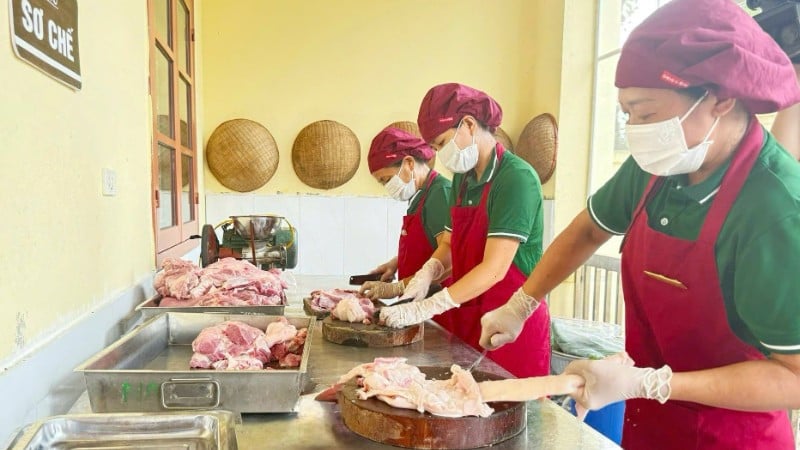
It has become a tradition that every day at 5am, nurse Nguyen Thi Huong, who works at Van Tao Kindergarten, Hong Van Commune (Hanoi), along with school representatives and parents of students, are present at the cooking area to receive and check the quantity and quality of food when the food supplier delivers it.
After receiving the food, the staff will prepare it for cooking. The school's cooking area is divided into separate areas, including the raw food preparation area and the cooking area. After being cooked, the food will be brought to the food distribution line area. Once prepared, the utensils are washed and placed in the drying cabinet, ensuring compliance with the regulations required by the authorities.
The school leaders affirmed: The school regularly coordinates closely with the health sector, education sector and local authorities to strengthen inspection and supervision of food safety in the kitchen. The unit focuses on stages such as selecting food suppliers, transportation, food preservation, food processing, food sample storage, environmental sanitation, etc.
According to Deputy Director of Hanoi Department of Health Vu Cao Cuong: Boarding meals are not only to provide energy for students after school, but also directly affect their physical, intellectual and psychological development. Statistics show that in the 2025-2026 school year, there will be about 3,100 collective kitchens in schools in Hanoi, with about 730,000 meals/meal.
Currently, school meals in the capital have two main forms: Collaboration with a food supplier (cooking contractor); schools cook by themselves. To reduce the risk of food poisoning in this area, since the beginning of the 2025-2026 school year, the city's interdisciplinary inspection teams have regularly organized inspections and supervision on the topic "Food safety in collective kitchens in schools".
The inspection and supervision content focuses on the conditions of facilities, equipment, tools, and people such as: Certificate of food safety qualified facility; certificate of food safety knowledge; health certificate for managers and people directly in contact with food; food product labels for food processing; water sources, raw materials used for food processing; kitchens arranged according to the one-way principle; food processing, preservation, and transportation processes; food sample storage of the facility and other related contents.
Through the above inspections and monitoring, promptly detect, prevent and handle violations of food safety and hygiene in school kitchens; at the same time, proactively prevent foodborne diseases, and prevent food poisoning in kitchens...
However, inspection practices show that there are still many small kitchen units that change locations frequently, making it difficult to manage synchronously, especially in non-public educational institutions. Many units do not keep full invoices and documents, making it difficult to trace the origin of food. Notably, authorities in some places have not yet strictly handled violations of food safety and hygiene, and are still heavily "formalistic" and "considerate", especially for establishments providing ready-to-eat meals and households producing and trading food around schools.
Recently, in the face of the situation of mass food poisoning cases occurring at school meals in a number of localities across the country, the Central Interdisciplinary Steering Committee on Food Safety continues to request the Ministry of Education and Training, the Interdisciplinary Steering Committee on Food Safety of provinces and cities to focus on inspection, examination, post-inspection, compliance with food safety regulations from the origin, processing, preservation, transportation, delivery of food and keeping food samples in school kitchens; fully manage, ensure no omissions, no unsafe establishments... Resolutely handle cases of violations of food safety regulations according to the provisions of law. In particular, it emphasizes that heads of food production and business establishments, units organizing collective kitchens must be responsible for food safety according to regulations; at the same time, publicize violations on the media for timely warnings.
Source: https://nhandan.vn/ngan-chan-ngo-doc-thuc-pham-tai-bep-an-trong-truong-hoc-post928366.html
![[Photo] 60th Anniversary of the Founding of the Vietnam Association of Photographic Artists](/_next/image?url=https%3A%2F%2Fvphoto.vietnam.vn%2Fthumb%2F1200x675%2Fvietnam%2Fresource%2FIMAGE%2F2025%2F12%2F05%2F1764935864512_a1-bnd-0841-9740-jpg.webp&w=3840&q=75)



![[Photo] National Assembly Chairman Tran Thanh Man attends the VinFuture 2025 Award Ceremony](/_next/image?url=https%3A%2F%2Fvphoto.vietnam.vn%2Fthumb%2F1200x675%2Fvietnam%2Fresource%2FIMAGE%2F2025%2F12%2F05%2F1764951162416_2628509768338816493-6995-jpg.webp&w=3840&q=75)




































































Comment (0)